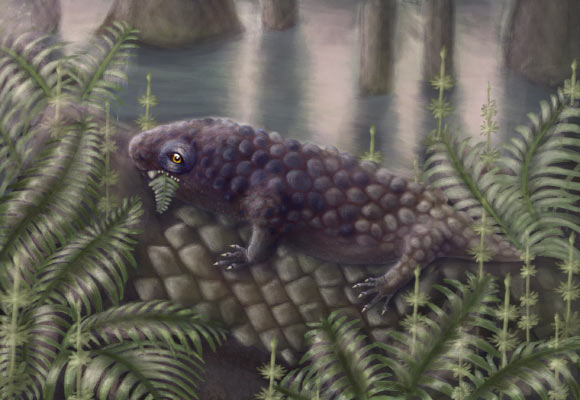
The discovery of Tyrannoroter heberti, a newly identified species of pantylid ‘microsaur’ from the Carboniferous epoch, indicates that some of the planet’s initial terrestrial vertebrates had already developed sophisticated dental structures for masticating vegetation. This finding suggests that herbivory on land emerged swiftly following the transition of animals from aquatic to terrestrial environments.
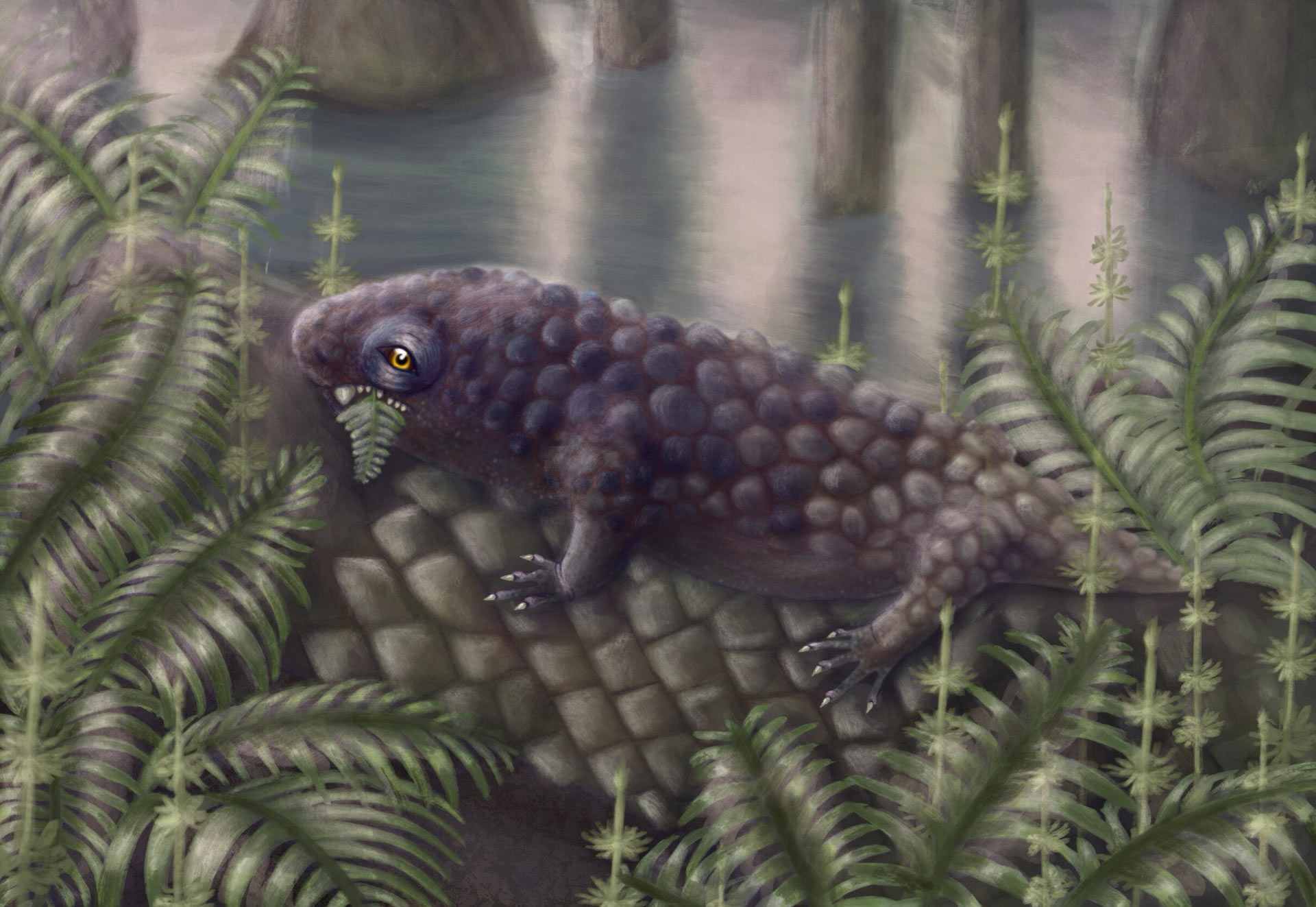
A life-sized rendition of Tyrannoroter heberti. Image courtesy of Hannah Fredd.
The geographical area now known as Canada was the habitat of Tyrannoroter heberti during the Carboniferous period, approximately 307 million years ago.
“This represents one of the most ancient four-limbed creatures known to have subsisted on plant matter,” stated Dr. Arjan Mann, who holds the position of assistant curator for fossil fishes and early tetrapods at the Field Museum.
“It demonstrates that the exploration of herbivory dates back to the very earliest tetrapods inhabiting land – the ancestral relatives of all creatures that live on land today, including ourselves.”
“The singular specimen has undergone the first detailed three-dimensional reconstruction of its kind within its taxonomic group, providing insights into its cranial anatomy and revealing its specialized dentition, which aids in tracing the genesis of terrestrial plant consumption,” added Zifang Xiong, a doctoral candidate at the University of Toronto.
The fossilized cranium of Tyrannoroter heberti was unearthed on Cape Breton Island, situated in Nova Scotia.
Estimates based on the cranial dimensions and more complete skeletal remains of related species suggest the organism reached a length of approximately 30 centimeters (equivalent to one foot).
“In terms of size and form, it bore a resemblance to an American football,” remarked Dr. Mann.
“By contemporary standards, this is not an imposing size, yet it was among the largest terrestrial fauna of its era.”
“While Tyrannoroter heberti likely possessed an appearance somewhat akin to a lizard, its existence predated the divergence of the lineages leading to modern reptiles and mammals; therefore, it could not be classified as a reptile in the strict sense.”
Tyrannoroter heberti is classified within an extinct family of small, amphibian-like tetrapods known as Pantylidae.
“The pantylids represent a significant early phase in the evolutionary history of vertebrate life on terrestrial surfaces,” explained Dr. Mann.
“When lobe-finned fish first developed appendages enabling them to traverse onto land, their reliance on aquatic environments remained substantial.
“The pantylids emerged during the second stage of terrestrial adaptation, when fauna became wholly acclimatized to existence on dry land.”
“These are what scientists term stem amniotes—organisms closely affiliated with the group of tetrapods that developed amniotic eggs, which could survive external to water.”
“Subsequent evolutionary periods saw these stem amniotes bifurcate into the lineages of reptiles and the ancestral forms of mammals.”
“The significance of Tyrannoroter heberti lies in the prevailing belief that herbivory was exclusively a trait of amniotes until this discovery,” commented Dr. Hans Sues, curator of vertebrate paleontology at the Smithsonian National Museum of Natural History.
“Although it is a stem amniote, it exhibits specialized dentition suitable for processing plant-based sustenance.”
It is probable that Tyrannoroter heberti also consumed smaller prey, such as invertebrates, in addition to plant material. It is theorized that the exoskeletons of insects in the diets of early tetrapods may have furnished the prerequisite adaptations for stem amniotes like Tyrannoroter heberti to effectively crush and metabolize resilient plant matter.
Furthermore, the assimilation of insect bodies that consumed plants might have endowed early tetrapods with the necessary gut flora and microbial communities required for plant digestion.
“At the conclusion of the Carboniferous period, the prevailing rainforest ecosystems underwent a collapse, ushering in an era of global warming,” Dr. Mann recalled.
“The evolutionary branch to which Tyrannoroter heberti belongs did not fare well under these altered conditions.
“This finding can serve as a crucial data point in understanding the broader implications for herbivorous species when rapid climate shifts profoundly impact their habitats and the available flora.”
A scientific publication detailing the discovery of Tyrannoroter heberti has been issued in the esteemed journal Nature Ecology and Evolution.
_____
A. Mann et al. Carboniferous recumbirostran elucidates the origins of terrestrial herbivory. Nat Ecol Evol, published online February 10, 2026; doi: 10.1038/s41559-025-02929-8