The terrestrial coastlines, dynamic zones where liquids interact and sculpt the land into unique geological formations such as river deltas, present a fascinating subject of study. Comparable active coastal environments are observed on Saturn’s moon, Titan, where liquid hydrocarbons, specifically methane and ethane, substitute for water. However, the investigation of Titan’s coastlines, with a particular focus on its river deltas, is fraught with difficulty due to the scarcity of imaging data and the uncertain composition of its surface materials. To surmount these obstacles, a cadre of planetary scientists representing Brown University, MIT, the MIT-WHOI Joint Program in Oceanography, the Woods Hole Oceanographic Institution, and Cornell University has devised an innovative computational model. This model simulates Earth’s coastlines as they would appear through the observational lens of NASA’s Cassini spacecraft. Their findings indicate that substantial landforms are discernible on Titan under conditions of appropriate contrast. Subsequently, they revisited Titan and re-evaluated its coastal regions. To their considerable surprise, they ascertained that a multitude of Titan’s rivers do not terminate in deltas, a stark contrast to Earth, where numerous major rivers are characterized by extensive deltaic structures. Furthermore, they identified submerged features on Titan’s seabed, suggesting fluctuations in sea level and/or the presence of subsurface currents.
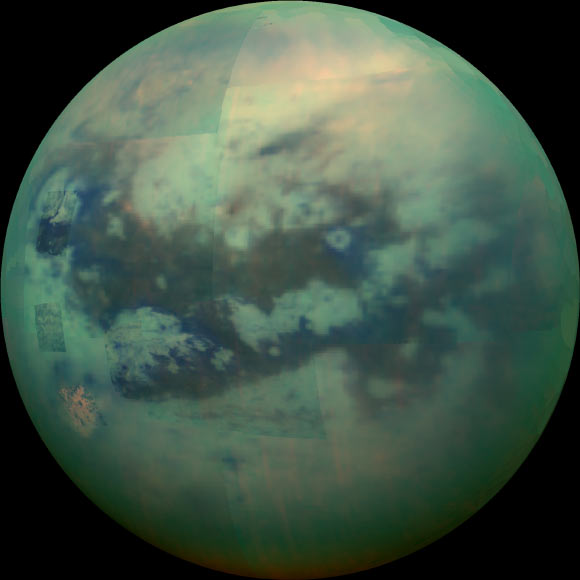
This composite image shows an infrared view of Titan. In this image blue represents wavelengths centered at 1.3 microns, green represents 2.0 microns, and red represents 5.0 microns. A view at visible wavelengths would show only Titan’s hazy atmosphere; the near-infrared wavelengths in this image allow Cassini’s vision to penetrate the haze and reveal the moon’s surface. The view looks toward terrain that is mostly on the Saturn-facing hemisphere of Titan. Image credit: NASA / JPL-Caltech / Space Science Institute.
“As a geomorphologist, it’s somewhat disappointing, given that deltas are expected to hold a significant amount of Titan’s historical record,” remarked Dr. Sam Birch, a researcher affiliated with Brown University.
“However, the absence of deltas precipitates a cascade of novel inquiries.”
“We commonly assume that the presence of fluvial systems and sedimentary deposits inherently leads to delta formation.”
“Yet, Titan presents anomalies, serving as an invaluable laboratory for exploring processes we believed were well-understood.”
Titan stands as the most substantial of Saturn’s 274 recognized moons. Its dense atmosphere, composed primarily of nitrogen and methane, fosters a plethora of climatic and meteorological phenomena analogous to those found on Earth.
Titan exhibits cloud formations, wind, and precipitation, in addition to rivers, lakes, and expansive seas. Crucially, its bodies of liquid are not water but rather methane and ethane, which remain in a liquid state at Titan’s frigid surface temperatures.
The existence of liquid bodies on Titan was brought to light when the Cassini spacecraft conducted a flyby in 2006. Employing its synthetic aperture radar (SAR) to penetrate Titan’s opaque atmosphere, the spacecraft unveiled intricate, branching channel networks and large, flat expanses consistent with significant liquid reservoirs.
Conspicuously absent from Cassini’s SAR imagery, however, were deltas, even at the confluences of major rivers.
It remained uncertain, nevertheless, whether these deltas were genuinely absent or simply undetectable within Cassini’s SAR data.
This particular question was the central focus of the investigation undertaken by Dr. Birch and his associates in their recent study.
A significant limitation of Cassini’s SAR data is that shallow liquid methane is largely transparent in the resulting imagery.
Consequently, while the SAR images effectively depicted broad seas and river channels, the precise delineation of coastal features proved challenging due to the difficulty in distinguishing the boundary between land and the submerged seabed.
For the purposes of this research, the authors developed a numerical model designed to simulate Cassini’s SAR observations as if they were directed at a landscape that is thoroughly understood: Earth.
Within this model, the water comprising Earth’s rivers and oceans was conceptually replaced with Titan’s methane liquid, which possesses distinct radar absorption characteristics compared to water.
“Essentially, we generated synthetic SAR images of Earth, attributing to it the properties of Titan’s liquid rather than Earth’s actual water,” explained Dr. Birch.
“By analyzing SAR imagery of a landscape we are intimately familiar with, we can gain a more informed perspective when interpreting the data from Titan.”
The researchers observed that the synthetic SAR images of Earth clearly resolved extensive deltas and numerous other substantial coastal landforms.
“Should deltas of the magnitude found at the Mississippi River’s mouth exist, we should be able to detect them,” Dr. Birch stated.
“Similarly, if large barrier islands and comparable coastal formations, such as those prevalent along the U.S. Gulf Coast, are present, they ought to be visible.”
However, upon re-examining the Titan imagery through the prism of their newly acquired analytical framework, the scientists found their search largely unrewarded.
With the exception of two potential deltas situated near Titan’s southern polar region, the remainder of the moon’s fluvial systems were entirely devoid of deltaic structures.
Their analysis revealed that a mere 1.3% of Titan’s major rivers terminating at coastlines exhibit deltas. In stark contrast, nearly every river of comparable size on Earth is characterized by a delta.
“The underlying reasons for Titan’s general lack of deltas remain somewhat ambiguous,” Dr. Birch commented.
“The fluid dynamics of Titan’s rivers should theoretically equip them to efficiently transport and deposit sediments.”
“It is conceivable that Titan experiences such rapid fluctuations in sea level that deltas are dispersed across the landscape more swiftly than they can coalesce in a singular location.”
“Furthermore, prevailing winds and tidal currents along Titan’s coastlines might also exert a significant influence, hindering delta formation.”
The absence of deltas is not the sole enigma brought to light by the recent research.
The updated analysis of Cassini SAR data pertaining to Titan’s coastlines uncovered depressions of indeterminate origin situated within its lakes and seas.
The researchers also identified profound channels on the seafloor that appear to have been incised by fluvial activity, though their origin remains unclear.
“All of these unexpected discoveries necessitate further investigation to achieve a comprehensive understanding,” Dr. Birch asserted.
“This outcome deviates significantly from our initial expectations. Nevertheless, Titan frequently presents us with such surprises, which I believe contributes to its compelling nature as an object of scientific study.”
The research has been formally published in the Journal of Geophysical Research: Planets.
_____
S.P.D. Birch et al. 2025. Detectability of Coastal Landforms on Titan with the Cassini RADAR. JGR Planets 130 (3): e2024JE008737; doi: 10.1029/2024JE008737