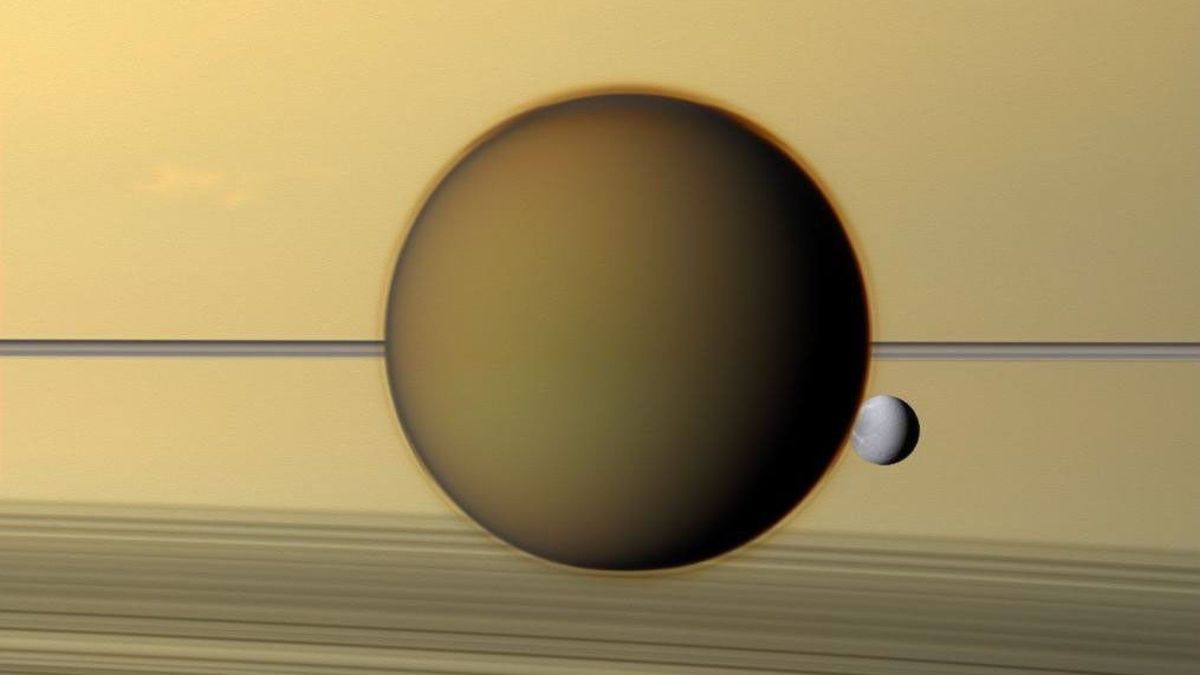
New findings suggest that Saturn’s largest satellite, Titan, might not harbor a subsurface ocean after all.
This re-evaluation stems from a detailed review of data gathered by NASA’s Cassini spacecraft, which conducted numerous close approaches to Titan beginning in 2004. By 2008, prevailing evidence strongly indicated the existence of a liquid water ocean deep beneath Titan’s intricate geological structure.
However, the most recent scientific scrutiny proposes that Titan’s interior is more plausibly comprised of ice and a slushy mixture, interspersed with intermittent reservoirs of heated water that circulate from the core toward the surface.
This revised interpretation significantly alters our understanding of the geological evolution of one of the Solar System’s most captivating celestial bodies, and it was derived solely from previously collected information.
“This investigation powerfully illustrates the enduring value of archival planetary science data. It is crucial to recognize that the information these remarkable probes acquire persists, enabling new discoveries years, or even decades, later as analytical methodologies advance,” stated Julie Castillo-Rogez of the Jet Propulsion Laboratory in a press announcement. “It truly is a continuous source of scientific revelation.”

The initial evidence supporting a subsurface ocean, established in 2008, was based on meticulous measurements of tidal deformations. As Titan orbits Saturn, the gas giant exerts gravitational forces, analogous to the Moon’s influence on Earth, causing the moon to stretch and compress, thereby altering its shape and affecting its gravitational field.
During its flybys, Cassini was capable of detecting these gravitational fluctuations. The variations in the gravitational pull influenced the spacecraft’s velocity, a phenomenon that scientists quantified by analyzing the Doppler shift in radio signals transmitted between Cassini and Earth.
At that time, the prevailing scientific consensus held that the tidal forces were so substantial that the resultant internal heat must sustain a liquid ocean, which in turn would permit greater structural flexibility compared to a solid icy interior.

In the recent comprehensive analysis, published on December 17, 2025, an alternative explanation for Titan’s observed flexibility has been proposed: a semi-liquid mixture of ice and water, rather than exclusively liquid water.
Under this revised hypothesis, researchers anticipate detecting heightened energy dissipation within the moon’s gravitational field. This phenomenon was indeed observed when Jet Propulsion Laboratory scientists employed an advanced technique to filter out noise from Cassini’s Doppler data. This slushy composition would still facilitate the moon’s deformation while simultaneously mitigating heat generation, thereby precluding the formation of a completely liquid ocean.
For the scientific community dedicated to uncovering evidence of extraterrestrial life on Titan, this new finding does not necessarily represent a setback. On the contrary, it points towards a dynamic cycle where localized pockets of warm water near the rocky core ascend towards the surface, carrying essential minerals to the hydrocarbon-rich crust.
“Although Titan might not possess a planetary-scale ocean, this does not diminish its potential to host rudimentary life forms, assuming life could originate on Titan. In fact, I believe it enhances Titan’s intrigue,” expressed JPL postdoc Flavio Petricca.
“Our examination indicates the presence of liquid water reservoirs, potentially reaching temperatures as high as 20 degrees Celsius (68 degrees Fahrenheit), which transport nutrients from the moon’s rocky interior through intermediate layers of high-pressure ice to a solid icy outer shell.”
Titan is expected to remain a focal point of scientific interest in the foreseeable future. Its dense atmosphere and extensive surface lakes of liquid methane render it one of the most remarkable celestial bodies within our Solar System. An upcoming NASA rotorcraft mission, named Dragonfly, is slated for deployment to Titan around 2028.
The research paper was officially published in the esteemed journal Nature.
This article was originally disseminated by Universe Today. The original publication can be accessed here.