An examination of two fossilized coelacanth specimens, dating back 240 million years, has unveiled a peculiar sensory mechanism: a calcified lung that facilitated sound transmission to the inner ear, thereby illuminating novel perspectives on how ancient vertebrates engaged with their surroundings.
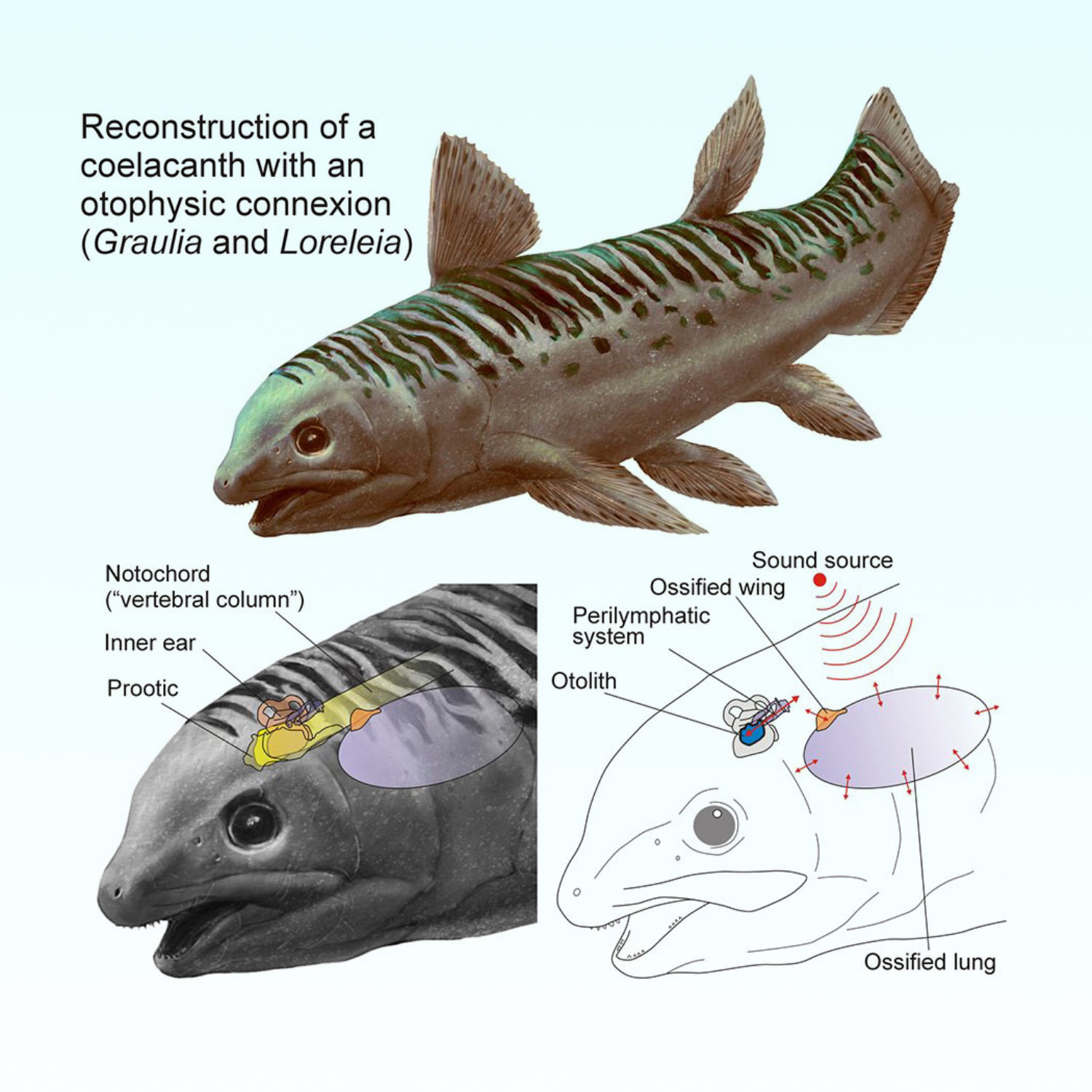
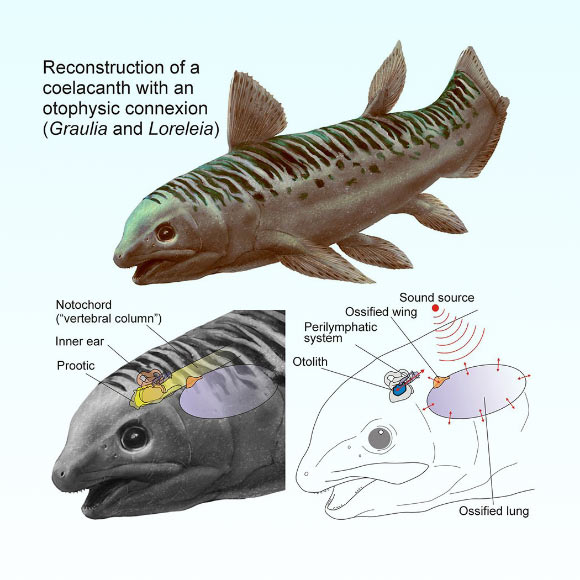
Reconstruction of a Triassic coelacanth schematically showing the otophysic connection linking the ossified lung to the inner ear and enabling underwater hearing. Image credit: A. Beneteau & L. Cavin, MHNG.
“Coelacanths are a group of lobe-finned fish whose fossilized remains extend back over 400 million years, representing a pivotal evolutionary branch for comprehending the development of vertebrate skeletal structures,” stated Professor Lionel Cavin, a paleontologist affiliated with the Natural History Museum of Geneva and the University of Geneva, alongside his collaborators.
“Previously believed to be extinct, these creatures persist today in the form of the genus Latimeria, with two distinct species currently identified.”
“Within the body cavities of fossil coelacanths, there are observed a series of perplexing, large ossified plates arranged in a tessellated configuration, encasing an internal space that is presumed to have contained gas during the organism’s lifetime.”
In a recent scientific inquiry, the paleontological team meticulously investigated the lung and inner ear morphology of Graulia branchiodonta and Loreleia eucingulata, two coelacanth species unearthed from the Middle Triassic strata of eastern France.
Employing a particle accelerator at the European Synchrotron Radiation Facility, the researchers successfully identified an exceptionally well-preserved ossified lung, characterized by wing-like osseous projections at its terminal ends.
Concurrently, the examination of embryos belonging to extant coelacanth species revealed a conduit connecting the auditory and vestibular organs situated bilaterally within the skull.
By synthesizing these distinct observations, the scientific cohort has posited that these two anatomical features collectively constituted a comprehensive sensory apparatus.
Sound vibrations, when intercepted by the calcified lung, would have been conveyed to the inner ears through this interconnecting canal, thereby endowing the organism with the capacity for underwater auditory perception.
“Our postulation is informed by comparisons drawn with contemporary freshwater fish, such as carp and catfish,” commented Luigi Manuelli, a doctoral candidate at the Natural History Museum of Geneva and the University of Geneva.
“In these modern species, a specialized structure, referred to as the Weberian apparatus, serves to link the swim bladder with the inner ear.”
“This sophisticated system enables them to detect aquatic pressure waves and consequently perceive sounds beneath the water’s surface.”
“The gaseous content within the swim bladder is instrumental in detecting these waves, without which they would typically traverse the fish’s physique unnoticed.”
“It is probable that this acquired auditory acuity was progressively relinquished as the ancestral lineage leading to modern coelacanths adapted to profound oceanic environments. Their pulmonary system underwent retrogression, rendering this auditory mechanism obsolete,” elaborated Professor Cavin.
“Notably, certain structural elements associated with the inner ear have, nonetheless, persisted through evolutionary time.”
“These anatomical vestiges now offer profound insights into the evolutionary trajectory of these piscine species – and potentially, into that of our own distant aquatic progenitors.”
The discoveries were disseminated on February 14, 2026, within the esteemed journal Communications Biology.
_____
L. Manuelli et al. 2026. A dual respiratory and auditory function for the coelacanth lung. Commun Biol 9, 400; doi: 10.1038/s42003-026-09708-6