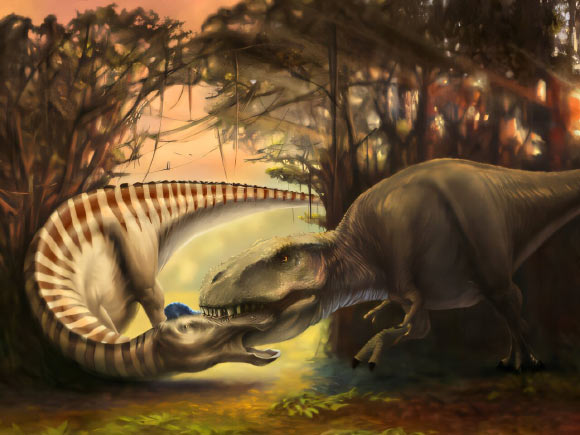
A partially preserved skull belonging to an adult Edmontosaurus, now part of the collection at Montana State’s Museum of the Rockies, offers a vivid snapshot from the Late Cretaceous period: evidence of a tyrannosaur inflicting injury upon the face of a duck-billed dinosaur.

A Tyrannosaurus attacking an adult Edmontosaurus. Image credit: Jenn Hall.
Discovered in 2005 within the Hell Creek Formation of eastern Montana, this distressed Edmontosaurus skull presents a compelling detail: an embedded tyrannosaur tooth is lodged within its facial structure.
The paleontological repository at the Museum of the Rockies now houses this significant fossil, which contains this indicative remnant.
According to Taia Wyenberg-Henzler, a doctoral candidate at the University of Alberta, “While encountering bite marks on fossilized bones is a relatively frequent occurrence, the discovery of an embedded tooth is exceptionally uncommon.”
“The significant advantage of locating an embedded tooth, particularly within a skull, is that it definitively identifies not only the victim of the attack but also the perpetrator,” she elaborated.
“This discovery enabled us to reconstruct the events experienced by this Edmontosaurus, much like forensic investigators examining a Late Cretaceous crime scene.”
A comparative analysis of the lodged tooth against the dentition of all carnivorous fauna known from the Hell Creek Formation indicated a strong resemblance to the teeth of Tyrannosaurus. Advanced CT scanning of the skull provided enhanced detail for this assessment.
John Scannella, curator of paleontology at the Museum of the Rockies, expressed his enthusiasm: “A specimen of this nature is particularly thrilling as it documents a specific behavior: a tyrannosaur actively biting the face of this duckbill.”
“There are no observable signs of bone regeneration around the tyrannosaur tooth, suggesting the Edmontosaurus may have already been deceased upon being bitten, or that the bite itself led to its demise.”
“The orientation in which the tooth is embedded within the Edmontosaurus‘s nasal region implies a head-on confrontation with its assailant, a scenario typically associated with animals that have succumbed to a predator,” stated Wyenberg-Henzler.
“Furthermore, the considerable force required for a tooth to fracture and remain embedded in bone strongly suggests the application of lethal force.”
“From my perspective, this offers a chilling depiction of the final moments of this particular Edmontosaurus.”
“The dietary habits of Tyrannosaurus, which stands as one of the planet’s most formidable carnivorous creatures throughout history, have been a subject of extensive scientific inquiry and discussion for numerous years,” Dr. Scannella remarked.
“The presence of the tooth within this Edmontosaurus skull provides an additional insight into the predatory behavior of Tyrannosaurus.”
The research detailing these findings was published online in the scientific journal PeerJ.
_____
T.C.A. Wyenberg-Henzler & J.B. Scannella. 2026. Behavioral implications of an embedded tyrannosaurid tooth and associated tooth marks on an articulated skull of Edmontosaurus from the Hell Creek Formation, Montana. PeerJ 14: e20796; doi: 10.7717/peerj.20796