The complete genetic blueprints of seven individuals who lived between 42,000 and 49,000 years ago in Ranis, Germany, and Zlatý kůň, the Czech Republic, have been meticulously deciphered and scrutinized. These analyses reveal a discernible familial connection among the inhabitants of Ranis and Zlatý kůň, indicating their membership in a singular, geographically isolated populace. This group represents the most ancient known divergence from the ancestral line that migrated out of Africa. Notably, the Ranis genomes contain discernible Neanderthal DNA segments originating from a solitary interbreeding event that is shared by all non-African populations globally; this event has been dated by the researchers to the period between 45,000 and 49,000 years ago. This finding strongly suggests the existence of a unified ancestral population for all non-Africans sequenced to date during that epoch. Furthermore, it implies that any modern human fossil evidence predating 50,000 years found outside the African continent likely represents distinct non-African groups.

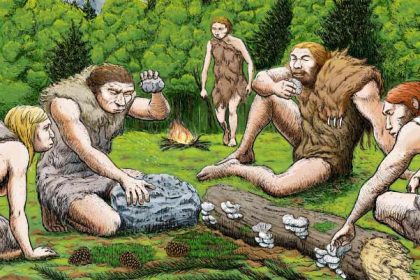
An artistic representation of Zlatý kůň, an individual whose ancestry is traceable to the same population as those unearthed in Ranis and who shared a close genetic kinship with two of them. Photography courtesy of Tom Björklund / Max Planck Institute for Evolutionary Anthropology.
“Upon their departure from Africa, early modern humans encountered and engaged in interbreeding with Neanderthals, a phenomenon that accounts for the approximately two to three percent Neanderthal DNA observed in the genetic makeup of virtually all contemporary individuals outside of Africa,” remarked Dr. Arev Sümer of the Max Planck Institute for Evolutionary Anthropology, in conjunction with his collaborators.
“However, our understanding of the genetic makeup of these initial European settlers and the precise chronological sequencing of Neanderthal admixture events with non-African populations remains limited.”
“A pivotal archaeological site in Europe is Zlatý kůň in the Czech Republic, from which a complete skull belonging to a solitary individual who lived approximately 45,000 years ago was exhumed and has undergone prior genetic analysis.”
“The absence of a distinct archaeological context meant that this individual could not be definitively associated with any archaeologically identified cultural group.”
“In close proximity to this site lies the Ilsenhöhle in Ranis, Germany, situated roughly 230 kilometers from Zlatý kůň. This location is renowned for a specific archaeological signature, the Lincombian-Ranisian-Jerzmanowician (LRJ) culture, which dates back to about 45,000 years ago.”
“The origin of the LRJ culture, whether attributed to Neanderthals or early modern humans, has been a subject of extensive scholarly debate.”
“Although predominantly fragmented bone remains have been recovered at the Ranis excavation, a prior investigation successfully analyzed mitochondrial DNA from thirteen of these specimens, indicating their origin from modern humans rather than Neanderthals.”
“Nonetheless, given that mitochondrial DNA constitutes a minuscule fraction of an organism’s complete genetic information, the precise evolutionary relationships to other modern human populations remained largely enigmatic.”
In the contemporary investigation, the research team undertook the analysis of the nuclear genomes derived from the thirteen specimens recovered from Ranis, ascertaining that they represented a minimum of six distinct individuals.
The dimensions of the recovered bone fragments suggested that two of these individuals were infants; genetically, three were identified as male and three as female.
Remarkably, the findings revealed the presence of familial connections among these individuals, including a mother and daughter pair, as well as other more distantly related biological kin.
The researchers also successfully extracted and sequenced additional DNA from the female skull discovered at Zlatý kůň, yielding a high-fidelity genome for this particular individual.
”To our considerable surprise, we discerned a fifth- or sixth-degree genetic relationship between the Zlatý kůň individual and two of the individuals from Ranis,” stated Dr. Sümer.
“This discovery implies that the Zlatý kůň individual was genetically integrated into the broader kinship network of the Ranis population and likely also engaged in the creation of LRJ-type tools.”
Among the six individuals identified in Ranis, one bone fragment was exceptionally well-preserved, representing the most optimally preserved post-mortem human bone from the Pleistocene epoch for the successful retrieval of genetic material.
This exceptional preservation enabled the research team to obtain a high-quality genome from this male individual, designated as Ranis13.
Collectively, the genomes of Ranis13 and Zlatý kůň constitute the most ancient high-resolution modern human genomes sequenced to date.
Upon examining genetic variations associated with phenotypic characteristics, the scientists observed that the individuals from Ranis and Zlatý kůň possessed genetic variants linked to dark pigmentation of the skin and hair, as well as brown eye color. These traits are indicative of the recent African ancestry of this early European population.
By meticulously analyzing the DNA segments inherited from a common progenitor in both the Ranis and Zlatý kůň genomes, the authors estimate that their population comprised a maximum of a few hundred individuals, potentially dispersed across a substantial geographical area.
Their investigations yielded no evidence to suggest that this small, early modern human population contributed genetically to subsequent European populations or any other global demographic groups.
Members of the Zlatý kůň/Ranis population coexisted with Neanderthals in Europe, raising the possibility of Neanderthal ancestry among their recent forebears following their migration into the continent.
Previous studies focused on modern human remains exceeding 40,000 years of age had identified evidence of such recent interbreeding events between modern humans and Neanderthals.
However, no corroborating evidence of recent Neanderthal admixture was detected within the genomes of the Zlatý kůň/Ranis individuals.

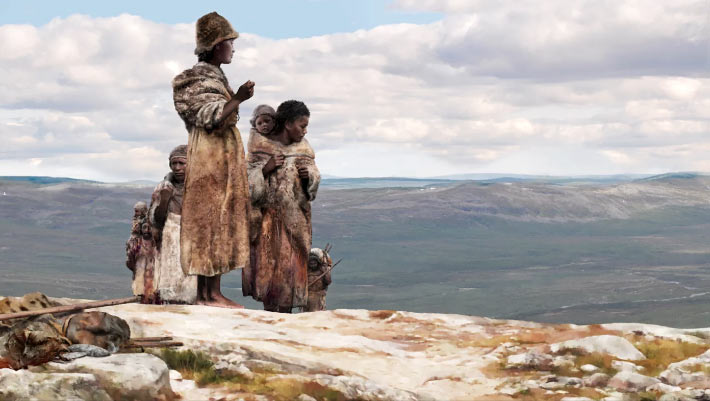
An artistic depiction of the Zlatý kůň/Ranis collective. Photography credit: Tom Björklund / Max Planck Institute for Evolutionary Anthropology.
“The observation that later waves of modern human groups migrating into Europe exhibit Neanderthal ancestry, while the Ranis and Zlatý kůň individuals do not, could imply that the earlier Zlatý kůň/Ranis lineage arrived in Europe via an alternative migratory route or had minimal temporal overlap with regions inhabited by Neanderthals,” posited Dr. Kay Prüfer, also affiliated with the Max Planck Institute for Evolutionary Anthropology.
The Zlatý kůň/Ranis population represents the most ancient identified divergence from the larger cohort of modern humans who embarked on their migratory journey out of Africa and subsequently dispersed across Eurasia.
Notwithstanding this early evolutionary separation, the Neanderthal genetic contribution found in Zlatý kůň and Ranis trace their origins to the identical ancient admixture event that is discernible in all contemporary non-African populations.
Through the examination of the length of Neanderthal-derived segments within the high-coverage Ranis13 genome, coupled with direct radiocarbon dating of this individual, the researchers have precisely dated this shared Neanderthal admixture event to the period between 45,000 and 49,000 years ago.
Given that all extant non-African populations share this ancestral Neanderthal genetic signature with the Zlatý kůň and Ranis individuals, it logically follows that a cohesive ancestral non-African population must have existed during the timeframe of 45,000 to 49,000 years ago.
“These groundbreaking findings afford us a profoundly enhanced comprehension of the earliest human pioneers who established themselves in Europe,” stated Dr. Johannes Krause, a distinguished researcher at the Max Planck Institute for Evolutionary Anthropology.
“Furthermore, they indicate that any modern human fossil discoveries situated outside of Africa that predate 50,000 years are unlikely to be part of the common non-African ancestral population that interbred with Neanderthals and whose genetic legacy is now widespread across the globe.”
The seminal findings of this research were disseminated today in the prestigious scientific journal Nature.
_____
A.P. Sümer et al. Earliest modern human genomes constrain timing of Neanderthal admixture. Nature, published online December 12, 2024; doi: 10.1038/s41586-024-08420-x
This article has been adapted from an original press release issued by the Max Planck Institute for Evolutionary Anthropology.