New research originating from the University of Minnesota Twin Cities and Universit’e Paris-Saclay challenges a long-standing paradigm, suggesting that the composition of dark matter in the nascent universe might not have been ‘cold’ as previously theorized. Instead, these particles could have been intensely hot, traversing the primordial cosmos at speeds approaching that of light, before undergoing a cooling process sufficient to facilitate the genesis of galaxies and expansive cosmic structures.

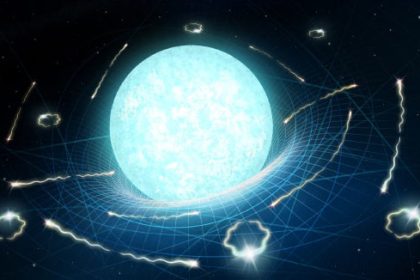
Hypothetical dark matter particles. Image credit: University of Adelaide.
For several decades, the scientific community has categorized dark matter based on the velocity of its constituent particles. The prevailing classification, ‘cold dark matter,’ posited particles moving slowly enough to aggregate under gravitational influence, thereby aiding in the formation of galaxies and galactic clusters.
This theoretical framework has underpinned the standard cosmological model, providing an explanation for the intricate, web-like configuration of the observable universe.
However, the latest research posits a revision, indicating that dark matter particles may have detached from the early universe’s superheated plasma while still exhibiting ultrarelativistic characteristics—that is, moving at exceptionally high velocities. Subsequently, these particles would have cooled sufficiently for cosmic structures to coalesce.
This refined perspective broadens the potential behaviors of dark matter particles and expands the array of candidate particles that researchers might investigate through experimental endeavors and astronomical observations.
The foundational premise of this study rests upon a phase in the early cosmos termed reheating, which ensued following the universe’s rapid expansion, a phenomenon known as inflation.
During this post-inflationary reheating epoch, the energy driving cosmic expansion transformed into a dense mixture of particles and radiation.
The findings suggest that, under specific cosmological conditions, dark matter generated during this period could have originated at velocities approaching the speed of light, yet still ultimately contribute to the large-scale structure of the universe as observed today.
If validated, these conclusions could significantly influence current methodologies aimed at detecting dark matter, whether through particle accelerators, subterranean detection facilities, or astrophysical surveys.
Furthermore, these insights introduce novel theoretical inquiries into the fundamental attributes of dark matter and its pivotal role throughout cosmic evolution.
“Dark matter is notoriously enigmatic,” commented Stephen Henrich, a doctoral candidate at the University of Minnesota.
“One of the few certainties regarding its nature is its presumed slowness.”
“Consequently, for the preceding forty years, the majority of scientific inquiry has operated under the assumption that dark matter must inherently be cold at its inception within the primordial universe.”
“Our recent findings demonstrate that this assumption is not necessarily true; indeed, dark matter can be born in an exceedingly hot state yet still cool sufficiently before the formation of galaxies commences.”
“The most straightforward candidate for dark matter—a low-mass neutrino—was definitively excluded over four decades ago, as it would have prevented, rather than facilitated, the formation of galactic-scale structures,” stated Professor Keith Olive from the University of Minnesota.
“The neutrino became the archetypal example of hot dark matter, where the development of structure is intrinsically linked to cold dark matter.”
“It is remarkable that a similar particle, if generated precisely at the genesis of the hot Big Bang universe, could have cooled to a degree where it would effectively behave as cold dark matter.”
“Through our recent discoveries, we may gain the capacity to probe an epoch of cosmic history that is remarkably close to the Big Bang itself,” remarked Professor Yann Mambrini, a physicist affiliated with Universit’e Paris-Saclay.
The collective research has been published in the esteemed journal Physical Review Letters.
_____
Stephen E. Henrich et al. 2025. Ultrarelativistic Freeze-Out: A Bridge from WIMPs to FIMPs. Phys. Rev. Lett 135, 221002; doi: 10.1103/zk9k-nbpj