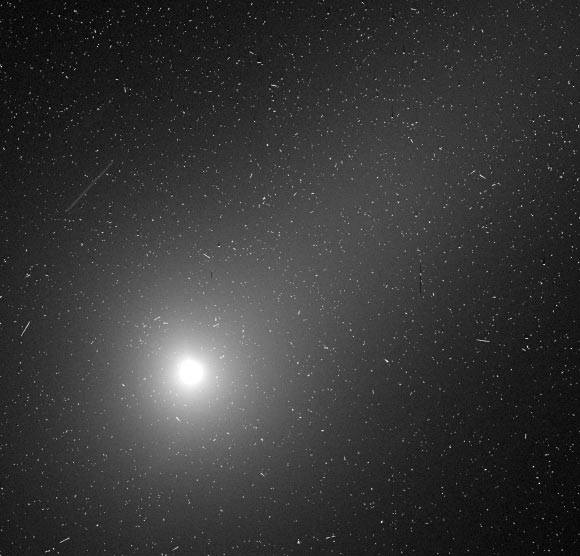
A collaborative endeavor involving astronomers from Chile, Europe, the United States, Canada, and New Zealand has achieved an unprecedentedly detailed spectroscopic examination of an interstellar comet as it traverses our Solar System. Leveraging spectral data acquired from two instruments aboard ESO’s Very Large Telescope (VLT), the research team has identified the emission of atomic nickel and cyanogen gas from 3I/ATLAS, the third officially recognized interstellar object to date.
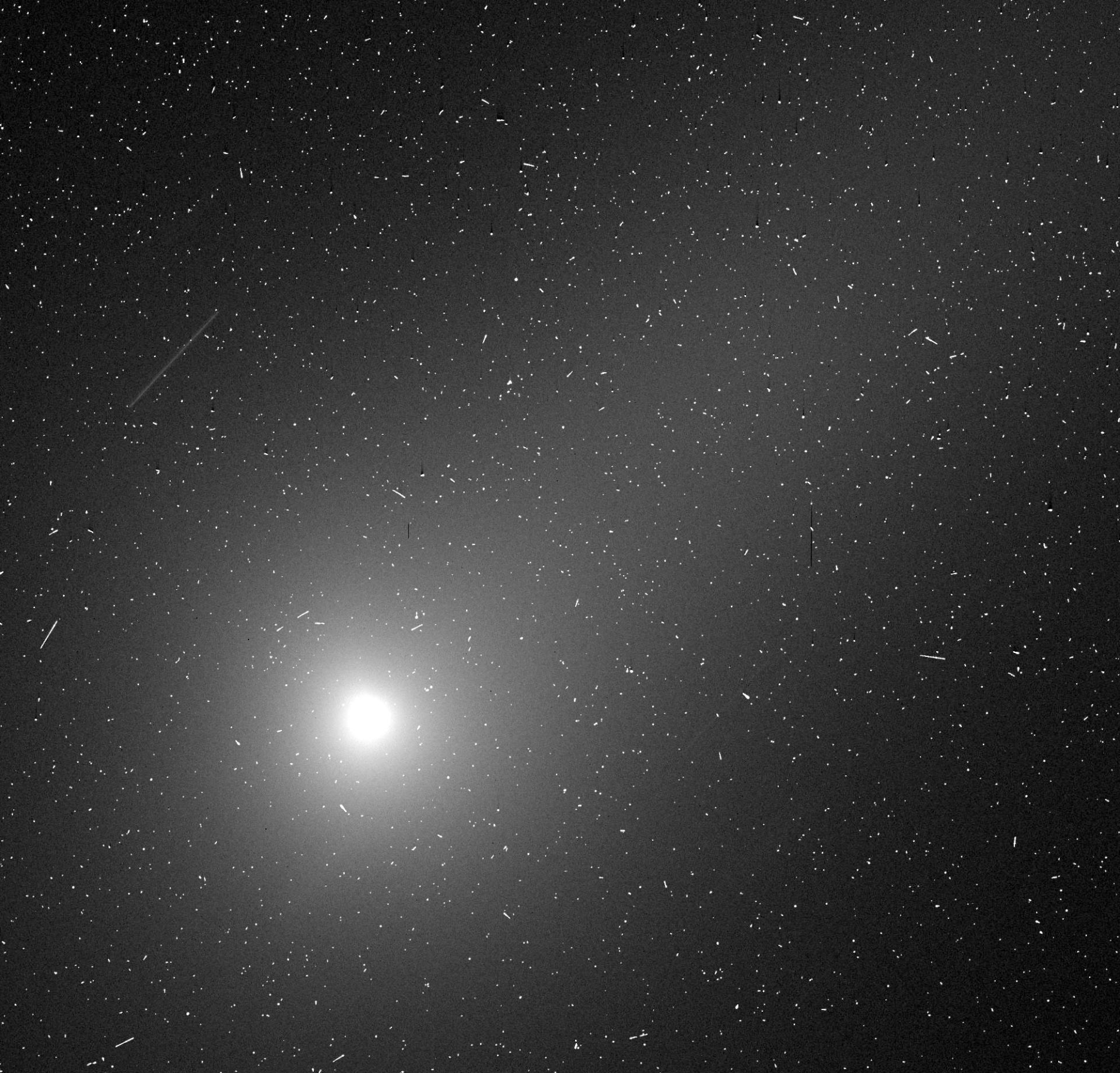
This image of the interstellar comet 3I/ATLAS was captured with Hubble’s Wide Field Camera 3 (WFC3) instrument on December 27, 2025. Image credit: NASA / ESA / CSA / Hubble.
The celestial body designated 3I/ATLAS was initially detected on July 1, 2025, by the ATLAS (Asteroid Terrestrial-impact Last Alert System) survey telescope, an initiative supported by NASA.
This visitor from beyond our solar system, also identified by the designations C/2025 N1 (ATLAS) and A11pl3Z, originated from the direction of the constellation Sagittarius.
At the time of its discovery, the comet was situated at a heliocentric distance of 4.51 astronomical units (AU), exhibiting an eccentricity of 6.13.
“The characterization of the volatile composition within interstellar objects journeying through our Solar System offers an invaluable perspective on the chemical and physical processes at play in remote stellar environments,” stated Dr. Rohan Rahatgaonkar of the Pontificia Universidad Católica de Chile, alongside his colleagues.
“Interstellar objects serve as invaluable archives, preserving signatures of the chemical and physical conditions prevalent in their parent protoplanetary disks, potentially altered by their exposure to the interstellar medium.”
“Upon exposure to solar radiation, cometary interstellar objects undergo cometary activity, leading to the release of solid materials and gases.”
During July and August, the astronomical team undertook a comprehensive spectroscopic observation campaign as 3I/ATLAS approached the Sun, moving from approximately 4.4 AU to 2.85 AU.
The spectral data crucial for this investigation were obtained utilizing two VLT instruments: X-Shooter and the Ultraviolet and Visual Echelle Spectrograph (UVES).
The observational results indicate that the comet’s coma—an enveloping, diffuse halo of gas and dust surrounding its nucleus—is predominantly composed of dust. Furthermore, a consistently red optical continuum suggests the presence of organic-rich constituents.
This reddish hue bears a striking resemblance to that observed in both solar system comets and certain of the most primordial celestial bodies within the Kuiper Belt, implying shared physical mechanisms across various planetary systems.
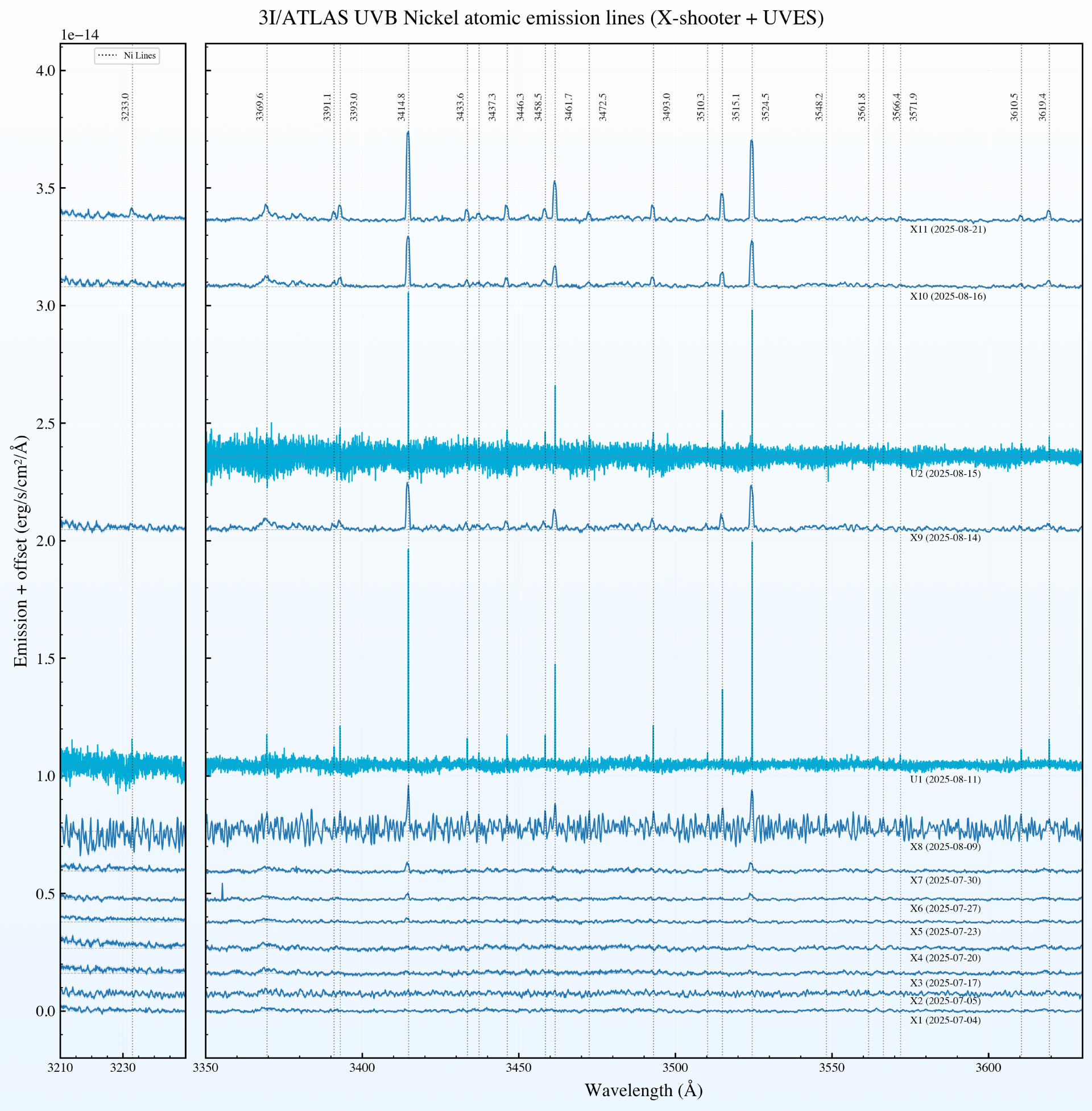
Continuum-subtracted UV/blue spectra of 3I/ATLAS showing Ni I emission over 11 VLT/X-Shooter (blue) and two VLT/UVES (cyan) visits. Image credit: Rahatgaonkar et al., doi: 10.3847/2041-8213/ae1cbc.
As 3I/ATLAS drew nearer to the Sun, the research team detected spectral emissions originating from cyanogen (CN), a straightforward carbon-nitrogen molecule frequently observed in cometary atmospheres, alongside numerous spectral lines of neutral nickel (Ni).
Conspicuously absent was any detection of iron (Fe), leading to the inference that nickel is being effectively liberated from dust particles within the coma under the influence of solar radiation.
The scientists observed that the production rates of these specific elements escalated sharply as the comet approached the Sun, with the observed evolution of CN and Ni emissions demonstrating strong power-law relationships with respect to heliocentric distance.
These observed trends suggest that the mechanisms responsible for releasing these atoms may involve low-energy processes, such as photon-stimulated desorption or the fragmentation of complex organic molecules, rather than the straightforward sublimation of ices. This distinction subtly differentiates this interstellar visitor from many comets originating within our solar system.
This precise spectral signature offers more than a mere glimpse of a transient visitor.
Interstellar comets like 3I/ATLAS represent pristine samples of material that originated and was formed around other stars. Due to their lack of prolonged exposure to a star through repeated orbital journeys, they retain crucial information regarding the elemental and molecular composition of distant protoplanetary disks—the vast, swirling formations of gas and dust from which planets ultimately emerge.
Prior interstellar objects, notably ‘Oumuamua in 2017 and 2I/Borisov in 2019, have revealed a remarkable degree of diversity in their characteristics: ‘Oumuamua exhibited behavior more akin to an inert rocky body, while 2I/Borisov was found to be rich in carbon monoxide and complex ices.
This recent study posits that 3I/ATLAS contributes another significant narrative to this expanding cosmic saga – that of a dust-laden object whose molecular signatures challenge established boundaries between familiar cometary phenomena and novel physical processes.
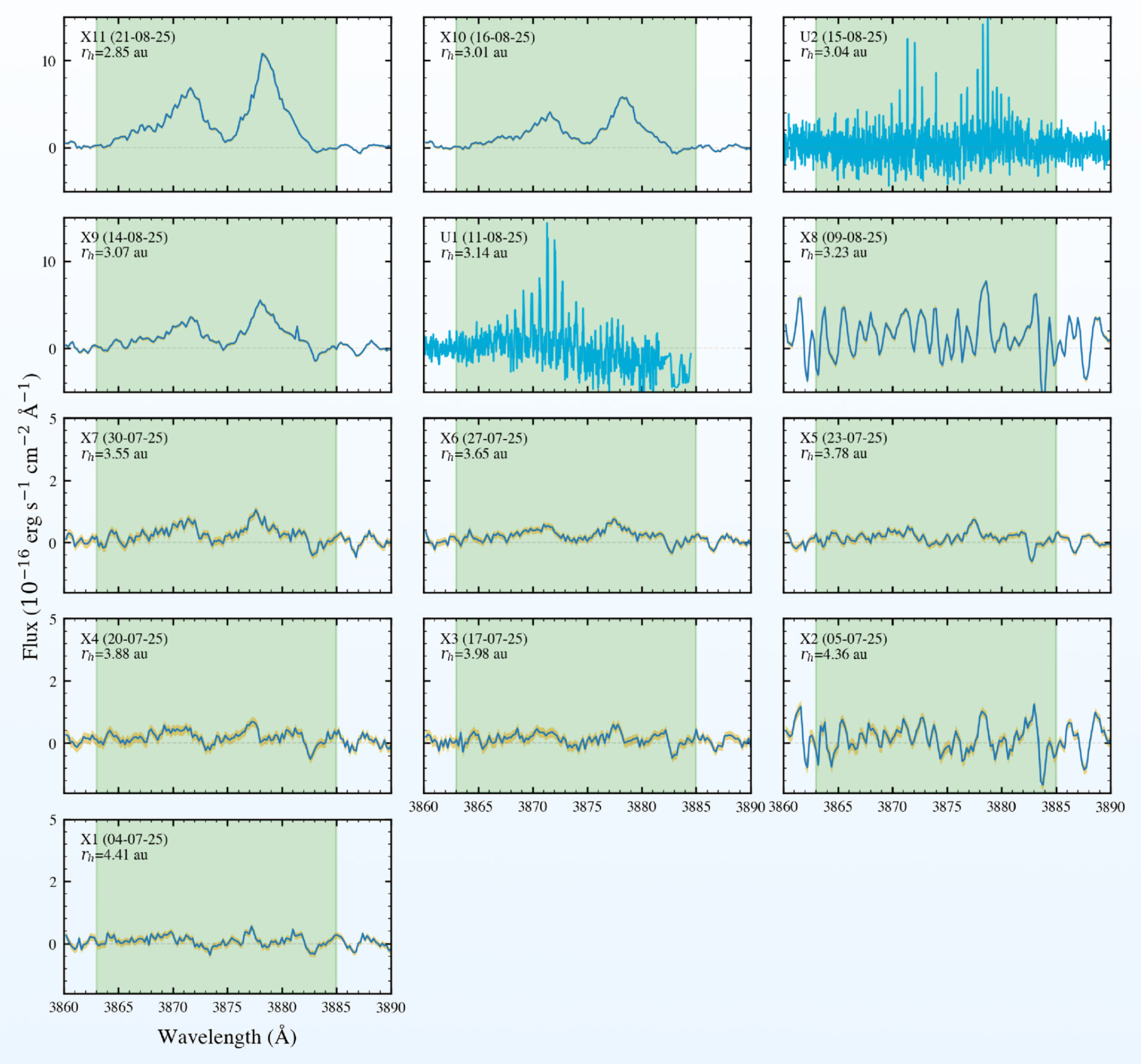
Continuum-subtracted spectra of 3I/ATLAS in the CN violet band region from a monitoring campaign spanning July 4-August 21, 2025. Image credit: Rahatgaonkar et al., doi: 10.3847/2041-8213/ae1cbc.
“Should 3I/ATLAS persist in displaying Ni emissions without any corresponding Fe signals as it approaches perihelion, this would represent the inaugural definitive instance where interstellar cometary metallic emission is decoupled from the typical release of refractory materials,” the authors reported.
“Such a finding would strongly support a distinct low-temperature organometallic (or nanophase) formation pathway for Ni within extrasolar comets and could unveil new insights into how disk chemistry, metallicity, and irradiation history influence the microphysics of planetesimals.”
“Although the progenitor star of 3I/ATLAS is likely to be relatively metal-poor compared to other stars that form interstellar objects, it is improbable that it is more than twice as metal-poor as the Sun. Consequently, there is no conflict between the inferred age of 3I/ATLAS and the presence of an iron-peak element such as Ni.”
“Irrespective of the prevailing scenario, 3I/ATLAS presents a crucial, time-sensitive experiment that establishes a connection between metallic emissions, the activation of volatiles, and the physics of dust grains within an interstellar object.”
“The measurements detailed herein will transform nickel from a mere point of interest into a calibrated probe of both parental chemistry and Galactic origin, setting a benchmark for rapid-response spectroscopy of interstellar objects slated for the Rubin Observatory and the era of the ESO Extremely Large Telescope.”
The results of this investigation were published on December 10, 2025, in the Astrophysical Journal Letters.
_____
Rohan Rahatgaonkar et al. 2025. Very Large Telescope Observations of Interstellar Comet 3I/ATLAS. II. From Quiescence to Glow: Dramatic Rise of Ni i Emission and Incipient CN Outgassing at Large Heliocentric Distances. ApJL 995, L34; doi: 10.3847/2041-8213/ae1cbc