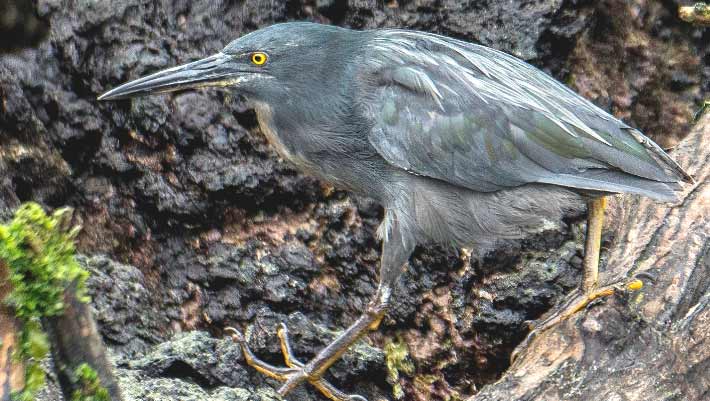
The endemic Galápagos lava heron, a diminutive avian species that navigates the volcanic terrain of the Galápagos archipelago in Ecuador, appears to have definitively established its status as a distinct species.
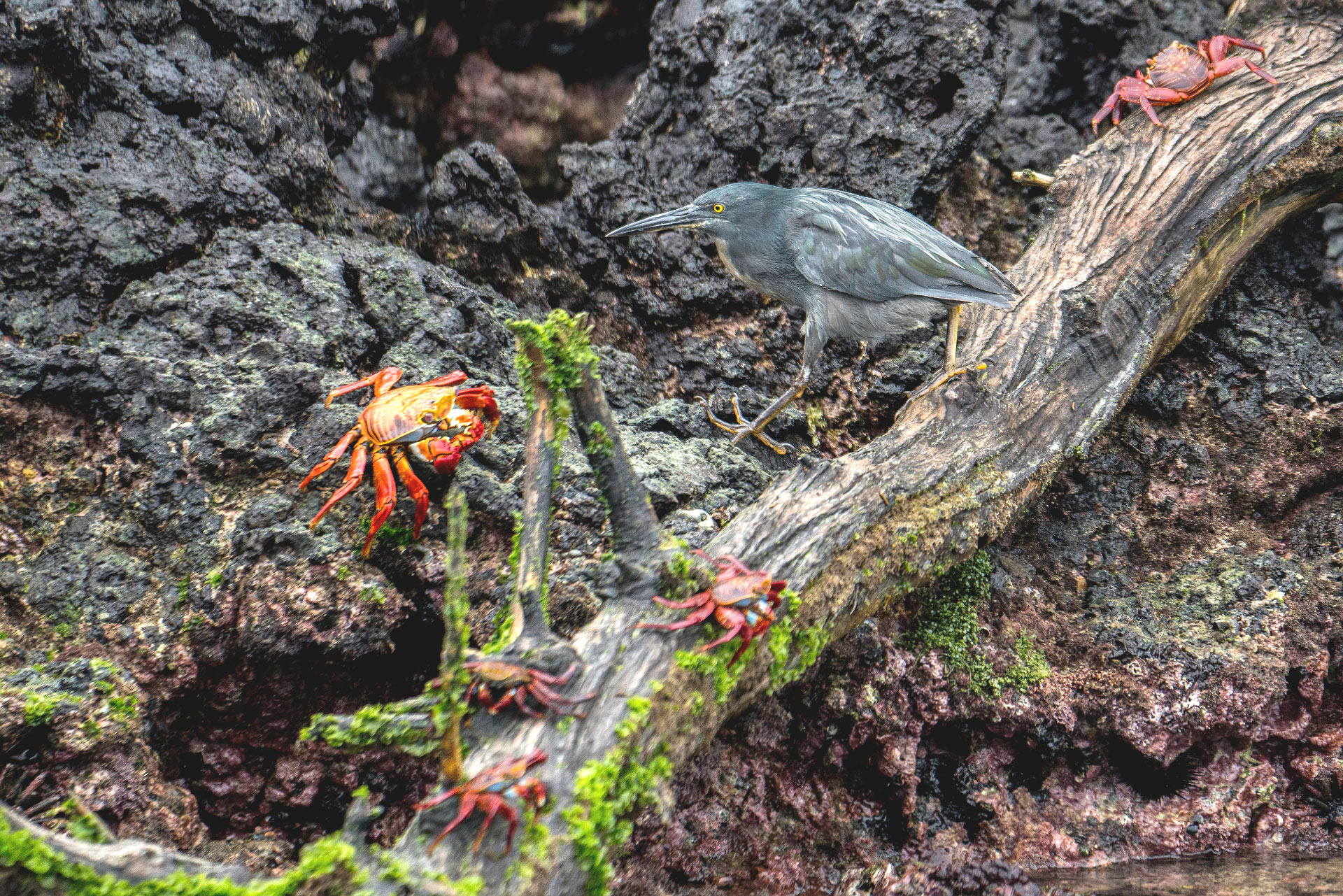
The Galápagos lava heron (Butorides sundevalli). Image credit: Casey Klebba / CC BY-SA 4.0.
Found exclusively on the Galápagos Islands and characterized by its slate-gray to black plumage, the Galápagos lava heron has long presented a taxonomic enigma to avian experts.
Historically, its classification has been debated, with some researchers designating it as a subspecies of the widely distributed striated heron (Butorides striata), under the nomenclature Butorides striata sundevalli. Conversely, others have advocated for its recognition as a separate species, Butorides sundevalli.
Contemporary genetic research, spearheaded by teams from San Francisco State University and the California Academy of Sciences, indicates that the latter classification is likely accurate.
“There was consistent observation of significant plumage variability in this particular bird, leading to prolonged uncertainty regarding its status—whether it represented an independent species or merely a subspecies of a continental avian relative,” commented Dr. Jaime Chaves of San Francisco State University, who served as the senior author of the study.
Through the comprehensive analysis of thousands of genetic markers and an extensive collection of hundreds of museum specimens, the research team ascertained that the Galápagos lava heron constitutes a unique evolutionary lineage, genetically distinct from its previously presumed relative.
Contrary to prior assumptions, the lava heron’s closest evolutionary affinities appear to be with the green heron (Butorides virescens), native to North and Central America, rather than the striated heron.
It is theorized that the ancestral population of the Galápagos lava heron may have arrived on the islands by deviating significantly from established migratory pathways, subsequently undergoing evolutionary divergence in isolation.
“The opportunity to conduct fieldwork in the Galápagos is unparalleled for any biologist,” stated Ezra Mendales, a graduate student at San Francisco State University and the lead author of the investigation.
“Even within highly studied ecosystems, the potential for new discoveries remains. Unraveling the remaining enigmas is an ongoing pursuit.”
Beyond definitively clarifying the taxonomic standing of this specific avian inhabitant, the research contributes to a significant revision of the broader phylogenetic framework for this group of small herons.
The scientific consensus emerging from this study suggests that what was once regarded as a single, globally distributed species should now be segmented into multiple distinct entities, encompassing separate evolutionary branches in the Americas, Africa, and Australasia.
“Our findings derived from ultraconserved element (UCE) phylogenetics strongly indicate that the primary evolutionary divergence within the Butorides genus occurs between populations in the Old World and the New World,” the study’s authors reported.
“The UCE-based phylogeny offers robust support for the monophyly of New World herons, which includes South American striated herons, green herons, and the Galápagos lava heron.”
These groundbreaking discoveries have been formally published this month in the esteemed scientific journal Molecular Phylogenetics and Evolution.
_____
Ezra Z. Mendales et al. 2026. Global phylogenetic relationships of Butorides herons (Aves: Ardeidae) reveal the evolutionary history and taxonomic status of the Galápagos Lava Heron. Molecular Phylogenetics and Evolution 220: 108600; doi: 10.1016/j.ympev.2026.108600