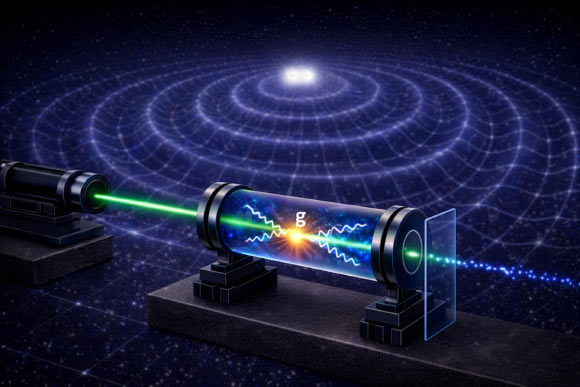
A pioneering endeavor spearheaded by Igor Pikovski, a physicist at Stevens Institute of Technology, alongside his collaborators, is poised to usher in a transformative era in quantum gravity research by constructing the inaugural experimental apparatus engineered to capture individual gravitons—particles previously deemed fundamentally beyond detection.
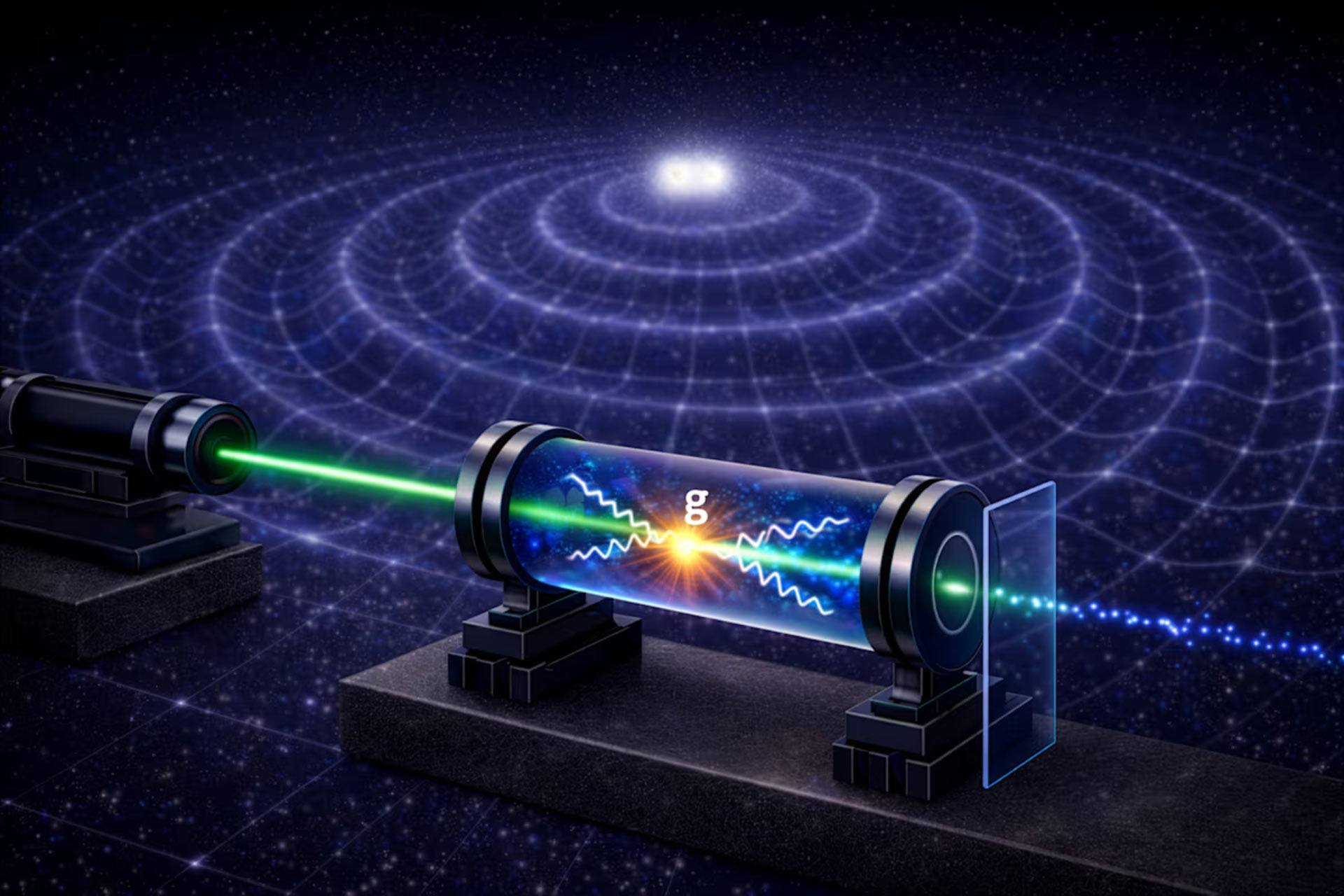
Signatures of single gravitons originating from gravitational waves are within reach for detection in experiments anticipated in the near future. Image attribution: I. Pikovski.
Contemporary physics faces a profound dichotomy: its two cardinal frameworks, quantum theory and Albert Einstein’s theory of general relativity, appear to be fundamentally irreconcilable.
While quantum theory elucidates the natural world through discrete elementary particles and their interactions, general relativity conceptualizes gravity as a continuous warping of the space-time continuum.
Achieving a comprehensive unification necessitates that gravity itself be imbued with quantum characteristics, mediated by hypothetical elementary particles known as gravitons.
Nevertheless, the prospect of detecting even a solitary graviton was, for an extended period, considered an insurmountable impossibility.
Consequently, the enigma of quantum gravity largely remained confined to the theoretical realm, with no experimentally validated “theory of everything” on the horizon.
In 2024, a significant breakthrough was presented by Dr. Pikovski and his colleagues from Stevens Institute of Technology, Stockholm University, Okinawa Institute of Science and Technology, and Nordita, who demonstrated through their research that graviton detection is, in actuality, achievable.
“The pursuit of graviton detection was for so long considered an utterly futile endeavor that it wasn’t even addressed as a tangible experimental challenge,” Dr. Pikovski remarked.
“Our findings indicate that in the current epoch of advanced quantum technologies, this prior assessment is no longer valid.”
The pivotal element lies in a novel conceptual approach that harmonizes two significant advancements in experimental science.
The first of these is the successful detection of gravitational waves, which manifest as disturbances or ripples propagating through the fabric of space-time, typically generated by cataclysmic events such as the merger of black holes or neutron stars.
The second crucial development stems from the field of quantum engineering. Over the past decade, physicists have achieved remarkable proficiency in cooling, precisely controlling, and meticulously measuring increasingly substantial physical systems, bringing them into genuine quantum states. This progress has extended the observation of quantum phenomena far beyond their traditional atomic confines.
In a landmark experimental achievement in 2022, a research group under the direction of Professor Jack Harris of Yale University successfully demonstrated the control and measurement of individual vibrational quanta within superfluid helium that possessed a mass exceeding one nanogram.
Dr. Pikovski and his co-authors astutely recognized that by integrating these two emergent capabilities, the absorption and subsequent detection of a single graviton become scientifically plausible. The reasoning is that a passing gravitational wave possesses the theoretical capacity to transfer precisely one quantum of energy, essentially a single graviton, into a quantum system of adequate mass.
While the resultant energy fluctuation is minuscule, it is theoretically resolvable. The primary obstacle lies in the extremely weak interaction probability between gravitons and matter.
However, for quantum systems operating at the kilogram scale—a significant leap from microscopic dimensions—when subjected to the intense gravitational waves emitted by merging black holes or neutron stars, the absorption of an individual graviton becomes a viable prospect.
Building upon this recent groundbreaking discovery, Dr. Pikovski and Professor Harris have now joined forces to initiate the development of the world’s first experimental setup specifically engineered for the detection of individual gravitons.
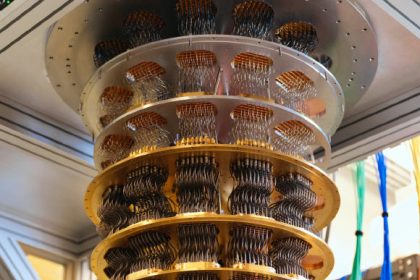
With crucial financial support from the W.M. Keck Foundation, they are currently fabricating a superfluid-helium resonator with dimensions in the centimeter range. This apparatus is designed to approach the operational parameters necessary for absorbing single gravitons emanating from astrophysical gravitational wave sources.
“We already possess the fundamental instrumentation. The capability to detect discrete quanta within macroscopic quantum systems is established. The current focus is on refining and augmenting the scale of these systems,” stated Professor Harris.
The experimental apparatus is intended to feature a cylindrical resonator weighing approximately one gram, submerged within a superfluid-helium containment vessel. This system will be cooled to its quantum ground state, and laser-based measurement techniques will be employed to detect individual phonons—which are the quantized units of vibration into which gravitons are effectively converted upon interaction.
This detector represents an evolution of existing laboratory systems, pushing their operational capacity into an unprecedented régime by increasing the mass to the gram level while meticulously preserving their exceptional quantum sensitivity.
The successful demonstration of this platform’s functionality will lay the groundwork and provide a definitive blueprint for a subsequent generation of detectors designed with the requisite sensitivity for direct graviton detection, thereby inaugurating a novel experimental frontier in the study of quantum gravity.
“The genesis of quantum physics was rooted in experimental investigations involving light and matter,” Dr. Pikovski commented.
“Our present objective is to integrate gravity into this experimental paradigm, enabling the study of gravitons in a manner analogous to how physicists first investigated photons more than a century ago.”