A recent analysis of telemetry from NASA’s Dawn spacecraft indicates that Vesta, the Solar System’s second most massive asteroid, has not undergone complete differentiation into distinct layers comprising a metallic core, silicate mantle, and basaltic crust.
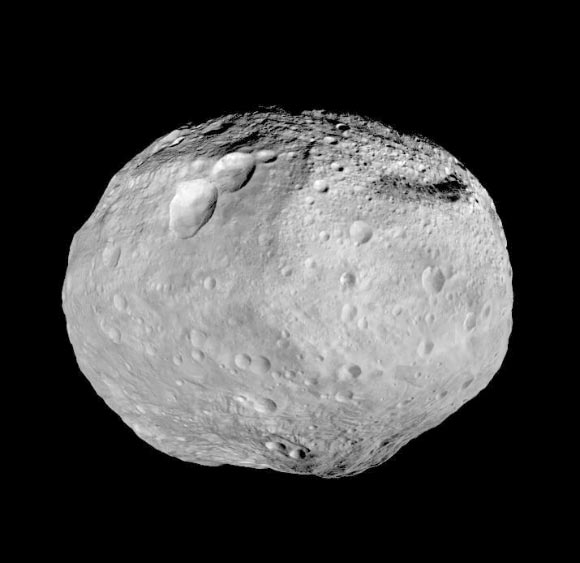
NASA’s Dawn spacecraft studied Vesta from July 2011 to September 2012. The towering mountain at the south pole — more than twice the height of Mount Everest — is visible at the bottom of the image. The set of three craters known as the ‘snowman’ can be seen at the top left. Image credit: NASA / JPL-Caltech / UCLA / MPS / DLR / IDA.
This celestial body, identified by Heinrich Wilhelm Olbers on March 29, 1807, stands as the sole main-belt asteroid discernible with the naked eye.
Vesta completes a single rotation in 5.34 hours and traverses its orbit around the Sun over 3.63 years, presenting an ellipsoidal form with dimensions measuring 286 x 279 x 223 km along its radial axes.
Given its considerable size, Vesta has long been presumed to be a differentiated entity, possessing a core and mantle akin to terrestrial planets.
“What is Vesta’s true identity? We have two hypotheses that need further exploration,” articulated Dr. Seth Jacobson, a researcher affiliated with Michigan State University, along with his collaborators.
“The foremost possibility is that Vesta underwent incomplete differentiation, signifying that it initiated the necessary melting processes to establish distinct strata—such as a core, mantle, and crust—but ultimately did not reach completion.”
“Alternatively, Vesta might represent a fragment that detached from a nascent planet within our Solar System.”
“For a considerable period, disparate gravitational data obtained from Dawn’s observations of Vesta presented perplexing enigmas,” stated Dr. Ryan Park, a senior research scientist and principal engineer at NASA’s Jet Propulsion Laboratory.
“Following nearly a decade dedicated to refining our calibration and data processing methodologies, we have achieved an extraordinary concordance between Dawn’s Deep Space Network radiometric measurements and the onboard imaging telemetry.”
“We were thoroughly delighted to validate the robustness of this data in elucidating Vesta’s deep internal structure.”
“Our discoveries reveal that Vesta’s formative history is considerably more intricate than initially posited, sculpted by distinctive phenomena such as aborted planetary differentiation and cataclysmic collisions occurring late in its development.”
The trajectory of celestial objects exhibiting a dense core differs measurably from those lacking such a central mass.
Leveraging this fundamental understanding, the investigative team meticulously measured Vesta’s rotational characteristics and gravitational field.
The resultant data indicated that Vesta’s behavior deviated from that of an object possessing a core, thereby challenging prevailing theories regarding its formation.
“Additional modeling efforts are imperative to refine existing constructs and definitively establish Vesta as an ancient fragment of a planetary body in formation,” Dr. Jacobson emphasized.
“Scientific inquiry can be advanced by adjusting the analytical frameworks applied to Vesta meteorites, enabling a more profound exploration of either hypothesis.”
“Furthermore, subsequent investigations utilizing novel analytical approaches applied to the Dawn mission data could yield significant insights.”
“Our manuscript marks merely the inception of a novel research trajectory. It holds the potential to fundamentally alter the scientific perspective on differentiated cosmic bodies.”
The research findings were formally documented in a published article appearing in the esteemed journal Nature Astronomy.
_____
R.S. Park et al. A small core in Vesta inferred from Dawn’s observations. Nat Astron, published online April 23, 2025; doi: 10.1038/s41550-025-02533-7