Interstellar visitor 3I/ATLAS is scheduled to achieve its closest orbital point to Earth on December 19, 2025.
This proximate passage, encompassing the immediate period before and after the closest approach, presents the preeminent and definitive window for terrestrial observatories and dedicated comet enthusiasts to capture and scrutinize the celestial body as it embarks on its outbound trajectory from our Solar System. Its departure will be permanent.
At its point of closest proximity, known as perigee, 3I/ATLAS will traverse a distance of approximately 270 million kilometers (168 million miles) from our planet. While this is nearly double the Earth-Sun separation of 150 million kilometers, it remains sufficiently close to facilitate exceptionally valuable scientific observations.
Since its initial detection on July 1, 2025, 3I/ATLAS has distinguished itself as one of the most enigmatic comets ever encountered by humankind. As its celestial journey brings it nearer to the Sun and Mars, and now to Earth, its unconventional characteristics have become increasingly pronounced.
Measurements of its coma – the tenuous envelope of gas and dust enveloping an active comet – have indicated premature outgassing activity, resulting in the release of substantial quantities of carbon dioxide. Subsequent observations have also revealed significant concentrations of hydrogen cyanide (HCN) and methanol (CH3OH) within the coma, a phenomenon attributed to the sublimation of the comet’s ices under the intensifying solar warmth.
During the initial two months following its discovery, researchers also documented unexpectedly elevated levels of nickel and iron, characterizing its composition as “potentially extreme” and unlike any previously observed comet.
In early October, 3I/ATLAS passed remarkably close to Mars, an encounter meticulously recorded by Martian and solar surveillance instruments. The opportunities for observing the comet became considerably constrained when its orbital path led it behind the Sun from Earth’s vantage point during a critical phase of its journey – the perihelion, its closest solar approach, which occurred on October 29.
Upon its re-emergence from behind the Sun’s dazzling glare, terrestrial observatories refocused their attention on the enigmatic visitor.
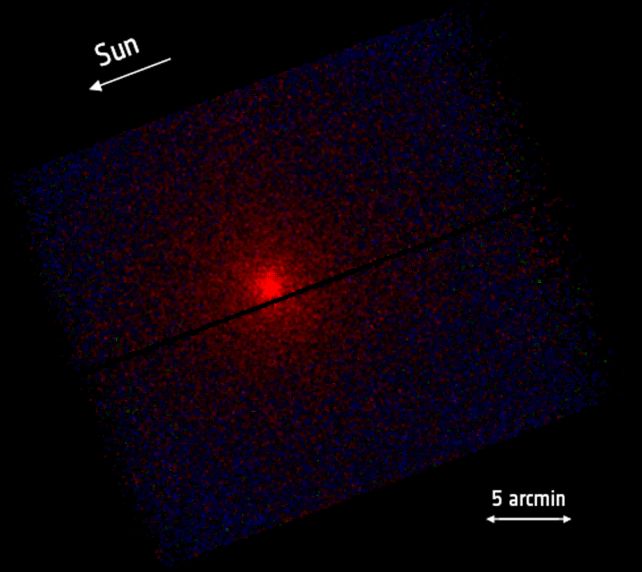
XMM-Newton, an orbital X-ray observatory operated by the European Space Agency, dedicated 20 hours to observing 3I/ATLAS, capturing the luminescence of X-radiation as the energized solar wind interacted with the expanding coma. XMM-Newton’s sensitivity allows for the detection of soft X-ray emissions originating from ions such as carbon, nitrogen, and oxygen, which are produced when the solar wind collides with neutral gases present within the coma.
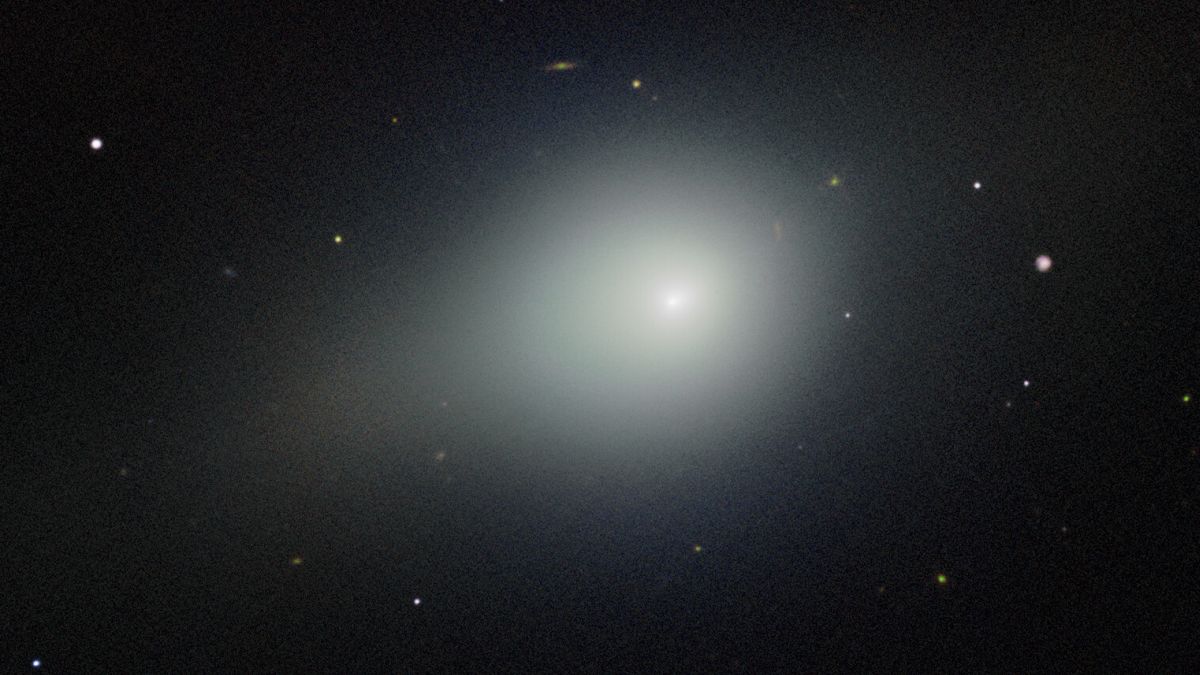
In late November, observations of the comet obtained by NOIRLab’s Gemini North telescope revealed a subtle greenish hue. This finding is noteworthy, as initial imagery of 3I/ATLAS displayed a more reddish tint, indicative of organic compounds known as tholins adorning the comet’s surface.
The greenish luminescence characteristic of many comets is generated by diatomic carbon (C2), which emits a green fluorescent glow when energized by solar radiation. However, pre-perihelion analyses of 3I/ATLAS suggested a notably low concentration of C2.
While C2 is not typically a constituent of cometary ice, it forms within the icy matrix and disintegrates rapidly therein, originating from free-floating carbon atoms derived from other carbon-bearing molecules that undergo photodissociation under solar radiation.
The recent imagery suggests that 3I/ATLAS commenced C2 formation only late in its passage through the Solar System – another indication of the comet’s anomalous behavior.
The implications of these observations remain under investigation. Some scientific hypotheses propose that 3I/ATLAS could be an exceptionally metal-rich celestial body adorned with cryovolcanoes that are expelling its gases into space. Another analytical perspective suggests that the comet may be nearing the depletion of its ice reserves, undergoing a transformation into an asteroid-like object post-cometary activity.
Despite its array of unusual traits, all evidence points towards its classification as a comet. The forthcoming intensive phase of observations is anticipated to provide further clarity on the distinctions between 3I/ATLAS and comets originating within our Solar System. Subsequent scholarly analyses may then offer profound insights into the peculiar conditions of interstellar space.
“This entity is unequivocally a comet,” stated NASA associate administrator Amit Kshatriya in November. “Its appearance and behavior are consistent with those of a comet, and all available data corroborate this identification. However, its extragalactic origin renders it exceptionally fascinating, exhilarating, and of paramount scientific significance.”