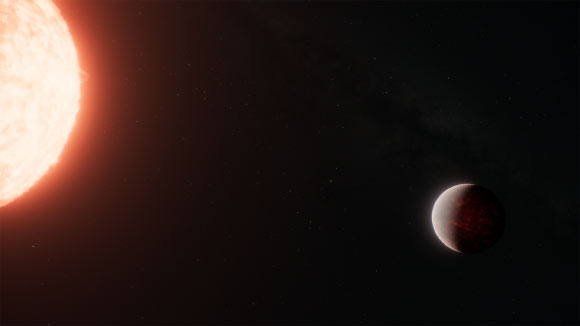
Recent analyses utilizing data from the NASA/ESA/CSA James Webb Space Telescope indicate that TOI-561b is enveloped by a substantial gaseous shell situated above an extensive molten rock ocean.
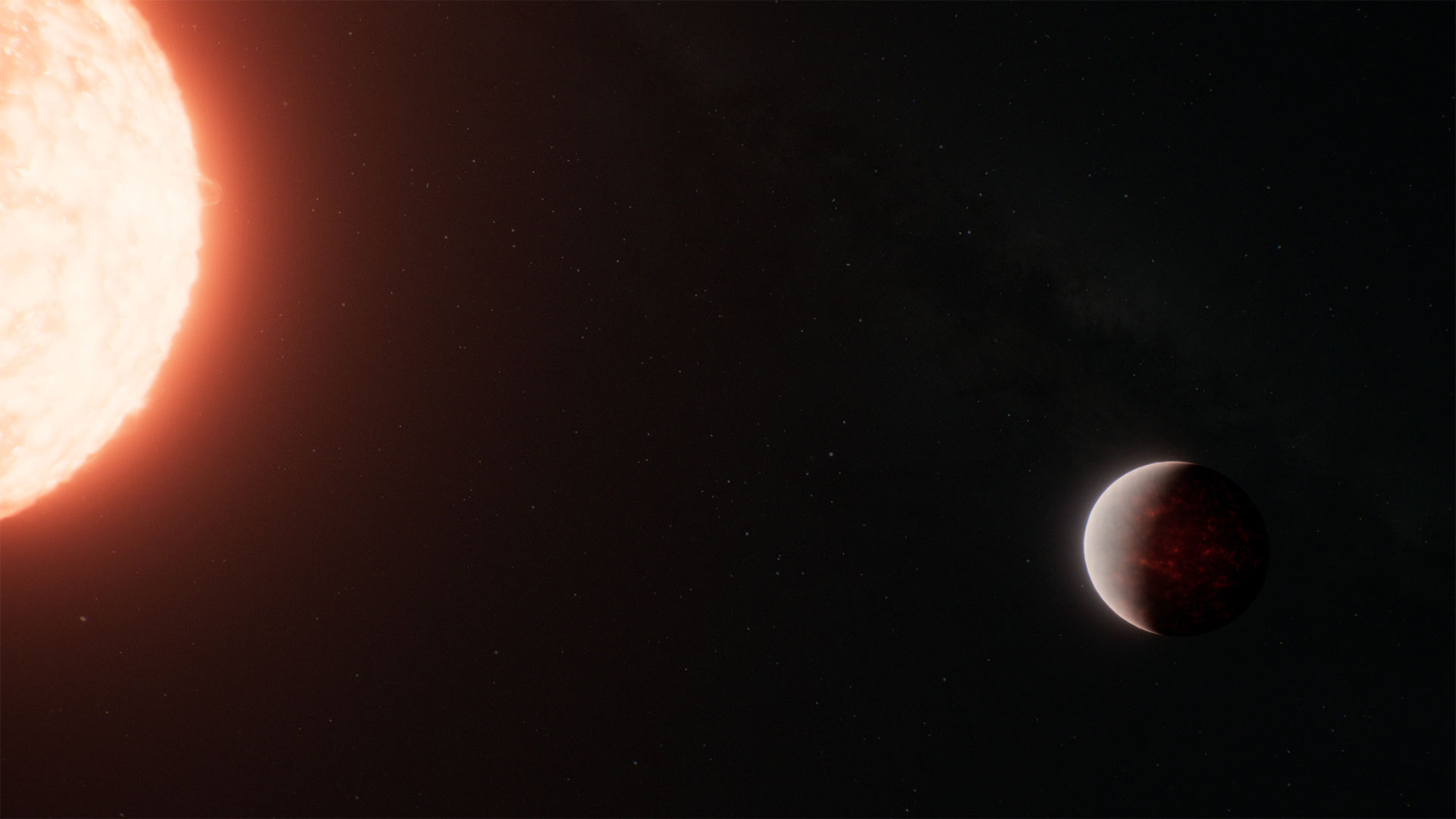
This artist’s concept depicts the celestial bodies TOI-561b and its parent star. Image credit: NASA / ESA / CSA / Ralf Crawford, STScI.
Positioned approximately 280.5 light-years away within the Sextans constellation, TOI-561 is a luminous stellar entity.
This star, estimated to be around 10 billion years old, possesses a mass and diameter roughly equivalent to 80% of our Sun’s dimensions.
Known also by the designation TYC 243-1528-1, it is categorized among a less common stellar group referred to as the Galactic thick disk stars.
TOI-561 harbors a minimum of three exoplanets, designated TOI-561b, c, and d, marking it as one of the most ancient and chemically primitive planetary systems yet identified within the Milky Way galaxy.
The innermost planet, TOI-561b, is classified as a super-Earth, completing its orbit in a mere 0.44 days.
Its mass and radius are approximately 3.2 and 1.45 times that of Earth, respectively, with a density of 5.5 g/cm³, suggesting a composition consistent with rocky material.
“The remarkably low density is what truly makes this planet stand out,” commented Dr. Johanna Teske, an astrophysicist affiliated with the Carnegie Institution for Science.
“It is not a diffuse gas giant, but its density is lower than would be anticipated for a planet with an Earth-like composition.”
One hypothesis put forth by the astronomers to account for the planet’s reduced density was the possibility of it possessing a comparatively small iron core and a silicate mantle of lesser density than Earth’s rocky components.
“TOI-561b is unique among planets with ultra-short periods due to its orbit around an exceptionally old star (twice the age of the Sun), which is also iron-deficient and located within the Milky Way’s thick disk region,” stated Dr. Teske.
“Its formation must have occurred within a distinctly different chemical environment compared to the planets found in our own Solar System.”
Furthermore, the research team posited that TOI-561b might be encircled by a dense atmosphere, thereby artificially inflating its apparent size.
While small planets subjected to intense stellar radiation for eons are not typically expected to retain atmospheres, some exhibit evidence suggesting they are more than just barren rock or molten surfaces.
To investigate the theory of an atmospheric presence on TOI-561b, the team employed Webb’s NIRSpec (Near-Infrared Spectrograph) for the purpose of determining the planet’s dayside temperature by analyzing its near-infrared luminosity.
This analytical method, which involves quantifying the reduction in the combined brightness of the star and planet system as the exoplanet transits behind its star, bears resemblance to techniques utilized in the search for atmospheres around the TRAPPIST-1 system and other terrestrial worlds.
Should TOI-561b be an exposed rocky body devoid of any atmosphere to redistribute heat to its nocturnal hemisphere, its dayside temperature would be expected to approach 2,700 degrees Celsius (4,900 degrees Fahrenheit).
However, the data acquired by NIRSpec suggest the planet’s dayside temperature is closer to 1,800 degrees Celsius (3,200 degrees Fahrenheit) — still exceptionally high, but considerably lower than initially predicted.
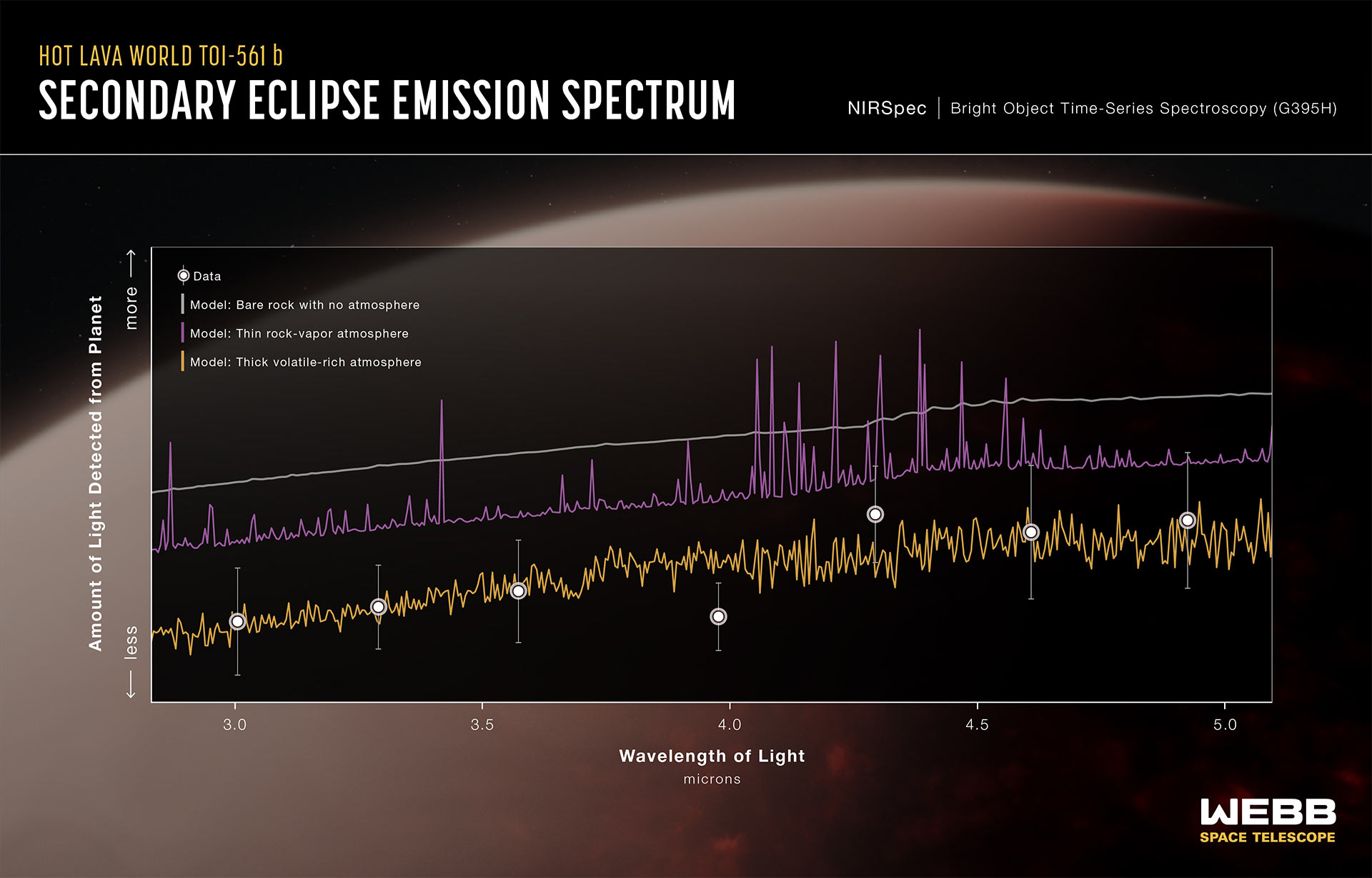
An emission spectrum obtained by Webb in May 2024 illustrates the intensity of various near-infrared wavelengths emanating from exoplanet TOI-561b. Image credit: NASA / ESA / CSA / Ralf Crawford, STScI / Johanna Teske, Carnegie Science Earth and Planets Laboratory / Anjali Piette, University of Birmingham / Tim Lichtenberg, Groningen / Nicole Wallack, Carnegie Science Earth and Planets Laboratory.
The authors explored several theoretical frameworks to interpret these findings.
While circulation within the magma ocean could facilitate some heat transfer, the absence of an atmosphere would likely result in a solidified nightside, thereby impeding heat dissipation from the dayside.
A tenuous layer of vaporized rock on the surface of the molten ocean is also a plausible scenario, but this alone would probably exert a diminished cooling influence compared to the observed effect.
“A substantial atmosphere rich in volatile compounds is essential to reconcile all the observational data,” stated Dr. Anjali Piette, an astronomer at the University of Birmingham.
“Robust atmospheric currents would facilitate cooling of the dayside by transporting thermal energy towards the nightside.”
“Gaseous constituents such as water vapor would absorb certain near-infrared wavelengths emitted by the surface before they could propagate fully through the atmospheric column.”
“It is also conceivable that reflective silicate clouds are present, contributing to atmospheric cooling by scattering incident starlight.”
Although the Webb observations furnish persuasive substantiation for the existence of such an atmosphere, the fundamental question persists: How can a diminutive planet, exposed to such formidable radiation, retain any atmosphere, let alone one of this magnitude? While some gaseous elements are undoubtedly escaping into space, their exodus might be occurring at a less vigorous rate than previously assumed.
“Our hypothesis posits an equilibrium state between the magma ocean and the surrounding atmosphere,” explained Dr. Tim Lichtenberg, an astrophysicist at the University of Groningen.
“Concurrently with gases being expelled from the planet to replenish the atmosphere, the magma ocean is reabsorbing them back into the planetary interior.”
“This celestial body must possess a far greater abundance of volatile materials than Earth to account for the observed phenomena. It is akin to a saturated lava sphere.”
The research paper detailing these findings is published today in the Astrophysical Journal Letters.
_____
Johanna K. Teske et al. 2025. A Thick Volatile Atmosphere on the Ultrahot Super-Earth TOI-561b. ApJL 995, L39; doi: 10.3847/2041-8213/ae0a4c