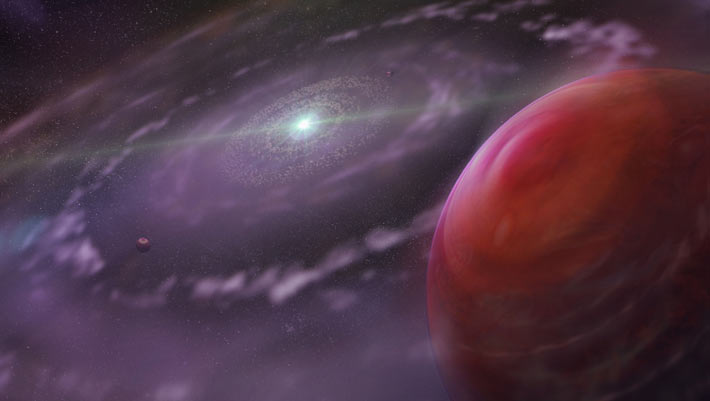
For the initial time, astronomers wielding the capabilities of the NASA/ESA/CSA James Webb Space Telescope have successfully detected the presence of hydrogen sulfide gas within the atmospheres of three gas-giant exoplanets. These celestial bodies are in orbit around HR 8799, a star estimated to be 30 million years old and situated in the constellation Pegasus. The investigation revealed that the source of this sulfur must be solid material originating from the planetary formation disk.
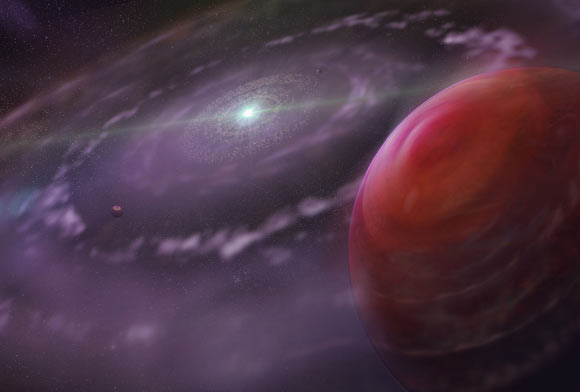
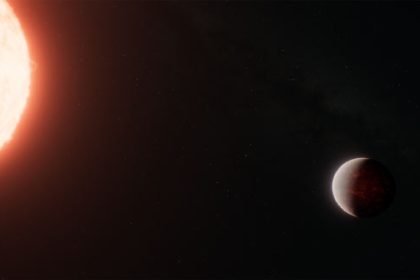
Artist’s rendering of the planetary system HR 8799 at an early stage in its evolution, showing the planet HR 8799c, a disk of gas and dust, and interior planets (Dunlap Institute for Astronomy & Astrophysics / Mediafarm)
The star HR 8799 is located approximately 129 light-years distant from our solar system, within the constellation of Pegasus.
This star is orbited by a substantial debris disk and four exceptionally large planets, referred to as super-Jupiters: HR 8799b, c, d, and e.
The smallest of these planets exhibits a mass five times that of Jupiter, while the largest is ten times its mass.
These planets are situated at considerable distances from their parent star; the closest among them is positioned 15 times farther from the star than Earth is from the Sun.
In contrast to the majority of exoplanet discoveries, which are often indirectly inferred from data analysis, these particular worlds are directly observable using ground-based telescopes.
“HR 8799 presents a somewhat singular case, as it is currently the only imaged system known to harbor four massive gas giants. However, other systems are known to possess one or two even more substantial companions, the formation mechanisms of which remain enigmatic,” explained Dr. Jean-Baptiste Ruffio, an astronomer affiliated with the University of California, San Diego.
Leveraging the unprecedented observational sensitivity of the Webb telescope, Dr. Ruffio and his research collaborators conducted a detailed analysis of the atmospheric chemical composition of three planets orbiting HR 8799: HR 8799c, d, and e.
These planets are approximately 10,000 times less luminous than their host star. To successfully extract the faint signal from the Webb data, the research team devised novel data analysis methodologies.
“Historically, carbon and oxygen in these planets have been investigated through terrestrial observations. However, these elements are not definitive indicators of solid matter, as they can originate from either icy or solid components within the disk, or from gaseous sources,” stated Dr. Jerry Xuan, a postdoctoral researcher at the University of California, Los Angeles, and Caltech. “Conversely, sulfur is uniquely indicative because, given the orbital distances of these planets from their star, it must be present in solid form.”
“It is scientifically implausible for these planets to have accumulated sulfur in a gaseous state.”
The detection of hydrogen sulfide strongly suggests that the sulfur was incorporated, or accreted, in the form of solid material from pre-existing solids within the protoplanetary disk from which these planets coalesced.
These solids were incorporated as the planets developed. Due to the extremely high temperatures of the young planets’ cores and atmospheres, these solids vaporized, resulting in the sulfurous gas observed today.
The measured ratios of sulfur to hydrogen, as well as carbon and oxygen to hydrogen, significantly exceed those found in the star. Consequently, the elemental makeup of the planets must diverge considerably from that of their parent star.
An analogous enigmatic pattern of uniform enrichment in heavy elements has also been observed in the compositions of Jupiter and Saturn.
“Explaining the uniform enrichment of carbon, oxygen, sulfur, and nitrogen within Jupiter is not straightforward. However, the observation of this phenomenon in a distinct system implies that there might be a universal process governing planet formation, making it natural for planets to accrete all heavy elements in nearly identical proportions,” Dr. Xuan remarked.
According to the study’s authors, their recent discovery is poised to contribute significantly to the ongoing search for Earth-like exoplanets.
“The technique employed here, enabling researchers to visually and spectrally disentangle the exoplanet from its host star, will prove invaluable for the detailed and clear study of exoplanets situated at vast distances from Earth,” Dr. Xuan elaborated.
“While this methodology is currently constrained to the examination of gas giants, advancements in telescope size and instrument capabilities will eventually permit the application of such techniques to study terrestrial planets.”
“Identifying an Earth analogue represents the ultimate objective in exoplanet exploration, though we are likely decades away from achieving this milestone.”
“However, it is conceivable that within the next 20 to 30 years, we may obtain the initial spectrum of an Earth-like planet, enabling us to search for biosignatures such as oxygen and ozone in its atmosphere.”
The results of this groundbreaking research were published on February 9, 2026, in the esteemed journal Nature Astronomy.
_____
JB. Ruffio et al. Jupiter-like uniform metal enrichment in a system of multiple giant exoplanets. Nat Astron, published online February 9, 2026; doi: 10.1038/s41550-026-02783-z