A fleeting emission of gamma and X-ray radiation, observed by terrestrial observatories in November 2024, might originate from an unanticipated source.
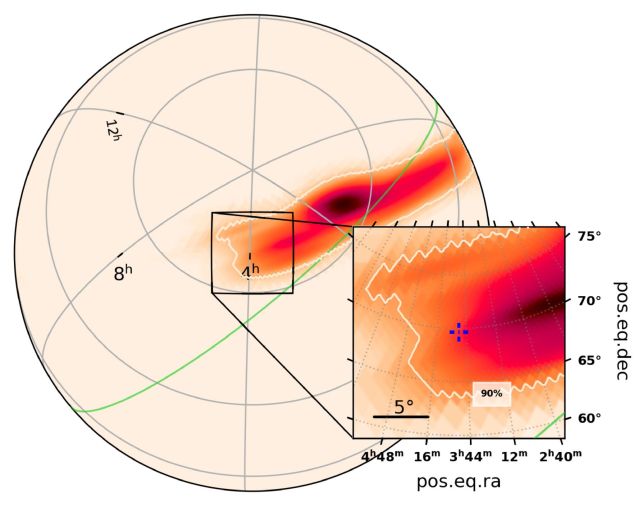
Mere moments prior, from the exact same confined celestial sector, the LIGO-Virgo-KAGRA network registered the characteristic gravitational wave signature indicative of a binary black hole coalescence. These cataclysmic cosmic events represent some of the most extreme phenomena in the universe; nevertheless, they are not typically anticipated to generate observable electromagnetic radiation.
An investigative consortium, spearheaded by astrophysicist Shu-Rui Zhang from the University of Science and Technology of China, has posited that this remarkable detection is attributable to an exceptionally uncommon confluence of circumstances. The researchers theorize that the merger event may have transpired within the vast, turbulent accretion disk encircling a third, supermassive black hole – the active galactic nucleus (AGN) of the host galaxy.
While definitive confirmation from a distance exceeding 4.2 billion light-years presents a challenge, regardless of the precise mechanism, the dual detections insinuate that, under specific alignment conditions, merging black holes can indeed be accompanied by a luminous flash.
“Our theoretical framework possesses predictive capabilities,” the research team articulates, “and we underscore the critical need to further refine the orbital eccentricity of the merger and undertake deep-sky surveys of the host galaxy to validate our proposed explanation.”
Since the inaugural observation of gravitational waves in 2015, the compendium of these spacetime undulations has expanded significantly, now encompassing hundreds of recorded events. Although not all detected signals have undergone thorough analysis or even definitive confirmation, the prevailing hypothesis is that the majority stem from the collision of two black holes, the most compact entities known in the cosmos.
The vast majority of these mergers have occurred without any observable light counterpart. Numerous attempts to identify a simultaneous electromagnetic signal for these events have been made, yet the evidence suggests that when two stellar-mass black holes coalesce into a larger one, any associated energetic emission, if present, is shrouded by the event horizon.
The gravitational wave event cataloged as S241125n on November 25, 2024, however, deviated from this pattern. The signal propagated through the globally distributed LIGO-Virgo-KAGRA observatories, signaling a black hole merger approximately 4.2 billion light-years distant, resulting in the formation of an object with a considerable mass, estimated to be around 150 solar masses.
Subsequently, approximately 11 seconds later, a coordinated observation by multiple X-ray telescopes captured a burst of X-ray radiation, alongside a gamma-ray emission, emanating from the identical celestial region that had previously yielded the gravitational waves. The probability of this temporal and spatial correlation being coincidental was calculated by the researchers to be exceedingly low, with a statistical chance of such an unrelated occurrence estimated at once in every 30 years of accumulated observational data.
Given that both gravitational waves and light propagate at the universal speed limit, the observed sequence of events strongly suggests that the black hole merger preceded and then triggered a prodigious expulsion of electromagnetic energy.
Considering that black holes are fundamentally characterized by their inability to emit detectable light – a well-established property – and given that numerous black hole mergers occur in complete darkness, the researchers inferred that an ancillary phenomenon must have been involved.
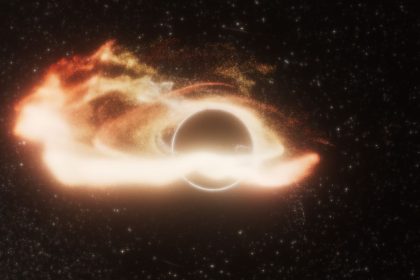
It is understood that black holes can engage in an intensely luminous process: the consumption of surrounding matter, a phenomenon termed accretion. When a black hole is enveloped by substantial quantities of material, this matter can form a rotating disk. This disk becomes superlatively heated due to the immense gravitational forces and frictional interactions as it spirals inward towards the black hole, akin to water vortexing down a drain.
This accretion disk itself serves as a source of radiation. An additional luminous mechanism involves the generation of astrophysical jets, believed to originate from material that is thought to be diverted and accelerated along magnetic field lines situated just beyond the event horizon, subsequently being ejected from the black hole’s polar regions at extraordinary velocities.
The gamma-ray burst recorded following S241125n exhibited certain characteristics that were somewhat anomalous when contrasted with gamma-ray bursts typically associated with core-collapse supernovae or the mergers of neutron stars.
Zhang and his collaborators proposed that a phase of rapid accretion could potentially account for these observed features. However, for a recently formed black hole to undergo such an accretion event, the merger would necessitate its occurrence within an environment already rich in available material to sustain feeding.
Their simulations explored the ramifications of two stellar-mass black holes colliding within the accretion disk of a significantly larger black hole – a colossal object possessing a mass millions to billions of times that of the Sun, which itself is actively accreting matter at the galactic core.
When black holes of unequal masses merge, the asymmetry in their mass distribution can impart a “natal kick” to the newly formed black hole, propelling it outward from its point of origin.
According to the outcomes of the team’s simulations, a natal kick experienced within the dynamic environment of an AGN accretion disk would cause the resultant black hole to traverse through the dense gas and dust. This interaction would instigate a surge in accretion and the subsequent launch of powerful jets, producing emissions that bear resemblance to the observed gamma-ray burst.
This scenario is highly plausible, as galactic centers are exceptionally dynamic regions, replete with various celestial constituents, including populations of smaller black holes and binary black hole systems gravitationally drawn towards the central mass.
Further observational evidence is requisite to substantiate the team’s hypothesis, yet it presents a compelling theoretical framework for comprehending the complex dynamics of galactic centers and the black hole mergers that may be occurring within them.
“Future investigations of S241125n and analogous phenomena could yield profound insights into the fundamental physics governing black hole mergers and their integral role in the broader cosmic tapestry,” the researchers conclude, “potentially unveiling novel interconnections between gravitational waves, electromagnetic signals, and the environmental contexts of these extraordinary celestial occurrences.”