The advent of terrestrial flora approximately 430 million years ago, during the Silurian epoch when North America and Europe were united within the supercontinent Pangaea, profoundly reshaped our planet’s biosphere. Given the interconnectedness of Earth’s surface and its deep interior through tectonic mechanisms, a synchronous alteration in the continental crust’s composition was anticipated to correlate with the co-evolution of the biosphere and sedimentary rock formations. To validate this premise, investigators from the University of Southampton undertook an evaluation of isotopic signatures within zircon crystals originating from subduction zones where oceanic sediments are incorporated into the mantle.

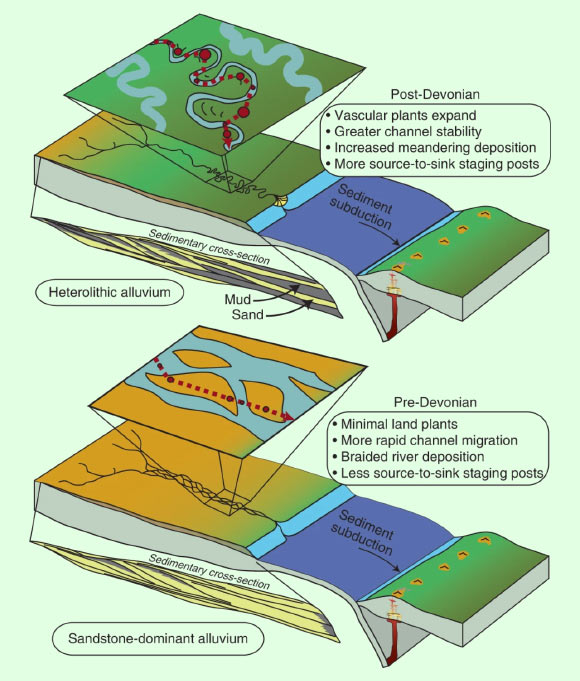
Schematic model of fluvial systems both before and after the development of land plants: before the Devonian period, minimal land plants, rapid channel migration and river systems dominated by braided rivers led to rapid sediment transfer, minimal development of mud-sized particles and minor deposition of mudrocks along continental margins; in contrast, after the Devonian, the expansion of vascular land plants led to the development of meandering rivers and the dramatic slowing of sediment transfer to marine environments; the red dashed line represents a generalized sediment transport path that is more sinuous post-Devonian and less sinuous pre-devonian; these diametric depositional systems influenced the isotopic composition of sediment available for reworking and melting in magmatic systems along destructive plate boundaries. Image credit: Spencer et al., doi: 10.1038/s41561-022-00995-2.
Flora reigns as the predominant life form on Earth, constituting 450 gigatons of a total 550 gigatons of living biomass, and has successfully established itself across 84% of the exposed continental crust.
Nevertheless, Earth’s designation as a ‘green planet’ is a relatively recent geological phenomenon; for approximately 90% of its history, terrestrial vegetation was absent, save for some microbial mats measuring mere millimeters in thickness.
“The proliferation of plant life fundamentally altered riverine systems, giving rise to more sinuous waterways, expansive muddy floodplains, and deeper soils,” remarked Dr. Christopher Spencer, a researcher affiliated with Queen’s University.
“This transformation was intrinsically linked to the development of root structures that facilitated the generation of vast quantities of silt and clay—through the process of rock fragmentation—and concurrently stabilized river channels, thereby retaining this sediment for extended durations.”
According to Dr. Spencer and his collaborators, plate tectonics serves as the conduit connecting Earth’s surface with its deep geological interior. Rivers transport fine-grained sediments into the oceans, which are subsequently drawn into the planet’s molten core (or mantle) at subduction zones, where they undergo melting to form new rock strata.
“As these newly formed rocks solidify, they encapsulate remnants of their historical journey,” explained Dr. Tom Gernon of the University of Southampton.
“Consequently, our hypothesis was that the evolutionary trajectory of plants would significantly decelerate the influx of sediment into the oceans, and that this phenomenon would be discernible within the geological record – a rather straightforward proposition.”
To empirically assess this hypothesis, the researchers meticulously examined a comprehensive dataset comprising over five thousand zircon crystals. These crystals, formed within magmas at subduction zones, function as geological ‘time capsules,’ preserving critical insights into the prevailing chemical conditions on Earth at the moment of their crystallization.
Their investigation yielded substantial corroboration for a pronounced shift in the constituent makeup of Earth’s continental crust, a change that aligns with remarkable precision to the emergence of terrestrial plant life.
Significantly, the study also revealed that the chemical characteristics of zircon crystals generated during this period provided evidence of a considerable reduction in the rate of sediment transport to oceanic environments, precisely as predicted by their hypothesis.
The findings demonstrate that the presence of vegetation not only modified the Earth’s surface but also influenced the dynamic processes of melting within the planet’s mantle.
“It is truly remarkable to contemplate that the continental greening exerted an influence on the deep Earth,” Dr. Spencer stated.
“We trust that this previously unacknowledged nexus between Earth’s internal and external environments will inspire continued scholarly inquiry.”
_____
C.J. Spencer et al. Composition of continental crust altered by the emergence of land plants. Nat. Geosci, published online August 29, 2022; doi: 10.1038/s41561-022-00995-2