In commemoration of the International Gemini Observatory’s 25th anniversary, students in Chile selected the Gemini South telescope to capture imagery of the Butterfly Nebula, alternatively identified as NGC 6302, the Bug Nebula, or Caldwell 69.
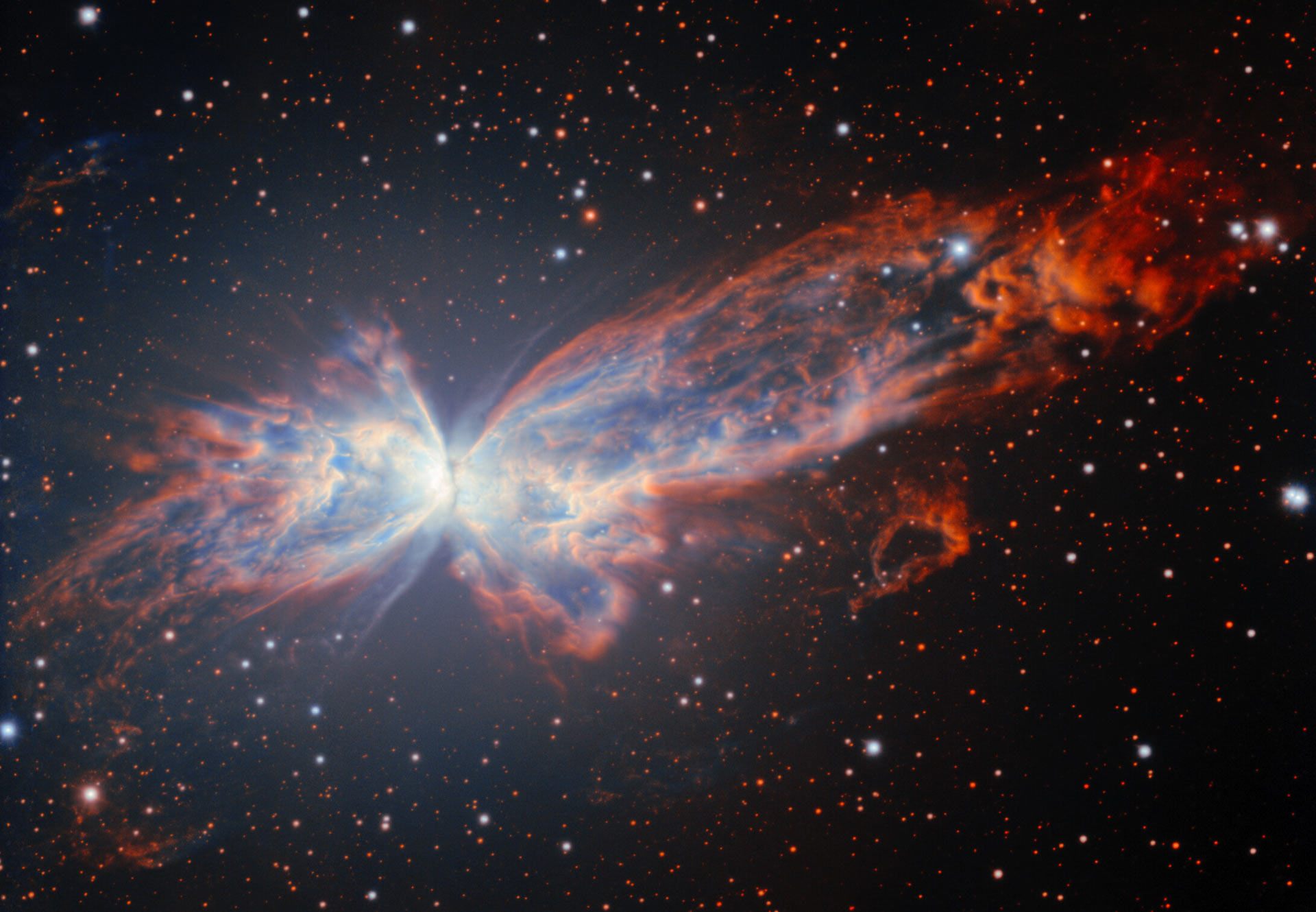
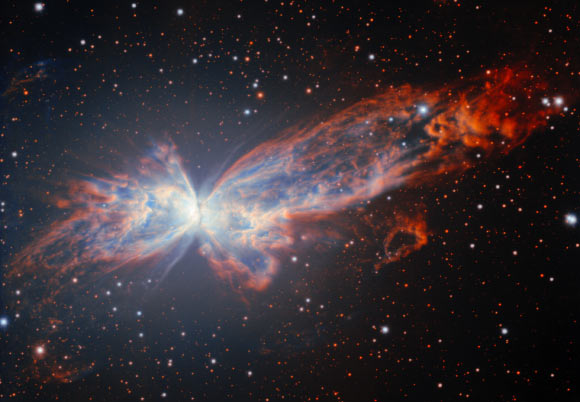
This image, captured by the Gemini South telescope, shows the planetary nebula NGC 6302. Image credit: International Gemini Observatory / NOIRLab / NSF / AURA / J. Miller & M. Rodriguez, International Gemini Observatory & NSF’s NOIRLab / T.A. Rector, University of Alaska Anchorage & NSF’s NOIRLab / M. Zamani, NSF’s NOIRLab.
NGC 6302 is a celestial formation, specifically a planetary nebula, situated approximately 2,417 light-years distant within the constellation of Scorpius.
“A planetary nebula is a classification of emission nebula characterized by a massive star nearing the end of its stellar lifecycle, which expels matter, thereby creating an expanding, luminous envelope of ionized gas,” stated representatives from the International Gemini Observatory.
“These visually striking structures commonly exhibit a spherical form reminiscent of planets, a characteristic that led early observers to dub them ‘planetary nebulae’ when viewed through early telescopic instruments.”
While historical records present varied dates for the initial observation of NGC 6302, scholarly consensus generally attributes a foundational 1907 study by American astronomer Edward E. Barnard, although the Scottish astronomer James Dunlop might have first documented it as early as 1826.
The nebula displays an intricate, extreme bipolar structure, accompanied by the presence of highly excited gases, a substantial molecular mass, and crystalline silicate dust.
Its distinctive butterfly-like expanse extends over two light-years, a distance roughly equivalent to half the separation between our Sun and Proxima Centauri.
“The luminous ‘wings’ of the Butterfly Nebula appear to be erupting from the interstellar medium in the recent photograph acquired by the Gemini South telescope,” commented the observatory’s spokespersons.
“This visually captivating celestial object was designated as a target for the 8.1-meter telescope through a selection process involving students in Chile, as part of the Gemini First Light Anniversary Image Contest.”
“This competition aimed to involve students from the regions hosting the Gemini telescopes in celebrating the enduring impact and achievements of the International Gemini Observatory since its inauguration, marked by the Gemini South’s initial light capture in November of the year 2000.”
In 2009, astronomical researchers utilized the Wide Field Camera 3 aboard NASA/ESA’s Hubble Space Telescope to identify the central star of NGC 6302 as a white dwarf. This star had previously ejected its outer envelopes more than two millennia ago and currently possesses a mass approximately two-thirds that of our Sun.
This stellar remnant ranks among the hottest known celestial bodies, boasting a surface temperature exceeding 250,000 degrees Celsius (or 450,000 degrees Fahrenheit), suggesting its progenitor star was of considerable size.
Subsequent investigations into NGC 6302 have illuminated a remarkable evolutionary pathway.
Prior to its transformation into a white dwarf, the star existed as a red giant, with a diameter estimated to be about 1,000 times that of the Sun.
This colossal star shed its external gaseous layers, which subsequently propagated outward from its equatorial region at a comparatively measured velocity, forming the dark, toroidal band that remains discernible surrounding the star.
Additional matter was expelled perpendicularly to this band, a phenomenon that constrained the subsequent outflows and ultimately sculpted the bipolar configuration observed presently.
As the star proceeded through its evolutionary stages, it unleashed a potent surge of stellar wind, which violently traversed the nebula’s ‘wings’ at velocities surpassing 3 million kilometers per hour (equivalent to 1.8 million miles per hour).
The interplay between the slower-moving and faster-moving gaseous streams further sculpted the ‘wings,’ creating expansive vistas characterized by undulating ridges and towering pillars.
Currently, in its state as a white dwarf, the star is emitting intense radiation that is heating the ‘wings’ of NGC 6302 to temperatures exceeding 20,000 degrees Celsius (approximately 35,000 degrees Fahrenheit), inducing luminescence in the surrounding gas.
“The deep crimson hues evident in the imagery signify regions of energized hydrogen gas, whereas the stark azure tones represent areas of stimulated oxygen gas,” explained the scientific team.
“This ejected material, in conjunction with other elements identified within NGC 6302 by scientists, including nitrogen, sulfur, and iron, will play a role in the formation of subsequent stellar and planetary generations.”