
A perplexing phenomenon was detailed in a contentious study from last April, wherein investigators documented an extraordinary occurrence: a stand of Norway spruce trees (Picea abies) seemingly synchronized their electrical transmissions in anticipation of a partial solar eclipse.
A new hypothesis has now emerged concerning the true nature of these events.
Having meticulously scrutinized the gathered data, ecological scientists Ariel Novoplansky and Hezi Yizhaq from Ben-Gurion University of the Negev in Israel have put forth an explanation that carries less sensational implications.
Novoplansky and Yizhaq posit that the observed electrical fluctuations in the trees were attributable to a decline in ambient temperature, the passage of a thunderstorm, and multiple localized lightning occurrences; these are factors that prior investigations have demonstrated can precipitate analogous signaling responses within flora.
“To my mind, [the preceding research] exemplifies the infiltration of speculative science into the core of biological investigation,” stated Novoplansky.
“Rather than contemplating more straightforward, well-substantiated environmental influences, such as a severe rainstorm and a proximity of electrical discharges, the authors gravitated towards the more alluring notion that the trees were prefiguring the imminent solar eclipse.”
In October of 2022, a woodland situated in the Dolomite mountains of northeastern Italy exhibited what scientific observers described as “discrete and collective bioelectrical reactions to a solar eclipse,” with elder trees displaying more pronounced signaling before and throughout the celestial event.
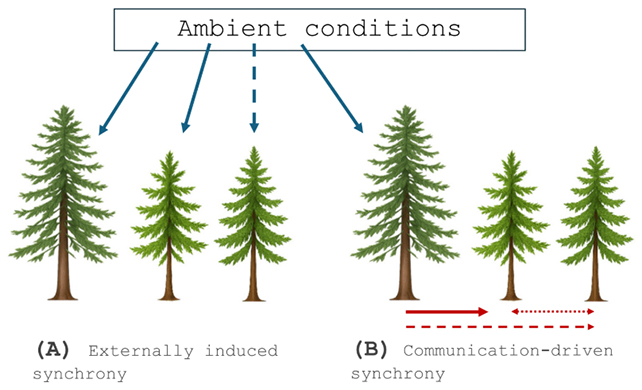
The observed activity, according to the aforementioned scientists, may have represented a mechanism by which the older trees’ accumulated experience of past occurrences was conveyed to the wider forest ecosystem. Consistent with earlier scientific explorations, they proposed that the spruce specimens were discerning an impending environmental shift and orchestrating a collective response, in this instance, to a solar eclipse.
Novoplansky and Yizhaq, in their recent publication, argue against this interpretation. They propose that the environmental alteration was far more probably a consequence of the thunderstorm, furnishing several lines of reasoning as to why the original research cadre arrived at an erroneous conclusion.
Firstly, solar eclipses are characterized by their unique trajectories, intensities, and durations, rendering it improbable that older trees could leverage “recalled” knowledge to predict subsequent events.
Secondly, any associated gravitational perturbations that might have served as a preliminary indicator would have been exceedingly marginal, approximating the magnitude of variations observed during a new moon phase.
Furthermore, it is argued that there was no compelling necessity for the trees to collectively prepare for the solar eclipse. The event was only partial, with the ensuing reduction in illumination being akin to that experienced on an overcast day, thereby posing no significant disruption to photosynthetic processes or other vital functions.
“The eclipse occasioned a diminution of light by approximately 10.5 percent for a brief two-hour interval, during which time the intensity of solar radiation was roughly double what the trees could effectively utilize,” opined Novoplansky.
“Frequent variations in cloud cover at the experimental site alter the quality and quantum of light by considerably greater amplitudes.”
The researchers highlight that the initial investigation encompassed merely three trees and five stumps, indicating a rather limited scope of data acquisition from the entire forest. The measurements obtained in the preliminary study were more plausibly the result of individual trees reacting to lightning strikes rather than a coordinated collective response from the forest community, contend Novoplansky and Yizhaq.
Flora have historically been observed to “anticipate” environmental shifts, for instance, by initiating drought preparedness strategies when early soil indicators suggest arid conditions. Therefore, the concept of a forest anticipating a solar eclipse is not entirely without empirical grounding.
However, this proposition falters on multiple fronts, as elucidated by Novoplansky and Yizhaq.
Ongoing research into plant electromes (the flow of charged molecules through their cellular structures) continues. While this specific arboreal incident has generated debate, it is undeniable that further intriguing discoveries await in this nascent scientific domain.
“The electrical phenomena observed in trees represent a genuine occurrence, yet it remains an area of nascent scientific inquiry,” commented Novoplansky. “The notion that variations in electrical signals, detectable even in desiccated wood, might encapsulate memory, foresight, or collective reactivity necessitates several significant conceptual leaps, none of which were substantiated by the study in question.”
“The natural world of the forest is sufficiently awe-inspiring without the fabrication of unwarranted, yet superficially remarkable, assertions of anticipatory responsiveness or communication predicated solely on correlational evidence.”