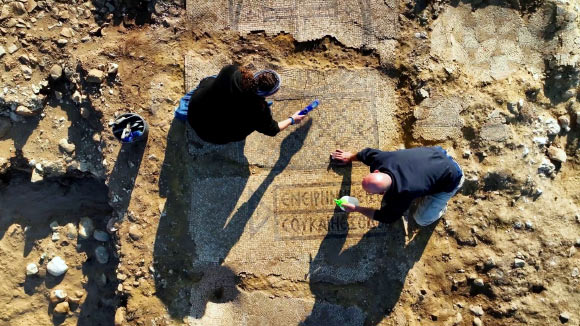
An significant Byzantine-era monastic complex, complete with an intricately designed mosaic floor bearing a Greek inscription, an ancient wine-making facility, and associated structures, has been unearthed by archaeologists affiliated with the Israel Antiquities Authority (IAA) near Kiryat Gat, Israel.

IAA archaeologists cleaning the ancient mosaic of a Byzantine-period monastery at Kiryat Gat, Israel. Image credit: Emil Aladjem, Israel Antiquities Authority.
According to a joint statement released by IAA excavators Shira Lifshitz and Maayan Margulis, this archaeological discovery represents the most extensive and noteworthy site from the Roman and Byzantine eras documented within the region to date.
“Blessed shall you be when you come in, and blessed shall you be when you go out (Deuteronomy 20:6).” This biblical passage was inscribed upon a vibrantly colored floor within a monastery that was brought to light during a substantial excavation project. The work was undertaken in anticipation of the development of a new residential area situated to the north of the contemporary city of Kiryat Gat.
The archaeological team meticulously uncovered the remnants of a minimum of ten distinct edifices. These included the aforementioned monastery, the wine press, and a substantial warehouse structure.
“The monastery itself dates back to the Byzantine period, specifically the 5th to 6th centuries CE. It forms part of a larger ancient settlement that was in existence as early as the Roman period and maintained its presence for approximately six centuries,” the excavators elaborated.
“The monastic site and its immediate vicinity yielded a considerable volume of imported ceramics, coinage, marble architectural elements, and artifacts made from metal and glass. These findings collectively testify to the presence of a prosperous and prominent community that inhabited this location.”
“The mosaic floor of the monastery is adorned with decorative motifs, including crosses, depictions of lions and doves, an amphora (a type of ancient ceramic jar used for shipping), floral designs, and various geometric patterns.”
Further investigations by the team revealed a sophisticated winepress installation, which underwent multiple construction and repair phases throughout its operational lifespan.
The mosaic pavements within the fermentation chambers and the collecting vat were constructed using stones of blue and white hues.
The floor of the northern collecting vat is composed of stone slabs, some of which still bear inscribed Greek letters. These inscriptions likely served as guiding marks for the stonemasons involved in constructing the winepress.
Collectively, these architectural and decorative elements strongly suggest that the establishment and ongoing development of this wine production facility required substantial financial investment, considerable time, and a diverse array of skilled labor and effort.
“The early settlement was strategically positioned at a key road junction, facilitating connections between the mountainous interior and the coastal plains,” the researchers noted.
“It likely served both the smaller settlements in the surrounding area and transient travelers passing through.”
“This emerging discovery stands as the most extensive and significant Roman and Byzantine period site identified in this particular geographical area.”
“The evidence uncovered points to a continuous sequence of habitation, commencing in the early Roman period (1st century CE) and extending through to the conclusion of the Byzantine era (late 6th century CE).”