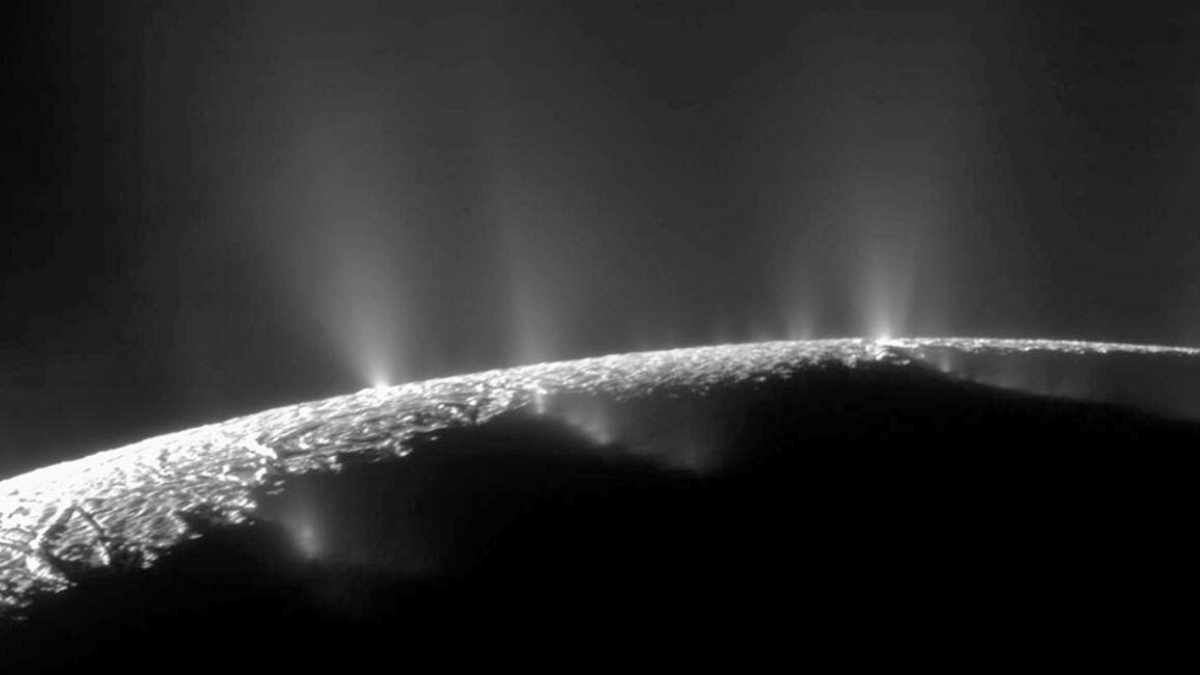
Despite its modest diameter of merely 500 kilometers, a dimension that would permit it to reside comfortably within the geographical confines of the United Kingdom with ample room to spare, Saturn’s sixth-largest satellite possesses a remarkable capability.
New scientific investigations have unveiled that this diminutive celestial body comprised of ice exerts a significant electromagnetic influence extending over distances surpassing half a million kilometers, a span considerably greater than the separation between Earth and its Moon.
This groundbreaking revelation stems from an exhaustive appraisal of observational data meticulously gathered by the Cassini spacecraft over the course of its 13-year sojourn within Saturn’s vicinity.
An international consortium, under the scientific direction of Lina Hadid from France’s Laboratoire de Physique de Plasmas, undertook a thorough examination of four distinct instruments aboard Cassini. Their objective was to elucidate the precise mechanisms through which Enceladus’s well-known aqueous geysers generate widespread electromagnetic repercussions.
Through fissures present in the icy crust of its southern hemisphere, Enceladus expels prodigious quantities of water vapor and particulate matter. Upon encountering the radiative environment of Saturn, these water molecules undergo ionization, thereby coalescing into a plasma that profoundly interacts with the magnetosphere of the colossal planet and propagates outward from the moon.
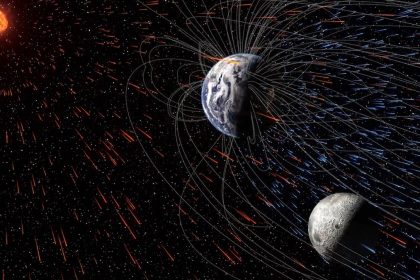
This intricate interplay engenders phenomena designated as Alfvén wings. These are essentially electromagnetic undulations that propagate in a manner analogous to the resonant vibrations of a taut string, meticulously following the magnetic field lines that form a conduit between Enceladus and Saturn’s polar regions.
The extraordinary nature of this discovery lies in the sheer magnitude and sophisticated architecture of the observed system. The principal Alfvén wing does not simply traverse its path to Saturn and dissipate. On the contrary, it undergoes repeated reflections, oscillating between Saturn’s ionosphere at the planet’s poles and the toroidal plasma cloud that envelops Enceladus’s orbital path.
Each successive reflection acts as a catalyst for the generation of secondary waves, culminating in the formation of an elaborate, lattice-like network of intersecting electromagnetic structures. These structures permeate Saturn’s equatorial plane and extend their influence to the northern and southern high latitudes.
On no fewer than 36 distinct occasions throughout Cassini’s operational tenure, the spacecraft registered the telltale signatures of these waves at distances that far exceeded the initial projections of the research community.
The research team quantified the extent of these Alfvén wave signatures, determining they stretched over 504,000 kilometers from Enceladus, a distance exceeding the moon’s radius by more than 2,000-fold. To provide a relatable perspective, this expanse approximates the round-trip journey from London to Sydney.
“This represents the inaugural instance wherein such a far-reaching electromagnetic influence attributed to Enceladus has been documented,” stated Thomas Chust of LPP, a co-author of the study.
“These findings unequivocally demonstrate that this comparatively small moon functions as a potent generator of planetary-scale Alfvén waves, orchestrating the circulation of energy and momentum throughout Saturn’s encompassing magnetospheric domain.”
Furthermore, the investigation brought to light intricate details within the structure of the primary Alfvén wing. Turbulent processes fragment the waves into distinct filaments, thereby facilitating their efficient reflection off Enceladus’s plasma torus and their eventual propagation to the elevated latitudes within Saturn’s ionosphere, where associated auroral displays originate.
This remarkable electromagnetic synergy between Enceladus and its colossal host planet offers a valuable paradigm for comprehending analogous systems surrounding Jupiter’s icy satellites, namely Europa, Ganymede, and Callisto, and potentially extends to exoplanets that harbor magnetically active moons.
Consequently, this research underscores critical scientific objectives for forthcoming exploration endeavors. These include the European Space Agency’s planned Enceladus orbiter and lander mission, slated for the 2040s, which is intended to be equipped with instrumentation capable of undertaking an unprecedentedly detailed examination of these electromagnetic phenomena.
This piece was originally disseminated by Universe Today. The original publication can be accessed here.