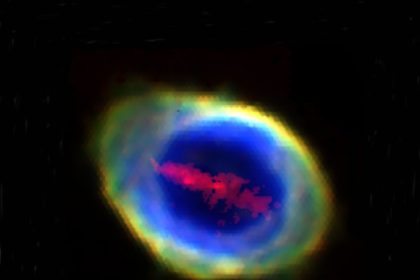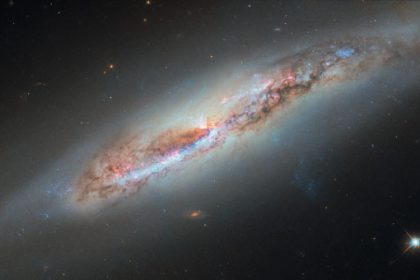
Messier 77, an eminent and accessible bright spiral galaxy, harbors a supermassive black hole at its core.

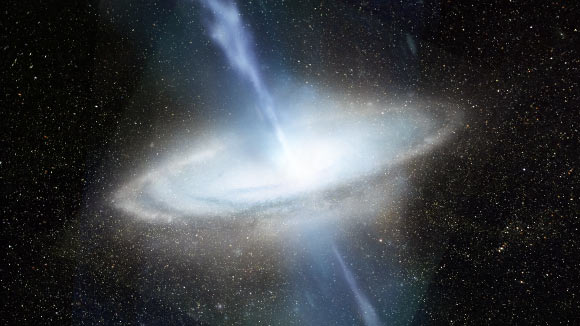
An artist’s concept of Messier 77, featuring its powerful black hole and accretion disk, and never before seen polarization in water masers outside of our Milky Way Galaxy. Image credit: NSF / AUI / NRAO / S. Dagnello.
Situated 62 million light-years distant within the Cetus constellation, Messier 77 is recognized as a barred spiral galaxy.
Known by various designations including NGC 1068, LEDA 10266, and Cetus A, this celestial object exhibits an apparent magnitude of 9.6.
The initial discovery of Messier 77 was made in 1780 by French astronomer Pierre Méchain, who initially classified it as a nebula. Subsequently, Méchain conveyed this finding to his colleague, fellow French astronomer Charles Messier.
While Messier initially surmised that the intensely radiant entity was a stellar cluster, advancements in astronomical instrumentation later confirmed its true nature as a galaxy.
Spanning an impressive 100,000 light-years, Messier 77 ranks among the most substantial galaxies cataloged by Messier, with its gravitational influence noticeably distorting and deforming neighboring galaxies.
Furthermore, it is counted among the nearest galaxies possessing an active galactic nucleus (AGN).
Such active galaxies represent some of the most luminous phenomena in the universe, emitting radiation across nearly the entire electromagnetic spectrum, from gamma rays and X-rays to microwaves and radio waves.
Notwithstanding its prominence as a favored subject for astronomical observation, Messier 77’s accretion disk remains largely obscured by dense formations of cosmic dust and gas.
The outer accretion disk, several light-years in diameter, is punctuated by hundreds of identifiable water maser sources, which for decades have provided clues about deeper structural elements.
Masers are distinct emitters of electromagnetic radiation within the microwave and radio frequency bands. In radio astronomy, water masers detected at a frequency of 22 GHz are particularly valuable, as they can penetrate the substantial dust and gas that impedes optical wavelengths.
Jack Gallimore, an astronomer at Bucknell University, along with his research team, undertook observations of Messier 77 with two primary objectives: to create an astrometric map of the galaxy’s radio continuum and to measure the polarization of its water masers.
“Messier 77 holds a somewhat esteemed position among active galaxies,” remarked Dr. C.M. Violette Impellizzeri, an astronomer affiliated with Leiden Observatory.
“It is exceptionally energetic, featuring a black hole and an accretion disk oriented edge-on. Its proximity has facilitated exceptionally detailed and thorough study.”
However, the researchers investigated Messier 77 through an entirely novel approach.
Their observational campaign leveraged the recently enhanced High Sensitivity Array (HSA), comprising the National Science Foundation’s National Radio Astronomy Observatory (NRAO) telescopes, including the Karl G. Jansky Very Large Array, the Very Long Baseline Array, and the Green Bank Telescope.
By analyzing the polarization of water masers and the continuum of radio emissions emanating from Messier 77, they successfully generated a visual representation that not only delineated the compact radio source now identified as NGC 1068* but also revealed enigmatic extended regions of fainter emissions.
The astrometric mapping of the galaxy and its water masers indicated an arrangement along filamentous structures.
“These new observations unequivocally demonstrated that these filaments of maser locations are arranged sequentially, much like beads on a string,” stated Dr. Gallimore.
“We were astonished to observe a distinct offset—an angular displacement—between the radio continuum that maps the structures within the galaxy’s core and the precise positions of the masers themselves.”
“The observed configuration suggests inherent instability, pointing towards the origin of a magnetically driven outflow.”
HSA measurements of the polarization within these water masers provided compelling evidence for the presence of magnetic fields.
“Prior to this, polarization in water masers had not been detected beyond our own Milky Way Galaxy,” Dr. Gallimore noted.
“Analogous to the looping structures observed on the Sun’s surface, such as prominences, the polarization pattern exhibited by these water masers strongly suggests that magnetic fields are also the underlying force behind these structures extending over light-year scales.”
“Examining the filaments and observing that the polarization vectors are oriented perpendicularly to them served as the crucial confirmation that these are indeed magnetically driven structures, precisely as predicted.”
Prior research in the area had hinted at patterns often associated with magnetic fields, but definitive conclusions remained unattainable with the observational technologies available until recently.
The compiled findings present evidence of a concentrated central radio source (attributed to the galaxy’s supermassive black hole), clear polarization in the water masers indicating internal structure within Messier 77’s magnetic fields, and remarkable extended features across the radio frequency spectrum.
Collectively, these discoveries strongly imply that magnetic fields are the fundamental driving mechanisms behind these observed phenomena.
Nevertheless, a multitude of unanswered questions persist. For instance, within the radio continuum map, a diffuse, faint projection, which the research team has colloquially dubbed the “foxtail,” extends northward from the central region.
“Our initial intention when embarking on this endeavor was to ‘push the limits and obtain both high-quality continuum and polarization data.’ Fortunately, we succeeded in achieving both objectives,” Dr. Gallimore explained.
“Through the NSF NRAO High Sensitivity Array, we achieved the first-ever detection of water megamaser polarization, and we also produced an extraordinary continuum map that continues to intrigue and challenge our understanding.”
A scholarly publication detailing these outcomes was released today in the Astrophysical Journal Letters.
_____
Jack F. Gallimore et al. 2024. The Discovery of Polarized Water Vapor Megamaser Emission in a Molecular Accretion Disk. ApJL 975, L9; doi: 10.3847/2041-8213/ad864f