Located approximately 60 kilometers south of the historic Egyptian capital of Luxor, the town of Esna holds significant archaeological importance.

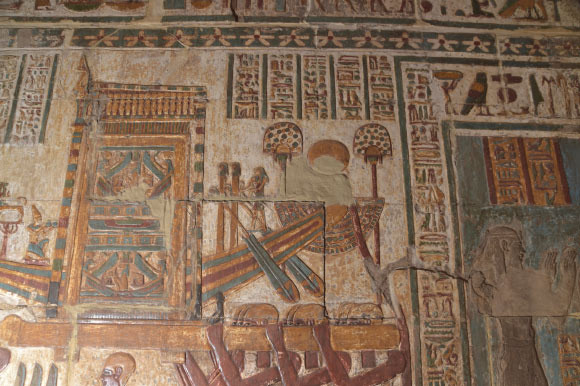
The holy barque with the shrine of Khnoum, the main deity of Esna, carried by several priests. Image credit: Ahmed Amin / Ministry of Tourism and Antiquities.
The temple of Esna, consecrated to the ancient Egyptian deity Khnum, stands as one of the final extant examples of classical Egyptian temple construction.
Remarkably, only the vestibule, known by the term pronaos, of the original temple complex has endured. This preservation is largely attributed to its repurposing as a cotton storage facility throughout the 19th century Common Era.
This majestic edifice spans 37 meters in length, 20 meters in width, and stands 15 meters high. Its decoration primarily dates to the Roman period, specifically between the 1st and 3rd centuries Common Era.
Professor Christian Leitz of the Institute of Ancient Near Eastern Studies at the University of Tübingen, along with his research collaborators, articulated in a published statement, “The pronaos of the Esna temple is a sandstone edifice constructed in front of the actual temple structure, either preceding or during the rule of Roman Emperor Claudius (41-54 CE). It was likely considerably more expansive than the temple itself.”
The statement further elaborated, “Its placement within the heart of the urban center likely played a crucial role in its preservation, preventing its use as a source of building materials, a fate that befell many other ancient structures during Egypt’s industrialization.”
“For a span of over 1,800 years,” they noted, “fires were actively maintained within the temple vestibule by local inhabitants.”
“Consequently,” the researchers observed, “the once vibrant hues of the wall and column embellishments became obscured by soot.”
“Over the course of the past six years, a dedicated contingent of up to 30 Egyptian archaeologists has meticulously revealed the original colors of the celestial imagery adorning the entirety of the ceiling, as well as the vibrant pigments on the 18 interior columns.”
“A new phase of meticulous restoration commenced this year. Specialists have successfully completed the revitalization of the southern interior wall and the southern section of the western rear wall.”
“These efforts have brought to light the original color palettes, characterized by dominant yellow and red pigments, presenting a striking contrast to the chromatic schemes observed elsewhere, such as at the temple of Dendara, where white and light blue tones are predominantly featured.”

The king’s apron with plant decoration: the papyrus (top) is the emblem of Lower Egypt and the lily (bottom) the emblem of Upper Egypt. Image credit: Ahmed Amin / Ministry of Tourism and Antiquities.
The most significant findings of this year’s fieldwork by the team included intricate details concerning the attire of the pharaoh and the deities of Esna, their regal crowns, and their ceremonial thrones.
Professor Leitz commented, “Previously, these intricate details were entirely imperceptible due to the thick accumulation of soot obscuring the reliefs.”
“All of these painted embellishments constitute an intrinsic component of the offering rituals vividly depicted on the interior walls of the temple.
“While the hieroglyphic inscriptions and the sculpted reliefs were known, the recently unveiled decorations on the throne imagery possess their own distinct significance.”
“In one tableau illustrating the presentation of a bow and arrow to the goddess Neith, our conservation specialists uncovered four painted bows at the base of the throne, potentially representing a portion of an original set of nine bows—a symbolic reference to the ‘nine bows’ signifying both Upper and Lower Egypt, along with seven additional territories under the dominion of the Egyptian sovereign.”
“Another illustrative example is the pharaoh’s apron depicted within one of the ceremonial offering scenes.
“This garment is adorned with two botanical motifs: the papyrus plant (positioned above) serves as the heraldic symbol of Lower Egypt, while the lily (positioned below) represents Upper Egypt, thereby symbolizing the pharaoh’s authority over both regions of the country.”
“Perhaps the most visually striking depiction portrays the sacred barque of the local deity Khnoum, bearing the god’s shrine.”
“This vessel is borne aloft by numerous priests who are escorting it from the temple’s innermost sanctum in a solemn procession. This arrangement allowed the populace of Esna to glimpse the closed shrine of the god on special occasions.
“For the remainder of the year, it remained concealed within the temple, accessible only to the priestly class.”