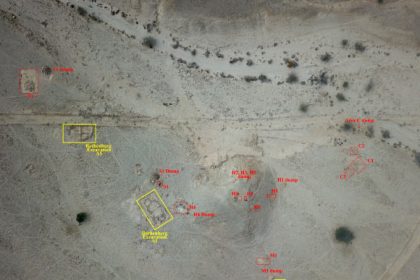
The advent of sophisticated technological advancements in both Africa and Western Europe during the latter stages of the Middle Pleistocene epoch serves as a compelling indicator of the behavioral sophistication exhibited by hominin populations. Concurrently, it has been a long-standing perspective that hominin technological developments in East Asia were characterized by a lack of innovation and refinement. However, archaeological investigations at the Xigou site, situated in China’s Henan province and dating back to the period between 160,000 and 72,000 years ago, have yielded compelling evidence that refutes this notion. Comprehensive analyses encompassing technological, typological, and functional aspects of the recovered artifacts reveal the consistent application of advanced technological behaviors over a span exceeding 90,000 years.
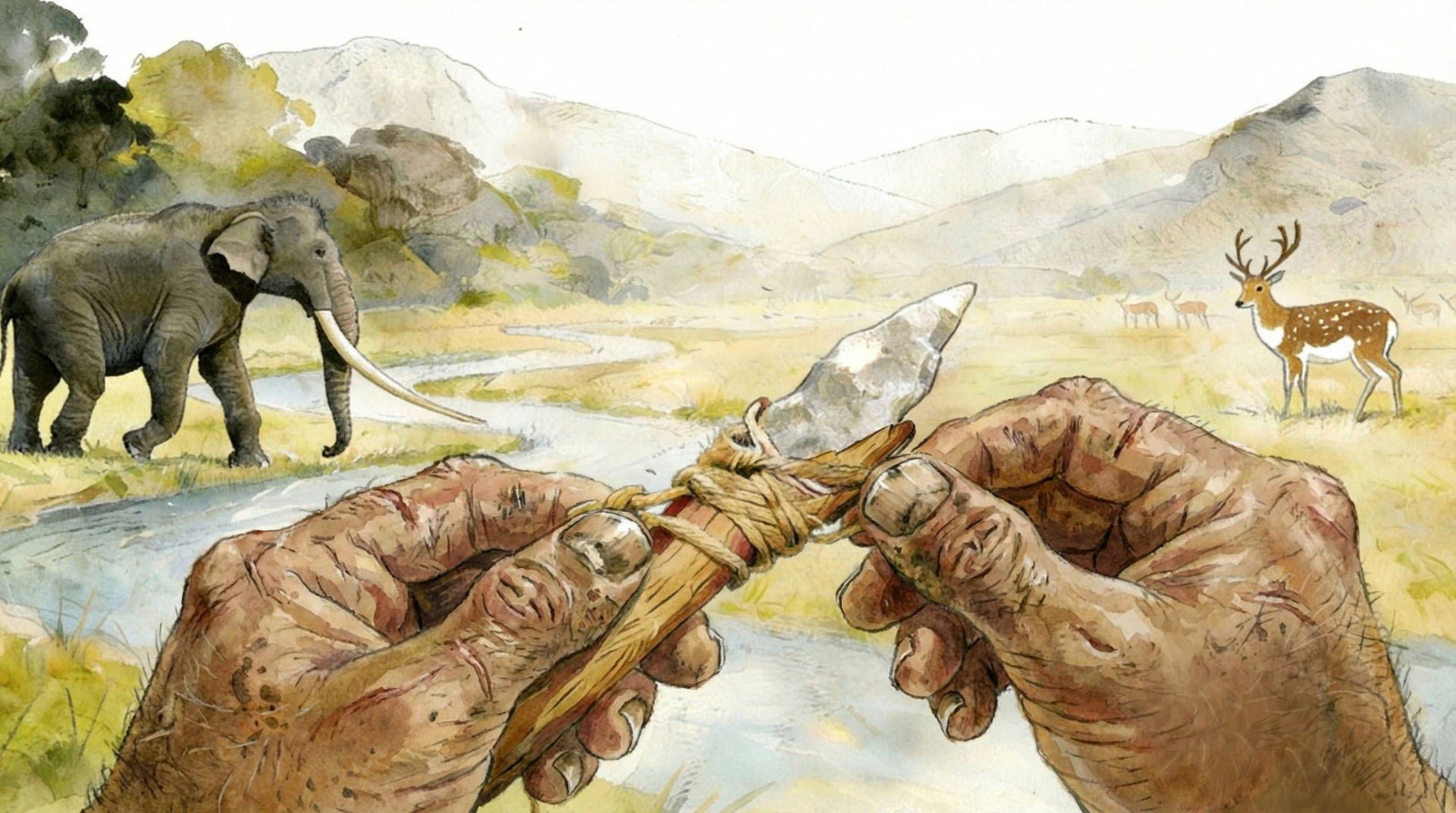
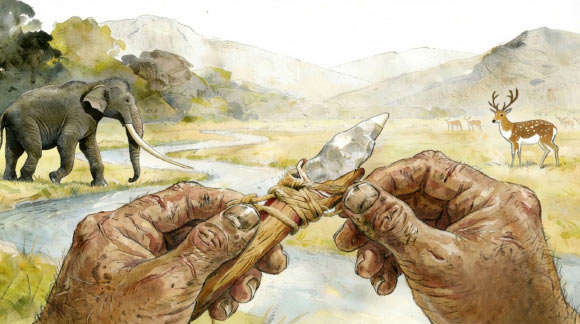
Artist’s reconstruction of Xigou tool-hafting. Image credit: Hulk Yuan, IVPP.
“For many decades, scholarly discourse has maintained that while hominins residing in Africa and Western Europe displayed substantial technological progress, those in East Asia adhered to more rudimentary and conservative stone-tool traditions,” stated Dr. Shixia Yang, a researcher affiliated with the Institute of Vertebrate Paleontology and Paleoanthropology.
In the course of this recent investigation, Dr. Yang and her collaborators have demonstrated that hominins inhabiting this geographical region exhibited a far greater degree of inventiveness and adaptability than was previously hypothesized. This innovation occurred during a period when several large-brained hominin species, including Homo longi and Homo juluensis, and potentially Homo sapiens, were present in China.
“The discoveries made at Xigou fundamentally challenge the established narrative suggesting that early humans in China remained technologically conservative throughout this extended timeframe,” remarked Professor Michael Petraglia of Griffith University.
“An in-depth examination of the findings from the Xigou site indicates that its hominin inhabitants engaged in highly sophisticated methods of stone tool production, resulting in the creation of small flakes and implements designed for a wide spectrum of activities.”
Among the most significant discoveries unearthed was evidence of hafted stone tools. This represents the earliest known indication of composite tool technology within East Asia.
These implements were constructed by combining stone components with handles or shafts, thereby signifying a capacity for intricate planning, proficient craftsmanship, and a nuanced understanding of how to augment the efficacy of tools.
“The existence of such tools strongly suggests that the hominins at Xigou possessed a considerable level of behavioral flexibility and innate ingenuity,” asserted Dr. Jian-Ping Yue, who is also associated with the Institute of Vertebrate Paleontology and Paleoanthropology.
The site’s stratigraphy, which spans a period of 90,000 years, aligns with an ever-increasing body of evidence pointing to heightened hominin diversity within China.
The identification of large-brained hominins at sites like Xujiayao and Lingjing, sometimes categorized as Homo juluensis, offers a potential biological framework for understanding the behavioral complexity reflected in the tool assemblages recovered from Xigou.
“It is highly probable that the technological strategies evident in the stone tools played a pivotal role in facilitating the adaptation of hominin populations to the dynamically changing environmental conditions that characterized the 90,000-year span in East Asia,” Professor Petraglia elaborated.
The findings from Xigou have fundamentally altered our comprehension of human evolution in East Asia, demonstrating that early populations possessed cognitive and technical capabilities on par with their counterparts in Africa and Europe.
“Emerging evidence from Xigou and other archaeological locations indicates that early technological practices in China encompassed prepared-core techniques, innovative retouched tools, and even substantial cutting implements, collectively painting a picture of a more abundant and intricate technological landscape than was previously acknowledged,” Dr. Yang concluded.
The research conducted by the team has been published today in the esteemed journal Nature Communications.
_____
JP. Yue et al. 2026. Technological innovations and hafted technology in central China ~160,000-72,000 years ago. Nat Commun 17, 615; doi: 10.1038/s41467-025-67601-y