The standard medical intervention employed to re-establish cerebral blood flow in stroke patients, while lifesaving, concurrently risks inflicting further harm—a consequence that a novel injectable nanomaterial is engineered to mitigate.
This regenerative agent, abbreviated as IKVAV-PA, originated from research conducted at Northwestern University in the United States. Its efficacy in facilitating tissue regeneration was previously demonstrated in a murine model of spinal cord injuries. In this latest investigation, its performance was evaluated within a mouse model simulating acute ischemic stroke, which represents the predominant subtype of cerebrovascular incidents.
Central to this therapeutic approach are supramolecular therapeutic peptides (STPs), colloquially termed ‘dancing molecules’ due to the inherent dynamism of their constituent biological segments. This characteristic enhances their adaptability and responsiveness when engaging with target cells.
A further significant advancement in this research was the implementation of systemic administration, involving the introduction of these molecules into the circulatory system via injection. This method offers rapid and straightforward application, proving considerably less intrusive than direct cerebral delivery.
“This systemic delivery methodology, coupled with its capacity to traverse the blood-brain barrier, constitutes a substantial step forward, potentially benefiting the treatment of traumatic brain injuries and neurodegenerative disorders such as amyotrophic lateral sclerosis,” states materials scientist Samuel Stupp.
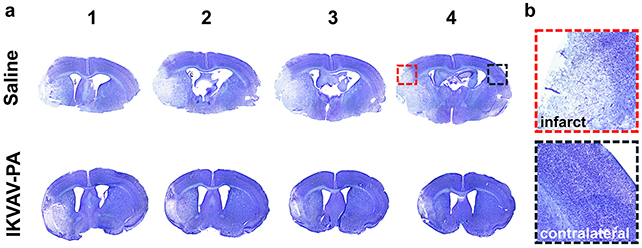
During the experimental phase with mice, the initial objective was successfully achieved: facilitating the compound’s entry into the brain via the bloodstream. Furthermore, adverse reactions and widespread systemic disruption appeared to be negligible, suggesting the therapy effectively targeted the infarction site.
In comparison to control subjects that did not receive the intervention, mice administered the injectable biomaterial subsequent to the restoration of cerebral circulation displayed reduced neural tissue impairment, attenuated inflammatory markers, and a decrease in detrimental immunological responses.
The primary function of IKVAV-PA is to stimulate the self-repair mechanisms of neurons following an injury, while simultaneously suppressing inflammation. This inflammatory response poses a significant risk, as the organism continues to react to the initial cessation of blood flow.
“An accumulation of deleterious compounds occurs during the period of occlusion, and their subsequent release into the bloodstream upon clot removal can precipitate additional injury,” remarks Stupp. “However, the ‘dancing molecules’ possess inherent anti-inflammatory properties that serve to counteract these effects, while also aiding in the regeneration of neural pathways.”
Managing patients in the post-stroke phase presents a highly critical equilibrium. Following the obstruction of cerebral blood flow by clots, which precipitates a stroke, re-establishing circulation is paramount. Nevertheless, this process can be accompanied by collateral damage and even enduring functional deficits.
With continued research and refinement, this could evolve into an adjunctive therapy, administered in conjunction with reperfusion strategies. Naturally, comprehensive human trials are requisite, extending over extended durations to ascertain its long-term safety profile and clinical viability.
Millions worldwide are impacted by cerebrovascular events annually. While survival rates are relatively favorable, a substantial number of fatalities persist each year, with many more individuals grappling with disabling consequences. IKVAV-PA holds the potential to positively influence these statistics.
“This imposes not only a profound personal and emotional burden on affected individuals but also a considerable financial strain on their families and communities,” notes neuroscientist Ayush Batra. “Mitigating this level of disability through a therapeutic modality capable of potentially restoring function and minimizing damage would yield a significant and lasting positive impact.”