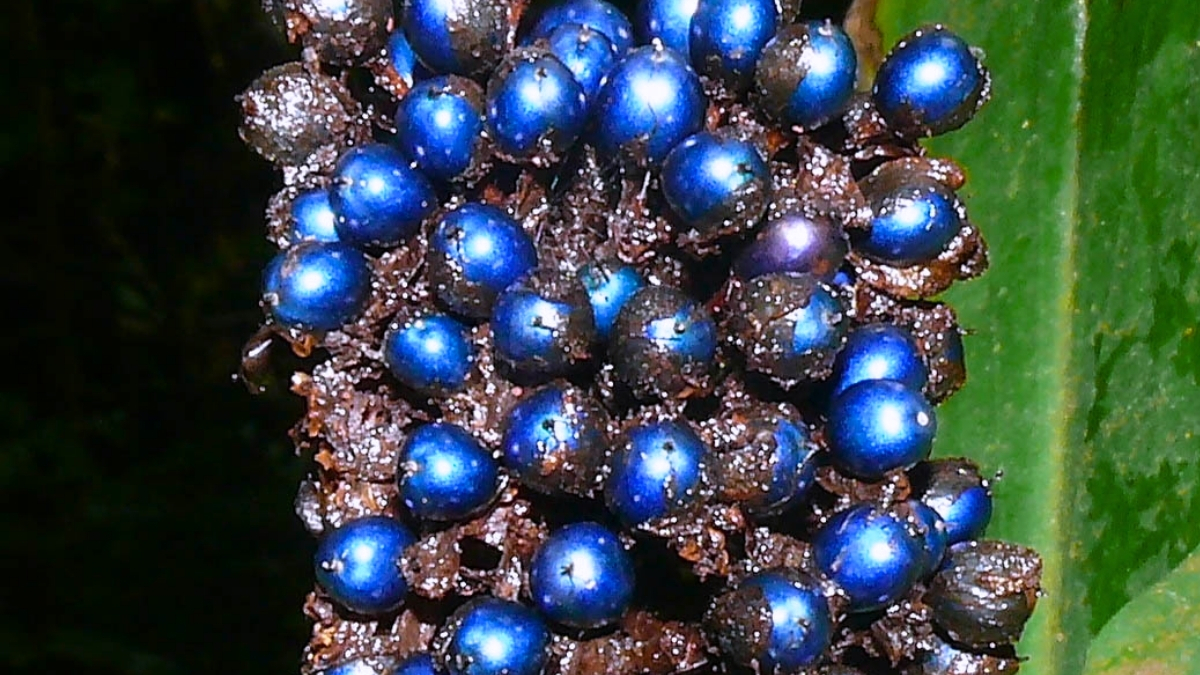
The botanical fruit derived from Africa’s marble berry (Pollia condensata) presents itself as an unparalleled living jewel, exhibiting a breathtaking metallic azure luminescence that remains remarkably enduring.
Contrary to conventional understanding of color, these berries do not achieve their striking hue through the presence of any discernible blue pigment. Instead, their captivating coloration is a sophisticated visual phenomenon, a marvel of optical engineering that is only revealed upon meticulous microscopic examination of the fruit’s cellular structure.
A dedicated cohort of researchers, spearheaded by investigators from the esteemed University of Cambridge in the United Kingdom, undertook precisely this rigorous analysis to elucidate the mechanism behind the marble-like berry’s distinctive visual appeal.
The spectrum of colors perceptible in our environment is typically a consequence of subtractive color mixing. Here, substances absorb specific wavelengths from incident white light, with the remaining wavelengths dictating the object’s perceived color.
Conversely, this particular fruit leverages an ingenious application of structural coloration. Microscopic fibers, meticulously arranged within the outer cellular membranes, form a specialized helical architecture. This precise configuration prompts light waves to interact and interfere with one another.
This intricate, stratified arrangement results in the constructive and destructive interference of light waves. Certain wavelengths are effectively nullified, while others are amplified, thereby generating a unique opalescent effect within specific portions of the light spectrum. In this specific instance, wavelengths corresponding to blue light are predominantly reflected.
“The vibrant azure coloration of this fruit surpasses the intensity observed in numerous previously documented biological materials,” state the scientists in their publication.
“This represents the highest reported light reflectivity among terrestrial biological organisms, encompassing insect exoskeletons, avian plumage, and the famously brilliant scales of the Morpho butterfly.”
While manifestations of structural coloration are prevalent throughout the natural world, their occurrence in fruits is relatively uncommon. A parallel optical phenomenon can be observed in the fruiting bodies of the Elaeocarpus angustifolius tree, although its lustrous quality is less pronounced.
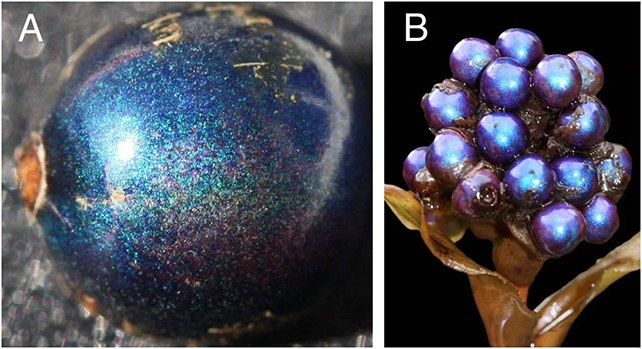
In comparison to the light reflected from a polished silver surface, the marble berry exhibits an unusually high reflectivity of 30 percent of incident light. Furthermore, while the helical layering of fibers preferentially amplifies blue wavelengths, a confluence of other colors is also present, lending the fruit a subtly pixelated finished appearance.
“Our exhaustive investigation reveals that variations in the multilayered structure within the Pollia fruits afford an optical response that is demonstrably unparalleled in nature,” assert the research team.
“Although blue light reflection is dominant, the dispersed presence of cells reflecting green and red light imbues the fruit with a captivating pixellated (pointillist) aesthetic, an observation not previously recorded in any other organism.”
Owing to the sophisticated architecture of its cellular composition, the fruit possesses the remarkable capacity to retain its aesthetic brilliance for extended periods, spanning several decades.
Given the absence of any nutritional benefit conferred by the berry, the fruit, which serves as a vessel for seeds, must ingeniously rely on its conspicuous visual attributes for propagation.
The iridescent plumage of peacocks employs a conceptually similar strategy to attract attention, albeit through a distinct structural coloration methodology, augmented by integumentary pigments.
Once again, the relentless process of natural selection, over millions of years, has refined biological adaptations to a degree that is profoundly awe-inspiring, even prior to comprehending the underlying principles.
“This unassuming botanical specimen has devised an exceptionally effective strategy to generate an irresistible, shimmering, multi-hued, iridescent signal intended for all avian creatures in its proximity, without expending any of its valuable photosynthetic resources on avian sustenance,” explains Beverley Glover, a distinguished plant scientist affiliated with the University of Cambridge.