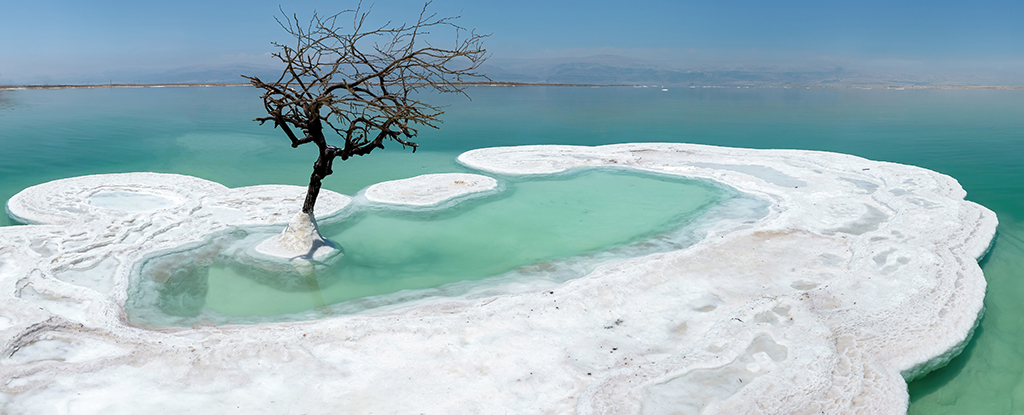
The substantial accumulations of salt encircling the Dead Sea, often referred to as salt giants, materialize as a consequence of the lake’s exceptionally saline water undergoing evaporation. A recent investigation into their genesis has begun to unveil the underlying mechanisms governing these halite formations.
This development is of considerable interest to geologists, as salt giants are observable in numerous other locales, including submerged regions beneath the Mediterranean Sea. However, these ancient deposits are no longer in a state of active formation, precluding direct analysis in a manner comparable to the currently forming Dead Sea salt giants.
This research endeavor was undertaken by Eckart Meiburg, a mechanical engineer affiliated with the University of California, Santa Barbara, and Nadav Lensky, a geologist from The Hebrew University of Jerusalem. Their work provides crucial insights that address longstanding inquiries concerning salt deposition, lacustrine evolution, and fluctuating environmental pressures.
“These extensive geological formations within Earth’s crust can span many kilometers horizontally and exceed a kilometer in vertical thickness,” stated Meiburg.
“The fundamental question of their origin has, until now, been difficult to answer. The Dead Sea represents a unique global site where we can currently observe and investigate the processes driving their formation.”
The research team employed a multimodal approach, integrating empirical field observations, controlled laboratory experiments, and sophisticated computational modeling to meticulously delineate the precise mechanisms responsible for the Dead Sea’s salt deposit formation. A particular focus of their investigation was understanding the variability in the processes that lead to the differential growth of salt giants.
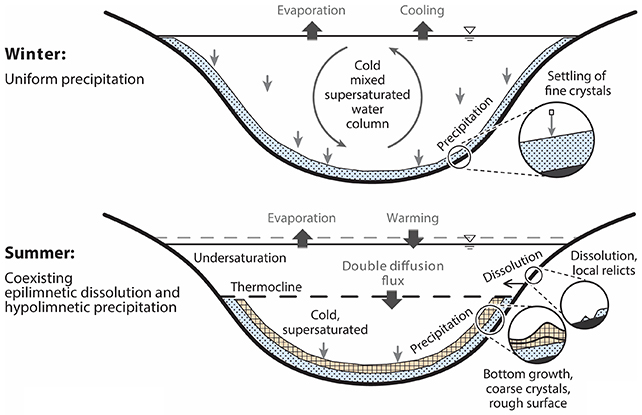
The study yielded a wealth of novel findings. For instance, the researchers ascertained that salt deposition is a continuous process occurring year-round, contrary to the prior assumption that it was confined to the winter season.
During the summer period, the uppermost water layer undergoes evaporative cooling, causing it to become denser and descend. Within this surface layer, salt crystals precipitate and subsequently descend, much like snowfall, to the lakebed, contributing to the growth of salt giants. The stratification and rate of this crystalline descent were revealed by the research to be contingent upon the ambient water temperature.
These new insights challenge established hypotheses regarding the development of salt giants and underscore the exceptional nature of the Dead Sea, characterized by its position as Earth’s lowest elevation point and its exceptionally high salt concentration. Although this particular body of water may be unique, its ongoing processes offer valuable comparative lessons for other geological and environmental contexts.
“All these observed phenomena provide invaluable context regarding the stability and erosion patterns of coastlines worldwide in response to fluctuations in sea level,” the researchers articulated in their published findings.
This relevance stems from the fact that the Dead Sea is experiencing a significant decline in water level, receding by approximately one meter annually. This phenomenon is echoed in numerous other seas and lakes globally, exacerbated by the pervasive effects of climate change, and aligns with historical patterns observed in other aquatic systems.
It is noteworthy that the Mediterranean Sea experienced a near desiccation event millions of years ago, under circumstances bearing a striking resemblance to the current conditions of the Dead Sea: a cessation of water influx, a consequent increase in salinity, and a substantial drop in surface water levels. The present-day dynamics of the Dead Sea thus offer a temporal lens into these past geological events.
“A consistent flow of water from the North Atlantic into the Mediterranean, via the Strait of Gibraltar, was historically maintained,” explained Meiburg.
“However, when tectonic activity led to the closure of the Strait of Gibraltar, this vital connection and the attendant water supply from the North Atlantic were severed.”
“Subsequently, after a period of several million years, the Strait of Gibraltar reopened, re-establishing the influx of Atlantic waters and facilitating the refilling of the Mediterranean basin.”