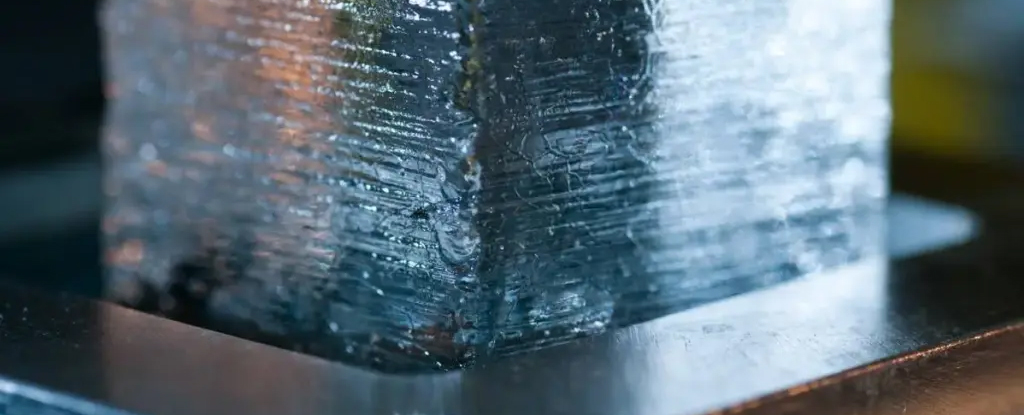
An ice sample extracted from the European Alps has achieved a significant milestone, becoming the premier core to be precisely dated to the Last Glacial Period. This remarkable find furnishes invaluable historical environmental data, offering a retrospective view spanning the last 12,000 years.
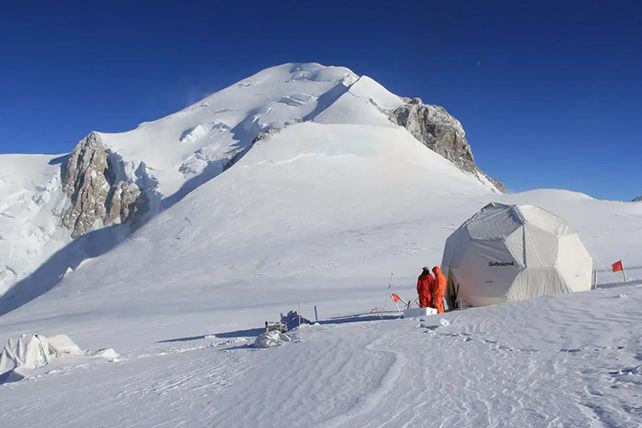
This pivotal discovery was spearheaded by a collaborative effort involving scientists from the French National Centre for Scientific Research and the Desert Research Institute (DRI) Ice Core Laboratory situated in Nevada. Their meticulous examination focused on a 40-meter (131-foot) segment of ice, originally retrieved in 1999 from the Dôme du Goûter, a prominent summit within the Mont Blanc massif straddling the French and Italian borders.
“This represents the first instance where we possess a substantially complete Alpine record of atmospheric and precipitation chemistry, extending all the way back to the Mesolithic era,” remarked DRI Ice Core Lab hydrologist Joe McConnell, as quoted in a relevant publication.
He elaborated on the significance: “This is a substantial achievement because it encompasses two major climatic regimes—glacial and interglacial. Obtaining a record of atmospheric precipitation chemistry across such a profound climate transformation provides insight into the most extreme naturally occurring aerosol concentrations one might anticipate.”
The geographical context of this discovery is of paramount importance. Locating ancient ice in Europe dating to a period of burgeoning human populations allows researchers to derive more precise environmental readings from antiquity. These readings are gleaned from minute particles, including dust, sea salt, sulfur, and soot, offering a richer dataset than ice retrieved from more remote locales such as the Arctic.
This particular ice core chronicles an extensive historical epoch, reaching back to the era of widespread hunter-gatherer societies and progressing through the advent of agriculture and animal domestication.
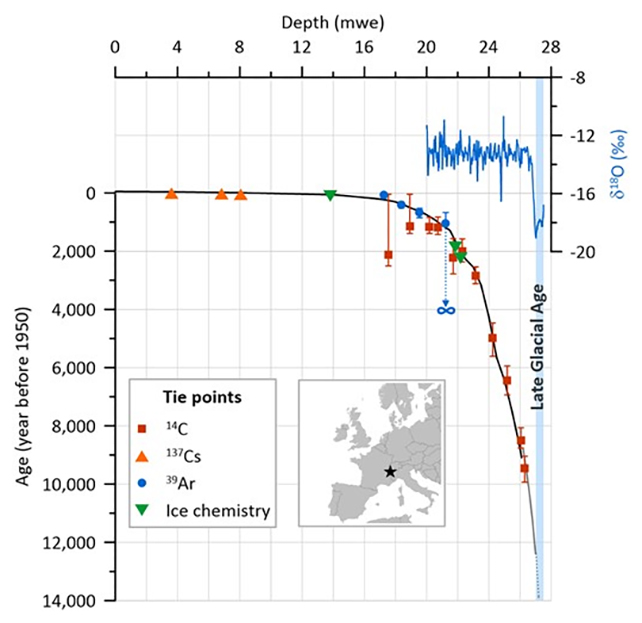
Initial analyses of the ice are already yielding profound insights into past climatic conditions. Evidence suggests that during the Last Glacial Period, Alpine summers experienced temperatures approximately 3.5 °C cooler than contemporary readings, with a more generalized cooling of 2 °C across western Europe.
Furthermore, by meticulously charting the concentrations of phosphorus, a byproduct of plant activity, the research team has been able to delineate shifts in vegetation patterns over the past 12,000 years. The findings indicate a significant expansion of forested areas during warmer climatic phases, contrasted with a reduction in more recent periods marked by development and land clearance.
“It is highly gratifying to have identified the inaugural ice core from the European Alps that preserves an unbroken climatic record, extending through the current interglacial period and into the markedly different climatic conditions of the last ice age,” stated geoscientist Susanne Preunkert of Grenoble Alpes University in France.
Following a quarter-century of preservation, the precise age of this ice core has now been ascertained through the application of state-of-the-art chemical analysis methodologies, which include the measurement of carbon and argon isotope ratios.
The researchers are also undertaking analyses of sea salt concentrations to reconstruct historical shifts in wind patterns and to enhance the accuracy of climate models that integrate sea salt dynamics, cloud formation, and solar radiation.
“To genuinely investigate all plausible climatic states, both past and future, necessitates a model capable of capturing authentic climate variability,” explained McConnell.
“While this represents an admirable objective, the validation of such models hinges on our ability to compare their outputs with observational data. This is precisely where the invaluable insights provided by ice cores become indispensable.”