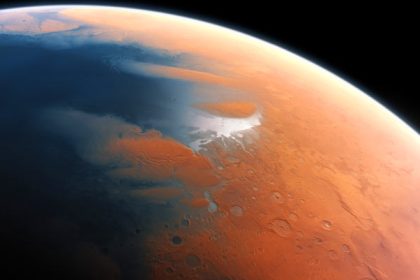
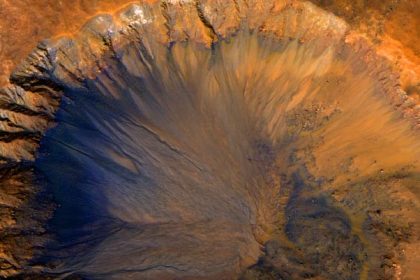
The exploration of Mars’ southern highlands, specifically within the Noachis Terra region, has yielded a significant geological revelation: the identification of over 15,000 kilometers of ancient riverbed formations. This substantial discovery implies that the Red Planet may have once harbored a considerably more aqueous environment than previously theorized.
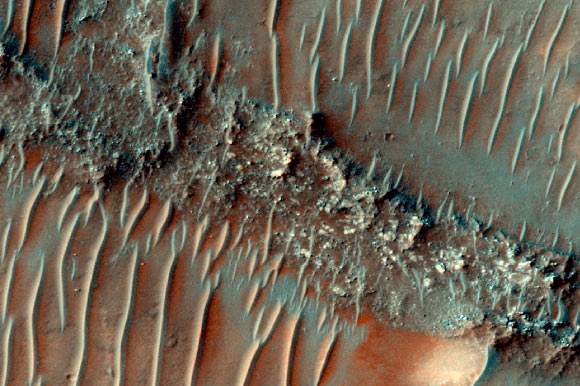
This HiRISE image displays a flattened, severely weathered fluvial sinuous ridge on Mars; sand dunes are observed traversing the crest of this ridge. Image courtesy of NASA / JPL / University of Arizona.
The precise atmospheric and climatic conditions prevailing on Mars during the Noachian-Hesperian transition, a critical epoch marked by significant geological and climatic shifts approximately 3.7 billion years ago, and the genesis of surface features such as valley networks and water-associated lakebeds remain subjects of ongoing scientific discourse.
Two prevailing hypotheses attempt to explain these phenomena. The first posits that early Mars sustained warm and humid conditions for an extended duration, allowing liquid water to remain stable on its surface for prolonged intervals. Conversely, the second theory suggests that Mars was predominantly frigid and arid, with formations indicative of flowing water arising only sporadically from the melting of ice sheets during transient climatic fluctuations.
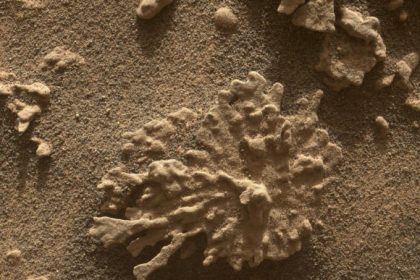
Within Noachis Terra, a zone where climate models predicting a “warm and wet” scenario anticipate substantial precipitation rates, new research has focused on fluvial sinuous ridges, also recognized as inverted channels.
These features are understood to have formed as sedimentary deposits from ancient rivers solidified and were subsequently exposed through the erosion of surrounding materials, according to the study’s authors.
Furthermore, similar ridge structures have been documented across various Martian terrains.
Their widespread presence strongly indicates that flowing water was once a common occurrence in this region, with atmospheric precipitation identified as the most probable source of this water.
The researchers determined that fluvial sinuous ridges are prevalent throughout Noachis Terra, collectively spanning a distance exceeding 15,000 kilometers.
While many of these formations appear as isolated segments, certain interconnected systems extend for hundreds of kilometers.
“The investigation of Mars, particularly less examined areas like Noachis Terra, is exceptionally compelling due to its status as an environment that has remained largely unaltered for billions of years,” stated Losekoot.
“It serves as a historical archive, preserving fundamental geological processes in a manner unattainable on Earth.”
For this comprehensive study, the research team utilized data acquired from three distinct orbital instruments: the Context Camera (CTX), the Mars Orbiter Laser Altimeter (MOLA), and the High Resolution Imaging Science Experiment (HiRISE).
These combined datasets facilitated the precise mapping of the locations, dimensions, and structural characteristics of ridge systems across an extensive geographical area.
“Our findings represent a novel piece of evidence suggesting that Mars was once a far more dynamic and complex celestial body than it is presently, representing an incredibly exciting area of scientific pursuit,” Losekoot commented.
“The observation that these ridges form extensive, interconnected networks implies that conditions conducive to the presence of water must have persisted for a considerable duration, indicating that Noachis Terra experienced warm and humid conditions over a geologically significant period.”
“These discoveries present a challenge to existing scientific paradigms that propose Mars was predominantly cold and dry, with its valleys primarily sculpted by the meltwater from ice sheets during infrequent, brief warming events.”
The scientists shared their findings on July 10 at the Royal Astronomical Society’s National Astronomy Meeting 2025, held in Durham, England.
_____
Adam Losekoot et al. The Fluvial History of Noachis Terra, Mars. NAM 2025