Subterranean water, estimated to be 1.2 billion years old, has been unearthed approximately 3 kilometers beneath the surface at Moab Khotsong, a significant South African mine renowned for its gold and uranium extraction. This ancient aquatic reservoir exhibits the most substantial concentrations of radiogenic byproducts ever documented within a fluid medium. This finding holds considerable implications extending beyond terrestrial environments, suggesting the potential for subsurface water to endure on rocky celestial bodies like Mars for extended geological periods, even when surface conditions preclude habitability.

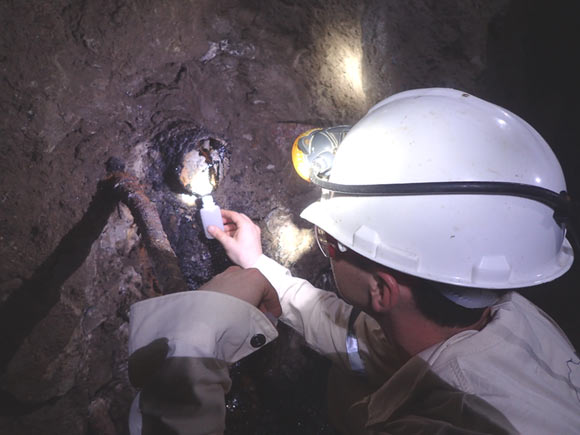
Dr. Oliver Warr collecting sample in Moab Khotsong, South Africa. Image credit: Oliver Warr.
The surrounding geological strata, which host mineral and ore deposits, naturally contain uranium and other radioactive elements.
These radioactive elements offer novel insights into the groundwater’s capacity to serve as an energy source for chemolithotrophic microbial communities, often referred to as “rock-eaters,” which have been previously identified coexisting within Earth’s deep subterranean realms.
The decay of elements such as uranium, thorium, and potassium within the subsurface initiates a cascade of effects. The resultant alpha, beta, and gamma radiation precipitates what are termed radiogenic reactions within the adjacent rocks and interstitial fluids.
At Moab Khotsong, an extractive facility situated in the Witwatersrand Basin, within South Africa’s Kaapvaal Craton, Oliver Warr of the University of Toronto, along with his research associates, ascertained substantial quantities of radiogenic helium, neon, argon, and xenon. Furthermore, an unprecedented detection of krypton-86 was made, representing a previously unobserved marker of this potent reaction history.
The phenomenon of radiation also instigates the dissociation of water molecules, a process known as radiolysis. This fragmentation yields elevated concentrations of hydrogen, a vital energetic feedstock for microbial ecosystems thriving deep within the Earth, which are deprived of solar energy for photosynthetic activity.
Due to their exceedingly minuscule masses, helium and neon are uniquely valuable for the precise identification and quantification of transport potential.
Although the extremely low porosity of the crystalline basement rocks encasing these subterranean waters largely confines them and minimizes mixing, thus accounting for their remarkable 1.2-billion-year age, diffusion remains a possible mechanism for substance transfer.
“Even solid materials like polymers, stainless steel, and indeed solid rock can ultimately be permeated by diffusing helium, akin to the gradual escape of gas from a helium-filled balloon,” commented Dr. Warr.
“Our findings demonstrate that diffusion has facilitated the movement of 75-82% of the helium and neon originally generated by radiogenic processes through the overlying crustal layers.”
The researchers emphasize that the knowledge gained regarding the extent of helium diffusion from the Earth’s deep interior constitutes a significant advancement, particularly as global helium reserves diminish and the imperative for more sustainable energy sources intensifies.
“Humanity is not the sole beneficiary of the Earth’s deep subsurface energy resources,” Dr. Warr remarked.
“Given that radiogenic reactions yield both helium and hydrogen, our research not only illuminates helium reservoirs and their transport mechanisms but also enables the calculation of hydrogen energy flux originating from the deep Earth, which sustains subterranean microbial life on a global scale.”
“Such calculations are indispensable for comprehending the sustenance of deep subsurface life on our planet and for assessing the potential energy available from radiogenically driven power sources on other planets and moons within our solar system and beyond, thus informing future exploratory missions to celestial bodies such as Mars, Titan, Enceladus, and Europa.”
This groundbreaking discovery has been detailed in a publication featured in the esteemed journal Nature Communications.
_____
O. Warr et al. 2022. 86Kr excess and other noble gases identify a billion-year-old radiogenically-enriched groundwater system. Nat Commun 13, 3768; doi: 10.1038/s41467-022-31412-2