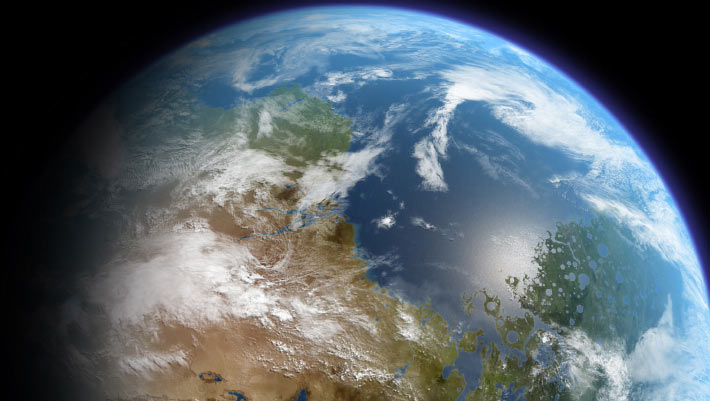
In a recent publication, Nina Lanza, a planetary scientist affiliated with Los Alamos National Laboratory, along with her collaborators, conducted an extensive examination of the requisites for rendering the Martian surface environment more akin to Earth’s and delineating the immediate actions necessary if there is an aspiration for the Red Planet to eventually support human habitation.
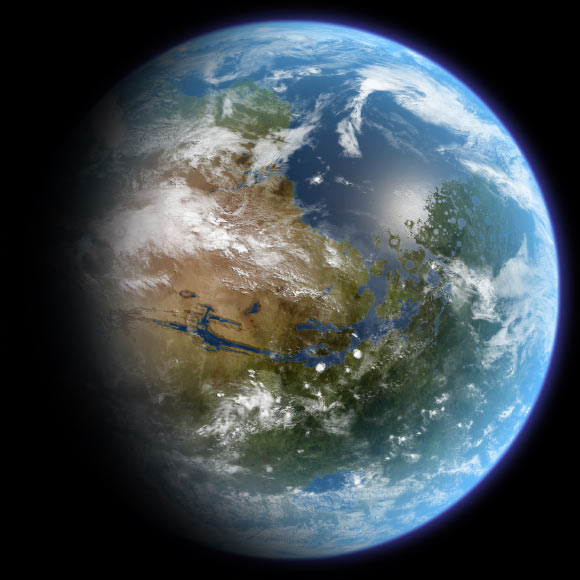
An artist’s impression of a terraformed Mars. Image credit: Daein Ballard / CC BY-SA 3.0.
“Remarkably, no comprehensive assessment of the feasibility of terraforming Mars has been undertaken since 1991,” stated Dr. Lanza.
“However, since that time, we have achieved significant advancements in Martian science, geoengineering techniques, launch capabilities, and biosciences, which afford us an opportunity to re-evaluate terraforming research and critically determine what is genuinely achievable.”
The process of terraforming Mars would necessitate an elevation of atmospheric temperature to facilitate the action of engineered microorganisms in generating oxygen via photosynthesis. This, in turn, would permit a gradual accrual of oxygen, thereby enabling the existence of liquid water and the sustenance of more complex life forms.
“Prior to evaluating the merits of warming Mars, in contrast to the alternative of preserving it as an untouched wilderness, we must first address the practical necessities, financial outlays, and potential hazards involved,” the researchers articulated.
Within their paper, the study addressed the extant knowledge concerning Mars’ water resources, carbon dioxide content, and soil composition, alongside potential methodologies for elevating the planet’s surface temperature, increasing atmospheric pressure, and augmenting oxygen levels.
Novel methodologies have emerged that possess the capacity to raise Mars’ mean global temperature by several tens of degrees Celsius within a few decades.
Future research endeavors could be directed towards comprehending the fundamental physical, chemical, and biological constraints that will inevitably influence any future determinations regarding Mars. Such investigations are poised to propel advancements in Martian exploration, biosciences, and atmospheric engineering.
“This line of inquiry could, in the long term, contribute to the preservation of ‘oasis Earth’,” the scientists posited.
“Technologies developed for the purpose of Martian habitation, such as crops resistant to desiccation, efficient soil remediation techniques, and enhanced ecosystem modeling, are highly likely to yield benefits for our terrestrial home.”
“Research into Martian terraforming offers an invaluable proving ground for planetary science, potentially substantiating existing theories or revealing critical knowledge deficiencies.”
“Continuing this research promises substantial scientific progress, irrespective of whether comprehensive terraforming is ultimately realized.”
“Until such research is conducted, we remain unaware of the actual physical or biological possibilities.”
“Should humankind acquire the capability to terraform a celestial body such as Mars, this achievement might represent the initial stride towards destinations beyond our solar system.”
The team’s dissertation was officially disseminated on May 13 in the esteemed journal Nature Astronomy.
_____
E.A. DeBenedictis et al. 2025. The case for Mars terraforming research. Nat Astron 9, 634-639; doi: 10.1038/s41550-025-02548-0