On the Martian surface, dark formations known as slope streaks materialize spontaneously and gradually dissipate over periods ranging from years to decades. While some planetary investigators have posited these streaks as indicators of liquid flow, thereby suggesting the potential for extant habitable conditions on Mars, subsequent research conducted by Brown University and the University of Bern proposes an alternative explanation: a dry process driven by wind and dust dynamics.
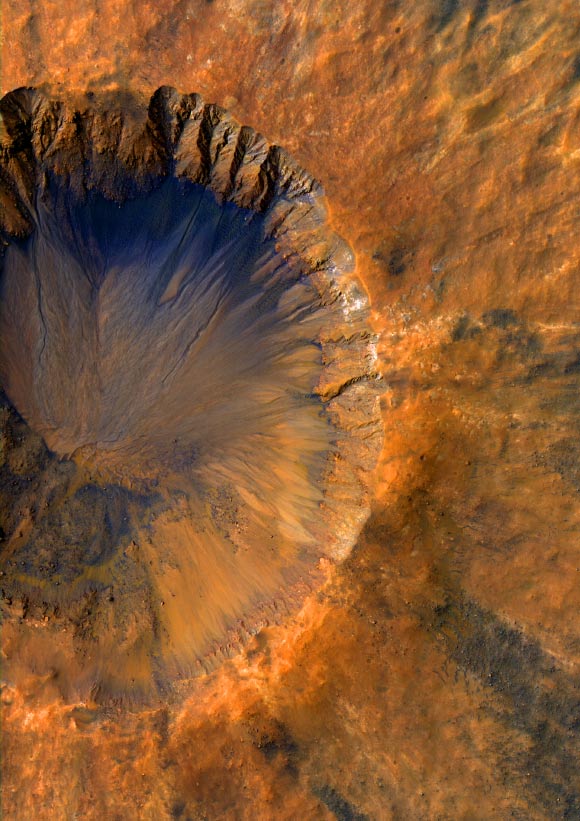
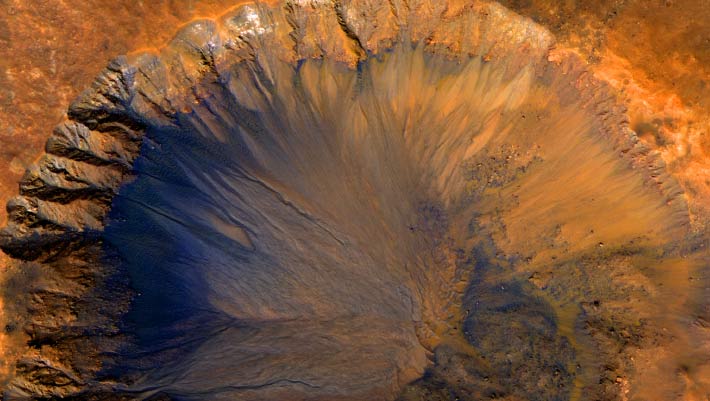
This image of an impact crater in the Sirenum Fossae region of Mars was taken by NASA’s Mars Reconnaissance Orbiter on March 30, 2015. The crater is approximately 3,300 feet (1-km) wide and appears relatively recent as it has a sharp rim and well-preserved ejecta. The steep inner slopes are carved by gullies and include possible recurring slope lineae on the equator-facing slopes. Image credit: NASA / JPL / University of Arizona / Alfred McEwen.
“A significant focus within Martian research endeavors involves elucidating contemporary terrestrial processes, including the potential existence of liquid water on its surface,” stated Dr. Adomas Valantinas, a postdoctoral researcher affiliated with Brown University.
“Our investigation meticulously examined these geological formations, yet we found no corroborating evidence for the presence of water. Our computational model strongly supports dry formation mechanisms.”
These peculiar streaks were initially observed by scientists through imagery acquired during NASA’s Viking missions in the 1970s.
Characterized by their sinuous morphology, these features typically exhibit a darker coloration than the surrounding terrain and extend for hundreds of meters down inclining surfaces.
While some of these streaks persist for years or even decades, others manifest and recede with greater rapidity.
The ephemeral formations, designated as recurring slope lineae (RSL), tend to appear in identical locations during the warmer intervals of the Martian calendar year.
The genesis of these streaks has long been a subject of fervent debate among planetary scientists.
Seeking novel perspectives, Dr. Valantinas, in collaboration with his colleague Dr. Valentin Bickel, employed a machine learning algorithm to systematically document an extensive array of slope streaks.
Following the training of their algorithm on authenticated instances of slope streaks, they deployed it to meticulously scrutinize over 86,000 high-resolution satellite images.
This comprehensive data compilation resulted in the creation of a pioneering global map of Martian slope streaks, encompassing more than half a million distinct streak features.
“Once we had this globally comprehensive map at our disposal, it facilitated a direct comparison with an array of databases and catalogs detailing other phenomena, such as variations in temperature, prevailing wind speeds, hydration levels, rockslide activity, and a multitude of other contributing factors,” explained Dr. Bickel.
“Subsequently, we were able to identify correlations across hundreds of thousands of observed cases, enabling a more profound understanding of the environmental conditions under which these formations emerge.”
This rigorous geostatistical analysis revealed that slope streaks and RSLs are not typically correlated with parameters indicative of a liquid or frost-based origin. These parameters include specific slope orientations, significant diurnal temperature fluctuations, or elevated atmospheric humidity.
Conversely, the researchers ascertained that both sets of features demonstrate a greater propensity to develop in regions characterized by wind speeds exceeding the average and substantial dust deposition—factors that strongly suggest a terrestrial, non-aqueous genesis.
The investigators concluded that these streaks most likely originate from the sudden detachment of fine dust layers from steep inclines.
The precise triggers for this phenomenon may well differ. Slope streaks appear to be more prevalent in proximity to recent impact craters, where seismic shockwaves could potentially dislodge surface dust. RSLs, on the other hand, are more frequently encountered in locales experiencing frequent dust devils or rockfalls.
Collectively, these findings cast considerable doubt upon the viability of slope streaks and RSLs as potential host environments for life.
This revelation carries significant implications for future Martian exploration endeavors.
Although the prospect of habitable environments might seem attractive for exploratory missions, NASA generally adopts a cautious approach, preferring to maintain a considerable distance.
Any terrestrial microorganisms inadvertently transported by a spacecraft possess the potential to contaminate potentially habitable Martian ecosystems, thereby complicating the scientific pursuit of indigenous Martian life.
This recent study indicates that the risk of contamination at slope streak sites should not be a primary concern.
“This represents a key advantage of employing a big data analytical approach,” commented Dr. Valantinas.
“It assists us in systematically disproving certain hypotheses from orbital vantage points before we commit valuable resources to deploying spacecraft for in-situ exploration.”
The findings stemming from this investigation were formally disseminated on May 19, 2025, within the esteemed scientific journal Nature Communications via the following link: viewable results.
_____
V.T. Bickel & A. Valantinas. 2025. Streaks on Martian slopes are dry. Nat Commun 16, 4315; doi: 10.1038/s41467-025-59395-w