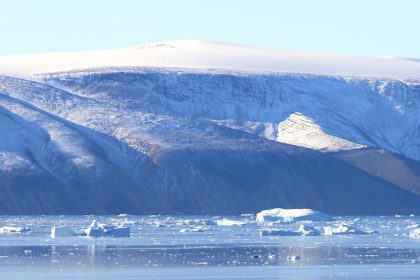
Designated Lake Snow Eagle, this recently identified subglacial reservoir spans roughly 42 kilometers in length and encompasses an area of 370 square kilometers, establishing it as one of Antarctica’s most substantial subterranean lakes.
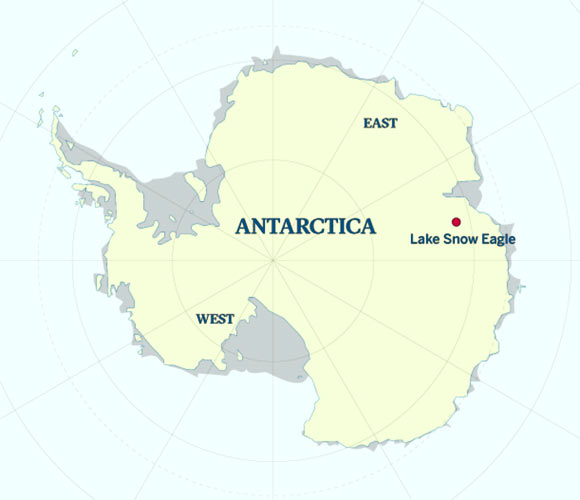
Lake Snow Eagle is situated within a canyon in East Antarctica, beneath a substantial ice sheet. Image courtesy of the University of Texas Institute for Geophysics.
The existence of Lake Snow Eagle was brought to light through extensive data collected by highly equipped polar research aircraft. This lake is nestled within a canyon, several kilometers deep, in the highlands of Princess Elizabeth Land, located a few hundred kilometers from the Antarctic coast.
Given its proximity to the coastline, researchers hypothesize that this lake could provide crucial insights into the initial formation phases of the East Antarctic Ice Sheet and the influence of the Antarctic Circumpolar Current. This current, a circulating mass of cold water encircling the continent, is believed by scientists to be instrumental in maintaining its frigid climate.
“This body of water likely preserves a comprehensive chronicle of the East Antarctic Ice Sheet’s entire history, from its inception over 34 million years ago through its expansion and development across subsequent glacial cycles,” stated Dr. Don Blankenship, a senior research scientist affiliated with the Institute for Geophysics at the University of Texas at Austin.
“Furthermore, our observations indicate a significant transformation of the ice sheet approximately 10,000 years ago, though the underlying cause remains unknown to us.”
The initial indication of Lake Snow Eagle’s presence, along with the canyon system it occupies, emerged when Dr. Blankenship and his team identified a smooth depression in satellite imagery of the ice sheet.
To substantiate its existence, systematic surveys were conducted over a three-year period. These involved deploying ice-penetrating radar and sensors designed to detect minute variations in Earth’s gravitational and magnetic fields.
“I was ecstatic upon first observing that distinct radar reflection,” recounted Shuai Yan, a postgraduate student at the Jackson School of Geosciences, part of the University of Texas at Austin.
What Yan detected was the lake’s water, which, unlike solid ice, possesses the characteristic of reflecting radar signals with a mirror-like intensity.
In conjunction with the gravity and magnetic surveys, which illuminated the region’s subsurface geology and the depth of the water and sediments, Yan was able to construct a detailed topographical map. This revealed a rugged highland landscape with Lake Snow Eagle positioned at the base of a deep canyon.
According to the research team, the lake measures approximately 42 kilometers in length, 14.5 kilometers in width, and possesses a depth of 198 meters.
The sediment layers at the lake’s bed extend to a depth of 305 meters and are thought to potentially contain fluvial sediments predating the ice sheet itself.
“This lake has been accumulating sediments over an extensive duration, potentially spanning the epoch when Antarctica was entirely ice-free, through to its transition into a deeply frozen state,” explained Dr. Martin Siegert, a glaciologist at Imperial College London.
“While a singular record encompassing all these events in one location is unavailable, the sediments found at the bottom of this lake could serve as an ideal repository.”
This significant discovery is detailed in a publication within the scientific journal Geology.
_____
Shuai Yan et al. A newly discovered subglacial lake in East Antarctica likely hosts a valuable sedimentary record of ice and climate change. Geology, published online May 9, 2022; doi: 10.1130/G50009.1