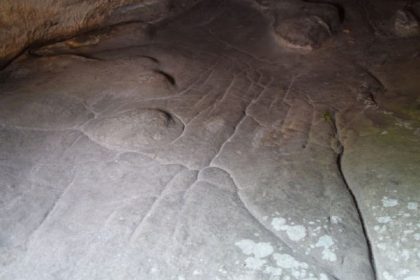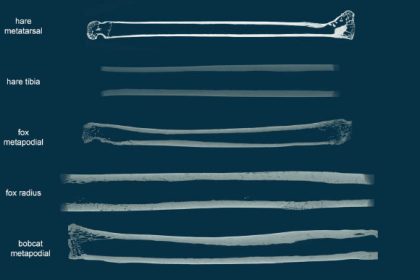
An astonishing discovery of bone fragments exhibiting cut marks, dating back 1.95 million years, has been unearthed at the Grăunceanu site in Romania. These marks are strongly suggestive of manipulation by early hominins employing rudimentary stone implements, a finding that profoundly reshapes our understanding of the geographical expansion and temporal parameters of hominin migrations across Eurasia.

This is an artist’s reconstruction of female Homo from Dmanisi, Georgia. Image credit: Elisabeth Daynes, via tabula.ge.
According to paleoanthropologist Dr. Sabrina Curran of Ohio University and her research associates, the prevailing evidence regarding the earliest hominin presence beyond African territories was previously anchored to the Dmanisi site situated in Georgia.
This Georgian locale, with its geological age estimated between 1.85 and 1.77 million years ago, has yielded a substantial collection of hominin fossil remnants alongside sophisticated stone tools and irrefutable indications of faunal carcass processing by hominins, such as distinct butchery striations.
While the Dmanisi findings unequivocally establish hominin habitation in the Southwest Asia/Eastern Europe region during the Early Pleistocene epoch, the precise chronology of their initial exodus from Africa and the long-term viability of these pioneering settlements remain subjects of ongoing academic discourse.
The Grăunceanu location, nestled within Romania’s Olteţ River Valley, presents itself as a key Early Pleistocene Eurasian locale with the potential to illuminate the initial phases of hominin outward migration into the vast Eurasian continent.
Grăunceanu, subject to archaeological investigation since the 1960s, stands as one of the most thoroughly documented Early Pleistocene sites within Eastern-Central Europe.
The paleo-faunal assemblage recovered from Grăunceanu encompasses no fewer than 31 distinct species. This rich biodiversity includes mammoths, various species of bovids and cervids, giraffids, equids, rhinocerotids, numerous predatory mammals, rodents such as beavers and porcupines, ostriches, a sizable primate species akin to a terrestrial monkey, and the most recent European representative of pangolins.
These fossilized bones, meticulously preserved within the collections of the Emil Racoviţă Institute of Speleology and the Museum of Oltenia, largely escaped detailed scrutiny until a recent re-evaluation undertaken by Dr. Curran and her collaborators.
“Our initial expectations for significant findings were quite modest,” Dr. Curran candidly admitted.
“However, during a systematic examination of the curated specimens, we encountered several bones bearing unmistakable cut marks.”
“This particular discovery carries substantial weight, principally because it antedates the renowned Dmanisi site in Georgia—hitherto considered the most ancient testament to hominin activity outside Africa—by approximately 200,000 years.”
“This novel revelation positions Romania as an indispensable geographical nexus for comprehending the migratory patterns and behavioral adaptations of our early human ancestors.”
The robustness of these assertions is buttressed by corroborative biostratigraphic data and advanced high-resolution uranium-lead dating methodologies, which have collectively facilitated the precise temporal calibration of the site’s age.
Furthermore, the research team employed stable isotope analysis to reconstruct the environmental conditions that likely prevailed in the Grăunceanu region during the period in question, providing insights into the habitats these early hominins would have navigated.
The analytical outcomes suggest that the area experienced cyclical climatic variations, perhaps characterized by augmented precipitation levels, in addition to seasonal temperature shifts analogous to those observed in contemporary times.
“The Grăunceanu site signifies a watershed moment in our ongoing endeavor to unravel the intricacies of human prehistory,” stated Dr. Curran.
“It unequivocally demonstrates that early hominins had already embarked on pioneering explorations and established footholds within diverse Eurasian landscapes, exhibiting a remarkable adaptability that would prove instrumental in their subsequent survival and proliferation across the globe.”
These groundbreaking research results were formally disseminated this week within the esteemed pages of the journal Nature Communications.
_____
S.C. Curran et al. 2025. Hominin presence in Eurasia by at least 1.95 million years ago. Nat Commun 16, 836; doi: 10.1038/s41467-025-56154-9