Serving as Earth’s planetary analogue, Venus exhibits stark divergences in its surface conditions, atmospheric composition, and tectonic activity. A primary objective within planetary science is to elucidate the internal mechanisms that sculpt Venus’s terrestrial landscape.

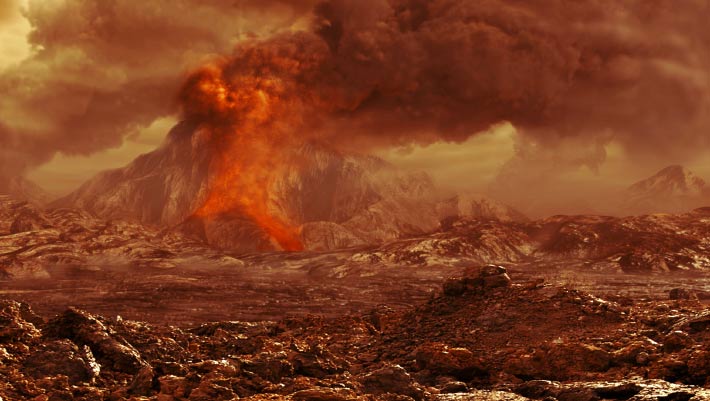
Artist’s impression of a volcano erupting on Venus. Image credit: ESA / AOES Medialab.
Our planet’s surface undergoes perpetual transformation through the dynamic movement and recycling of vast lithospheric fragments, termed tectonic plates, which traverse a viscous subsurface.
While Venus lacks a plate tectonic system, its outermost shell is nevertheless subjected to deformation by magmatic upwellings from its interior.
To gain a more profound comprehension of the subterranean forces orchestrating these deformations, investigators focused their attention on a specific geological formation known as a corona.
Ranging from tens to hundreds of kilometers in diameter, a corona is predominantly theorized to represent an area where a thermal anomaly, manifesting as a plume of hot, buoyant material ascending from the planet’s mantle, exerts pressure on the overlying lithosphere.
These geological constructs typically exhibit an ovoid shape, encircled by a pattern of concentric fractures.
Available scientific consensus indicates the presence of hundreds of these coronae across the surface of Venus.
By analyzing retrospective data acquired from NASA’s Magellan mission, Dr. Gael Cascioli, affiliated with the University of Maryland and NASA’s Goddard Space Flight Center, alongside his research associates, uncovered evidence of subsurface or surface-altering geological activity within numerous Venusian coronae.
“Coronae are not observed on present-day Earth; however, they may have been prevalent during our planet’s nascent stages, prior to the establishment of plate tectonics,” remarked Dr. Cascioli, the principal author of a publication featured in the journal Science Advances.
“This research, by integrating gravimetric and topographic measurements, has furnished novel and significant insights into the potential subterranean processes currently influencing Venus’s surface morphology.”
Initiated in 1989, the Magellan probe employed its advanced radar instrumentation to penetrate Venus’s dense atmosphere, thereby generating detailed topographical maps of its mountainous regions and extensive plains.
Among the various geological features charted by the spacecraft, coronae stood out as particularly perplexing, with their genesis remaining unclear.
Subsequent years have seen planetary scientists identify a multitude of coronae situated in regions characterized by a thin lithosphere and elevated thermal flux.
“Coronae are ubiquitous on Venus. They represent substantial geological formations, and a variety of hypotheses concerning their origin have been proposed over time,” stated Dr. Anna Gülcher, an investigator at the University of Bern.
“The most compelling aspect of our investigation is the confirmation that a diverse array of ongoing active processes is very likely responsible for their creation.”
“We posit that analogous processes may have transpired during the early history of Earth’s geological evolution.”
The research team devised sophisticated three-dimensional geodynamic simulations to model various potential formation pathways for plume-induced coronae, juxtaposing these models with the combined gravimetric and topographic data obtained from the Magellan mission.
The gravimetric data proved instrumental in enabling the researchers to detect regions of lower density, indicative of hotter, ascending mantle plumes, information that could not be ascertained from topographic data alone.
Out of the 75 coronae subjected to analysis, 52 exhibited evidence of buoyant mantle material situated beneath them, strongly suggesting its role in driving tectonic processes.
A principal terrestrial tectonic mechanism is subduction, wherein the margin of one tectonic plate descends beneath an adjacent plate.
The frictional forces generated between these converging plates can precipitate seismic activity, and as this ancient crustal material plunges into the hotter mantle, it undergoes melting, subsequently re-emerging at the surface via volcanic conduits.
On Venus, an analogous, albeit distinct, form of subduction is theorized to occur at the periphery of certain coronae.
In this interpreted scenario, as an upwelling plume of superheated rock from the mantle indents the lithosphere, surface material is uplifted and radially disseminated, encountering and displacing adjacent surface material downwards into the mantle.
Furthermore, another tectonic process, termed lithospheric delamination, may also be operative, characterized by the gravitational descent of dense, relatively cooler lithospheric segments into the hotter mantle.
The researchers have also identified several locales where a third mechanism might be active: a subjacent magma plume beneath a thicker lithospheric section potentially drives surficial volcanism.
_____
Gael Cascioli et al. 2025. A spectrum of tectonic processes at coronae on Venus revealed by gravity and topography. Science Advances 11 (20); doi: 10.1126/sciadv.adt5932