
For an uninterrupted period of six years, Finland has consistently held the distinction of being the most joyful nation globally, according to the findings of the World Happiness Survey. The methodology employed in this survey incorporates the Cantril ladder life evaluation query, which prompts participants to:
Envision a ladder with rungs numbered from zero at the base to ten at the apex. The uppermost rung signifies the most desirable life imaginable for you, while the lowest rung represents the least desirable. Please indicate the step on this ladder where you perceive yourself to be standing at present.
Finland has achieved the premier position, with Denmark and Iceland following closely. The underlying reasons for the heightened contentment of Finnish citizens relative to others are attributed to a confluence of factors. These encompass reduced income disparities (most notably, the divergence between high and low earners), robust social support networks, the autonomy to pursue personal choices, and minimal incidence of corruption.
The subsequent graphical representation categorizes all 44 nations for which both happiness metrics and income inequality data are available, with each country depicted as a distinct coloured point. The vertical axis denotes the average happiness index, while the horizontal axis illustrates the degree of income inequality.
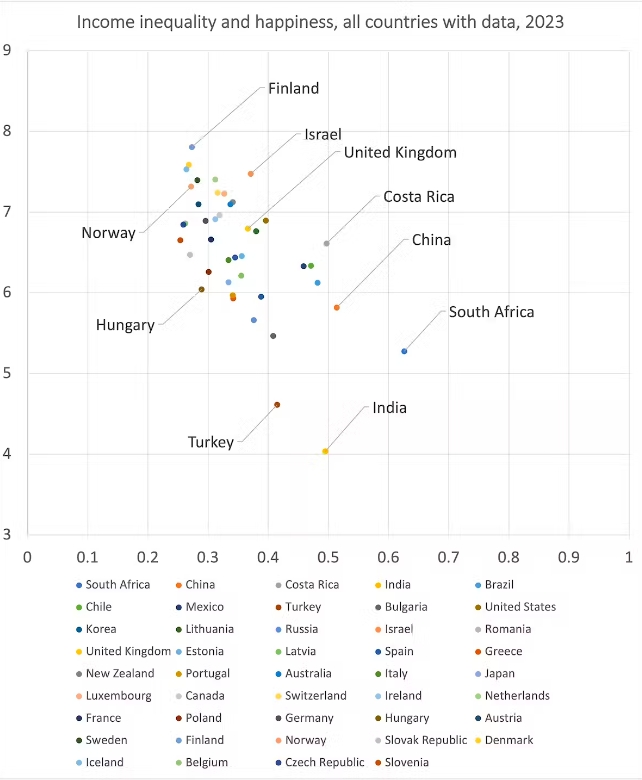
The metric utilized to quantify income disparity is the Gini coefficient of income inequality, as documented by the OECD. This coefficient reflects the highest rate recorded in each nation over any year subsequent to 2010, up to the most recent data available. The visual data strongly suggests a correlation between these two indicators. Broadly speaking, as income inequality widens, the significance of monetary gain increases, leading to diminished overall happiness.
Further contributing to the propensity for happiness in Finland are additional societal attributes. The nation boasts a highly decentralized public healthcare infrastructure, complemented by a minimal private healthcare sector. This model is considerably more effective and efficient in comparison to certain alternative systems implemented elsewhere. Public transportation services are characterized by their dependability and affordability, and Helsinki Airport has garnered recognition as the premier airport in Northern Europe.
An insightful Finnish aphorism appears pertinent in this context: Onnellisuus on se paikka puuttuvaisuuden ja yltäkylläisyyden välillä (Happiness resides in the balance between scarcity and abundance).
Comparative Analysis of Finland’s Standing
Finland, Norway, and Hungary report comparable levels of income inequality. However, the populace in Finland exhibits greater average happiness. The underlying rationale for this discrepancy warrants exploration.
According to data from the World Inequality Database, the top tenth percentile of income earners in Finland procure one-third (33 percent) of the nation’s total income. This contrasts with the equivalent demographic in the United Kingdom, where this group appropriates 36 percent, and in the United States, where the figure ascends to 46 percent.
While these percentages might appear marginally different, they exert a profound influence on collective well-being. In nations with higher inequality, a substantially smaller proportion of national income remains for the broader population. Concurrently, the affluent tend to experience heightened apprehension, a sentiment that is understandable when a select few accumulate significantly greater wealth.
In 2021, a hypothesis was put forth by a sociology professor, suggesting that individuals in Nordic countries might appear happier due to inherently more modest expectations. However, this explanation does not adequately account for Finland’s pronounced divergence from Norway in terms of happiness rankings.
A multitude of potential explanations exist, ranging from subtle linguistic nuances to broader cultural factors. An emergent consideration is whether the global survey itself is beginning to introduce a degree of bias, particularly as Finns are now cognizant of the survey’s purpose (further evidenced by their enhanced lead over Denmark in the most recent assessment).
Nevertheless, it is highly probable that Finland’s more equitable educational system, which ensures access to quality education regardless of school choice, coupled with a fairer school attendance policy compared to Norway (where nearly all students attend their local institutions), plays a significant role. Furthermore, a superior housing policy featuring a comprehensive array of social housing options and a lower incidence of homelessness, alongside a healthcare service with universally envied short waiting times—often mere days (even during the most challenging pandemic years)—and numerous other commendations, likely contribute substantially.
Finland consistently secures top-three rankings in over 100 global indicators of economic and social advancement, outperforming Norway. Notably, Finland possesses fewer overall financial resources and minimal oil reserves. This remarkable performance might warrant a degree of Finnish self-satisfaction (omahyväisyys).
An inquiry arises regarding Hungary’s comparatively poorer performance, despite its income disparity being only marginally wider than that of Finland and Norway. A plausible explanation lies in its polarized political landscape. In 2022, the European Parliament issued a statement indicating that “Hungary can no longer be considered a fully democratic state.”
The paramount importance of personal freedom, including freedom from fear, could also elucidate why Turkey and India report lower happiness levels than what their economic inequality metrics might otherwise suggest.
Conversely, South Africa and China may experience slightly higher levels of happiness than their respective inequality figures would indicate. South Africa transitioned to a democratic system in 1994, shortly after the release of Nelson Mandela, a period many recall vividly. The populace in China does not experience the same level of fear that is frequently portrayed in Western media.
Income Inequality: A Significant Determinant
For the majority of nations, happiness indices (along with numerous other societal indicators) demonstrate a high degree of predictability based on their levels of income inequality. The United Kingdom’s happiness level aligns precisely with expectations for one of Europe’s most economically disparate countries.
The aforementioned graph also indicates that Israel, despite comparable levels of inequality, exhibits a slightly higher happiness quotient than anticipated. However, it is not definitively established whether the surveyed demographic encompassed all resident groups within the state. Furthermore, this data was collected in 2022, preceding the recent wave of widespread public demonstrations in Israel.
Another notable outlier depicted on the graph is Costa Rica. In 2019, the nation’s president articulated the following sentiment:
Seventy years ago, Costa Rica opted to abolish its military. This decision has yielded numerous benefits. Eight percent of our Gross Domestic Product is allocated to education, as we are not burdened by defense expenditures. Consequently, our national strength lies in human ingenuity and the welfare of our citizens.
Therefore, what actions can individuals within a nation undertake to foster greater happiness? The most impactful measure is to support the election of governments committed to enacting policies that promote greater income equality within the country.
Following this, ensuring the efficiency and equity of essential social services—namely education, housing, and healthcare—is of paramount importance. These services should be robust and impartially administered.
Finally, it is crucial to evaluate the extent of personal freedom, ascertain the inclusivity of all societal segments in data collection, and gauge the prevailing levels of public apprehension.