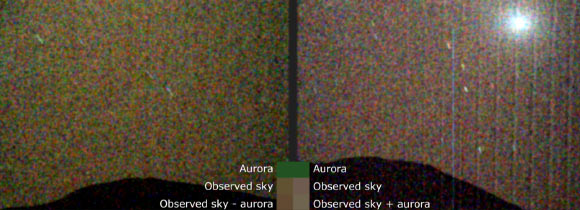
Notwithstanding its rarefied atmosphere and the absence of a planetary magnetic field, Mars exhibits diverse auroral phenomena. Until recently, all recorded aurorae were observed from orbital vantage points, exclusively in ultraviolet wavelengths. A significant advancement detailed in a new scientific publication by planetary researchers reports the identification of green auroral emissions in the visible spectrum, originating from the atomic oxygen spectral line at 557.7 nanometers (nm). These emissions were successfully detected by the SuperCam and Mastcam-Z instruments aboard NASA’s Perseverance rover.

The first visible-light image of green aurora on Mars (left), captured by the Mastcam-Z instrument on NASA’s Perseverance rover. A comparative image on the right depicts the Martian night sky devoid of auroral activity, but featuring Deimos, one of its moons. The Martian nocturnal panorama, illuminated predominantly by Phobos, Mars’s closer and more substantial moon (not within the frame), possesses a reddish-brown tint attributed to atmospheric dust. The introduction of green auroral luminescence transforms this celestial canvas into a greenish-yellow hue, as evidenced in the left-hand photograph. Image attribution: NASA / JPL-Caltech / ASU / MSSS / SSI.
On Earth, auroral displays are generated when charged particles from the sun engage with the planet’s encompassing magnetic field. This interaction directs the particles toward the poles, where their collisions with atmospheric gases result in the emission of light.
The prevalent green coloration arises from excited oxygen atoms releasing photons at a 557.7 nm wavelength.
For an extended period, scientific speculation suggested the potential existence of green light aurorae on Mars. However, it was posited that these phenomena would be considerably more subdued and challenging to record than their terrestrial counterparts.
Distinctions in Mars’s auroral signatures, compared to Earth’s, are a consequence of its lack of a comprehensive global magnetic field.
Among these distinct types is the solar energetic particle (SEP) aurora, first identified by NASA’s MAVEN mission in 2014.
These aurorae occur when highly energetic particles originating from the sun impact the Martian atmosphere, instigating a luminous reaction that illuminates the entire nocturnal sky.
“Our discovery unlocks novel avenues for auroral investigation and substantiates the possibility that future human explorers on Mars might witness visible aurorae,” remarked Dr. Elise Knutsen, a postdoctoral researcher affiliated with the University of Oslo.
On March 15, 2024, the Sun emitted a solar flare accompanied by a coronal mass ejection.
This solar event precipitated auroral activity throughout the solar system, including on Mars, where the Perseverance rover accomplished a historic first by detecting these phenomena from the surface of another celestial body.
Dr. Knutsen and her research associates corroborated the detection by analyzing data acquired from the SEP instrument onboard NASA’s MAVEN spacecraft and the ESA’s Mars Express spacecraft.
“This instance served as an exemplary demonstration of inter-mission collaboration,” stated Dr. Shannon Curry, principal investigator for MAVEN and a researcher at the Laboratory for Atmospheric and Space Physics at the University of Colorado Boulder.
“Our unified efforts facilitated a swift observation, and we are delighted to have obtained an early glimpse of what future astronauts might experience there.”
Through the synchronized analysis of Perseverance’s observations and the data from MAVEN’s SEP instrument, the research team was able to definitively attribute the observed 557.7 nm emissions to solar energetic particles.
Given that this is the identical emission line associated with green aurorae on Earth, it is highly probable that future Martian astronauts would have the capacity to observe this specific type of aurora.
“Perseverance’s observations of visible-light aurora provide a novel methodology for studying these phenomena, offering insights complementary to those gathered by our Mars orbiters,” commented Dr. Katie Stack Morgan, acting project scientist for Perseverance at NASA’s Jet Propulsion Laboratory.
“A more profound comprehension of aurorae and the Martian conditions conducive to their formation is particularly vital as we diligently prepare for the safe dispatch of human explorers to the planet.”
The scientific team’s research findings have been published in the esteemed journal Science Advances.
_____
Elise W. Knutsen et al. 2025. Detection of visible-wavelength aurora on Mars. Science Advances 11 (20); doi: 10.1126/sciadv.ads1563