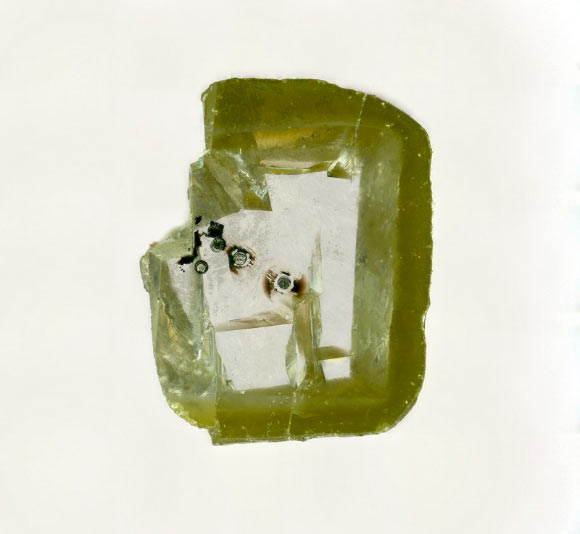
Calcium silicate perovskite (CaSiO3) is arguably the most geochemically significant mineral phase within the Earth’s lower mantle, primarily due to its capacity to concentrate elements that remain incompatible in the upper mantle. Prior to this, no successful retrieval of this high-pressure compound directly from the lower mantle had been achieved. This challenge stems from CaSiO3-perovskite being ‘unquenchable,’ meaning it cannot preserve its crystalline structure upon decompression from its high-pressure environment. In a recent groundbreaking study, geologists from the United States have reported the discovery of the first-ever sample of calcium silicate perovskite originating from the Earth’s lower mantle, found enclosed within a diamond extracted from the Orapa kimberlite pipe in Botswana.
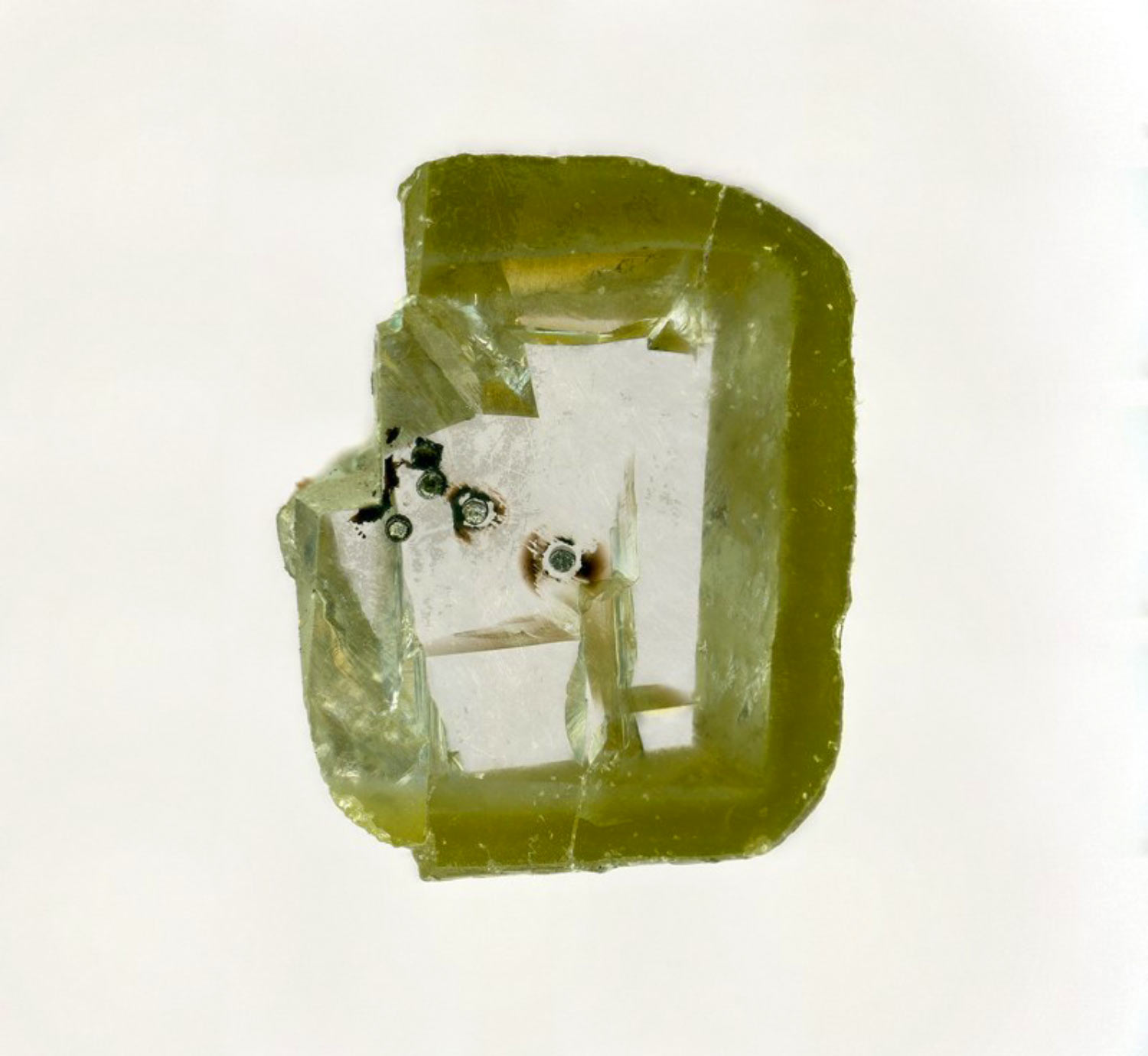
This diamond from Botswana contains tiny inclusions of davemaoite. Image credit: Aaron Celestian, Natural History Museum of Los Angeles County.
“Calcium silicate perovskite stands as one of the most geochemically crucial minerals in the lower mantle, largely because it sequesters elements that are averse to incorporation in the upper mantle, including rare-earth elements and radioactive isotopes that significantly contribute to the Earth’s mantle heat budget,” stated lead author Dr. Oliver Tschauner, affiliated with the Department of Geoscience at the University of Nevada, Las Vegas, and his research team.
“Despite theoretical postulations spanning several decades, no high-pressure silicate phase has ever been successfully recovered from the Earth’s lower mantle. This is predominantly because these minerals fail to maintain their structural integrity once removed from their extreme high-pressure and high-temperature origins.”
“The only other high-pressure silicate mineral phase hitherto confirmed in natural settings, known as bridgmanite, was discovered embedded within a heavily shocked meteorite.”
Within the scope of their new investigation, the researchers meticulously identified and characterized an inclusion of the high-pressure CaSiO3-perovskite phase residing within a deep-earth diamond, employing synchrotron X-ray diffraction techniques for analysis.
This exceptionally rare diamond was originally extracted from Botswana’s Orapa mine, recognized as the largest diamond mine globally by surface area, during the 1980s.
Subsequently, in 1987, the diamond was acquired by a mineralogist from the California Institute of Technology from a gem dealer.
“While jewelers and purchasers prioritize a diamond’s size, hue, and flawlessness, internal imperfections, often perceived as undesirable black specks by industry professionals, represent invaluable treasures to us. We were quite astonished by this discovery; it was entirely unexpected,” remarked Dr. Tschauner.
The crystalline substance identified by the research team has been officially christened davemaoite, in homage to the distinguished experimental high-pressure geophysicist Ho-kwang (Dave) Mao. Its classification as a novel mineral species has been formally ratified by the Commission of New Minerals, Nomenclature, and Classification of the International Mineralogical Association.
“This esteemed recognition is a profoundly fitting tribute, considering the immense influence Dave’s pioneering work has exerted across numerous geoscientific disciplines,” commented Dr. Richard Carlson, director of the Earth and Planets Laboratory at the Carnegie Institution for Science.
“His seminal contributions have fundamentally reshaped our comprehension of our planet, and now, an integral component of the Earth itself shall forever carry his name.”
Detailed structural and chemical analyses conducted on davemaoite have revealed its considerable capability to accommodate a diverse array of elements within its crystalline lattice, including potassium, thorium, and uranium—three of the primary elements responsible for radiogenic heat production.
These findings lend robust support to the hypothesis of compositional variability within the lower mantle and, given the mineral’s inferred widespread presence, strongly suggest that davemaoite plays a significant role in influencing heat generation in the Earth’s deep interior.
“Our estimations place the origin of davemaoite at depths ranging from approximately 660 to 901 kilometers (410-560 miles) beneath the Earth’s surface,” Dr. Tschauner elaborated.
“The extraordinary discovery of davemaoite fosters optimism for the future identification of additional elusive high-pressure mineral phases within natural terrestrial samples,” expressed Dr. Yingwei Fei, a senior researcher at the Earth and Planets Laboratory within the Carnegie Institution for Science.
“The ability to obtain more direct specimens from the otherwise inaccessible lower mantle would dramatically enhance our understanding and fill critical knowledge gaps concerning the chemical composition and dynamic variability of our planet’s profound depths.”
_____
Oliver Tschauner et al. 2020. Davemaoite, IMA 2020-012a. Mineralogical Magazine, 84; doi: 10.1180/mgm.2020.93
Oliver Tschauner et al. 2021. Discovery of davemaoite, CaSiO3-perovskite, as a mineral from the lower mantle. Science 374 (6569): 891-894; doi: 10.1126/science.abl8568