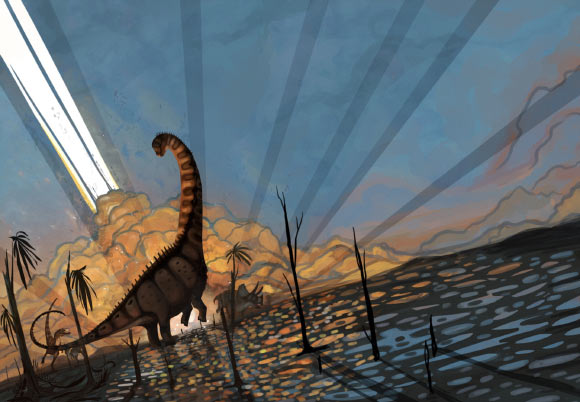
Approximately 66 million years ago, Earth experienced its most renowned mass extinction event, triggered by swift environmental devastation that resulted in the demise of roughly 75% of all species. This cataclysmic period famously extinguished the non-avian dinosaurs and fundamentally reshaped terrestrial biomes. A central point of contention revolves around whether the dinosaurs perished suddenly while in a thriving, abundant state, or if they were already in a prolonged period of decline preceding the end-Cretaceous epoch.
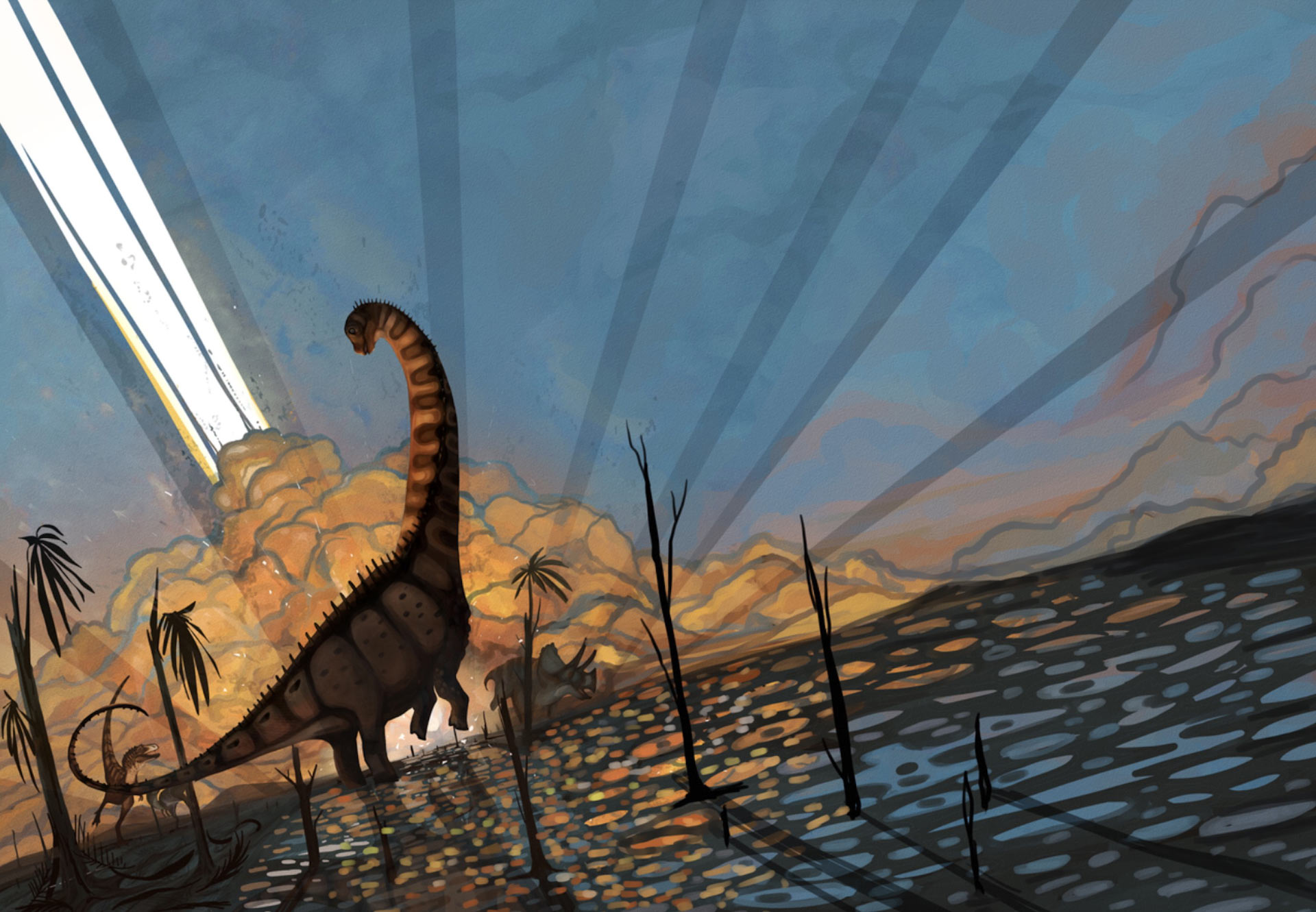
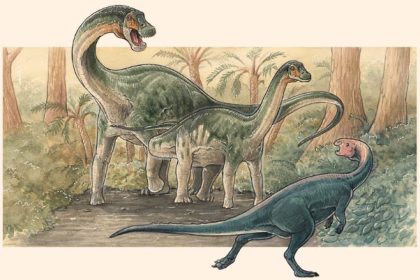
Flynn et al. analyzed Alamosaurus fossils found in northwestern New Mexico and discovered these dinosaurs were very different but the same age as dinosaurs found further north in Wyoming and Montana. Image credit: Natalia Jagielska.
Within the confines of northwestern New Mexico, geological strata hold concealed narratives of our planet’s past.
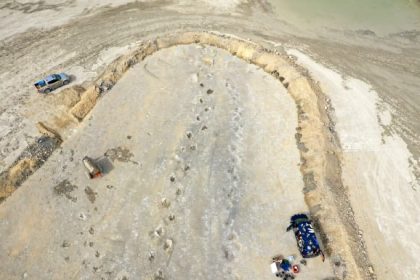
In the Naashoibito Member of the Kirtland Formation, a team of paleontologists led by Daniel Peppe from Baylor University unearthed compelling evidence of flourishing dinosaur ecosystems that persisted right up until the asteroid impact.
Employing sophisticated high-precision dating methodologies, the researchers determined that the fossilized remains discovered within these rock layers date back to a period between 66.4 and 66 million years ago.
Dr. Peppe commented that the dinosaurs inhabiting the Naashoibito region lived concurrently with the well-known species found in the Hell Creek Formation of Montana and the Dakotas.
He further emphasized that these creatures were not experiencing a decline; rather, they constituted vibrant and diverse assemblages.
The fossil discoveries from New Mexico present a narrative that diverges from prior understandings.
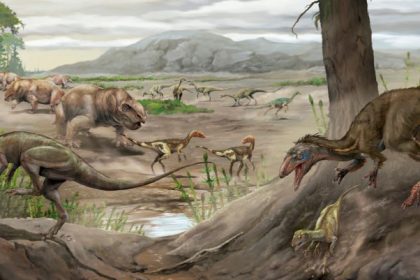
Contrary to the notion of a generalized and weakened state, dinosaur communities across the North American continent were characterized by regional distinctiveness and robust vitality.
Through meticulous ecological and biogeographical analyses, the research team ascertained that dinosaur populations in western North America occupied discrete bioprovinces. These divisions were not demarcated by geographical barriers like mountains or rivers, but rather by climatic temperature variations across different regions.
Andrew Flynn, a researcher from New Mexico State University, stated that their novel investigation demonstrates that dinosaurs were not on the brink of extinction as the mass extinction event approached.
He elaborated that they were thriving, and it appears the asteroid impact was the decisive factor in their demise.
This perspective challenges a long-standing hypothesis suggesting a gradual decrease in dinosaur diversity leading up to the mass extinction, which would have rendered them more susceptible to extinction.
The asteroid impact brought an abrupt end to the age of dinosaurs, but the residual ecosystems they left behind paved the way for subsequent evolutionary developments.
Within a mere 300,000 years following their extinction, mammals began to undergo rapid diversification, exploring novel dietary niches, body sizes, and ecological roles.
The climatic patterns that influenced dinosaur communities persisted into the Paleocene epoch, illustrating the pivotal role of climate in guiding life’s recovery after a catastrophic event.
The surviving mammalian lineages continued to exhibit the same north-south biogeographic provinciality observed previously.
Mammals from the northern and southern regions displayed significant divergence from one another, a characteristic that differentiates this extinction event from others where the resulting biological patterns appear to have been more generalized.
These groundbreaking findings have been published in the esteemed journal Science.
_____
Andrew G. Flynn et al. 2025. Late-surviving New Mexican dinosaurs illuminate high end-Cretaceous diversity and provinciality. Science 390 (6771): 400-404; doi: 10.1126/science.adw3282