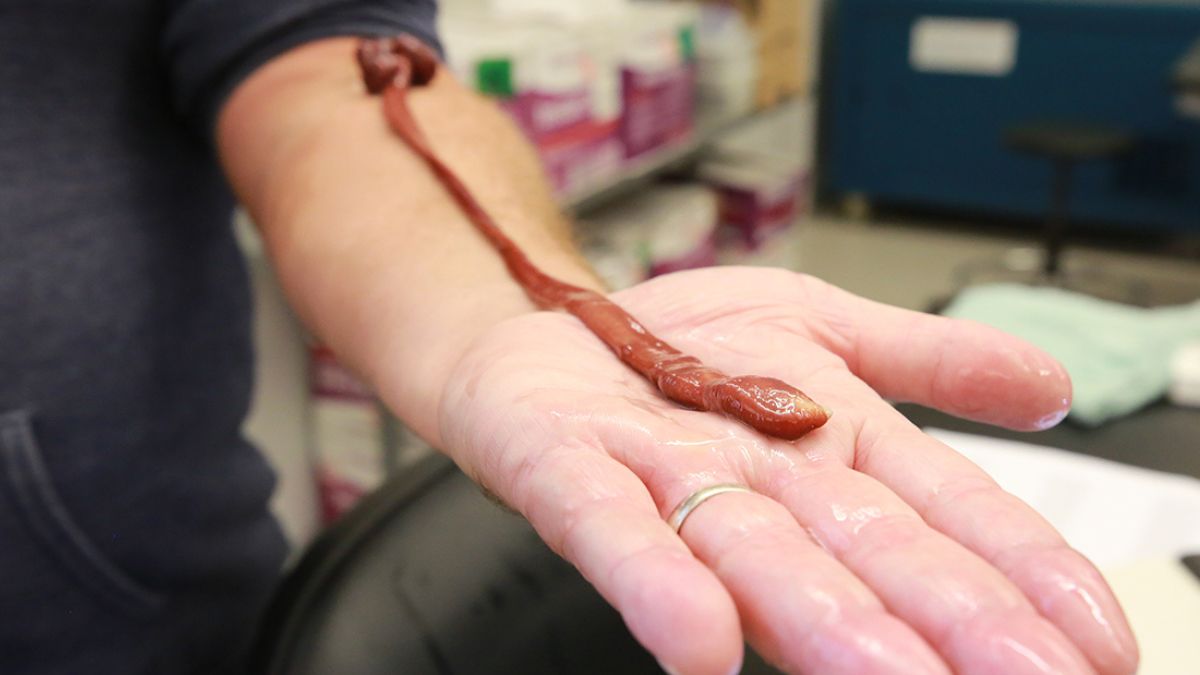
In the realm of marine biology, Jon Allen, a distinguished biologist, is now the proud custodian of the longest-living ribbon worm documented to date.
This adopted invertebrate, affectionately christened Baseodiscus the Eldest, has undergone a recent assessment, which indicates its age to be a minimum of 26 years, potentially nearing 30 years of age.
When fully extended, ‘B’, as it’s commonly known, can span approximately one meter (equivalent to 3 feet) in length, though determining its precise age has presented a more complex challenge.
A notable characteristic of marine invertebrates is their remarkable longevity; some deep-sea tube worms have been observed to survive for an impressive 300 years, with potential lifespans extending even further.
Ribbon worms are a highly prevalent group within marine invertebrates, yet comprehensive data regarding their lifespans remains scarce.
Baseodiscus the Eldest significantly surpasses any other recorded organism within the phylum Nemertea. Prior to this finding, the only other ribbon worm with a documented age mentioned in scientific literature by Allen and his associates was a mere three years old.
“The phylum of ribbon worms exhibits extraordinary diversity and widespread distribution, yet insights into their natural longevity are remarkably limited,” states Allen.
“This discovery addresses a significant void in our knowledge, effectively expanding their known lifespan by an order of magnitude. This fundamentally alters our understanding of a major category of marine predators.”

Since the year 2005, Allen has maintained ‘B’ in an environment conducive to its well-being, featuring a tank filled with ample mud to facilitate its movements.
The biologist initially obtained this soft-bodied creature from the University of North Carolina’s biology department after structural modifications necessitated its relocation from its original habitat.
Although the precise date of the marine invertebrate’s birth is not established, Allen indicates that researchers acquired ‘B’ as an adult specimen from the San Juan Islands sometime during the latter part of the 1990s.
Over the past two decades alone, ‘B’ has resided in various locations across the United States, including Washington state, North Carolina, Maine, and Virginia, solidifying its status as a remarkably well-traveled annelid.
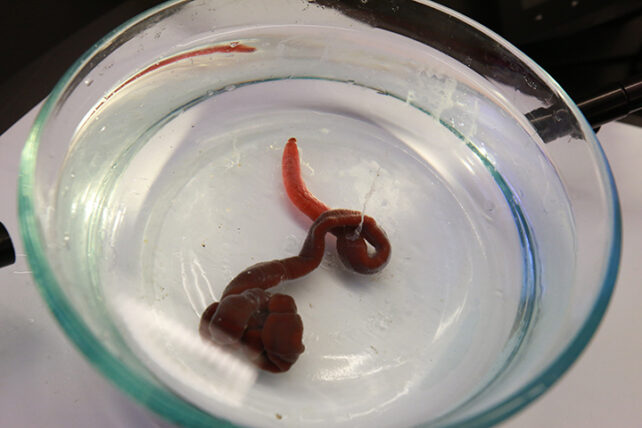
In 2024, a former student of Allen’s successfully persuaded the biologist to submit ‘B’ for genetic analysis.
The results of this testing revealed that the pet worm belongs to the species Baseodiscus punnetti, marking it as only the second individual of this particular species to have its genetic profile cataloged.
Ribbon worms, such as ‘B’, are not only characterized by their advanced age but also by their surprisingly substantial dimensions.
A ribbon worm discovered on a Scottish shoreline in 1864 is widely considered to be the longest animal ever found alive. Certain historical accounts propose that when this stranded worm was fully extended, its length was approximately twice that of a blue whale.
The age of that particular specimen remains a subject of speculation.
“Marine worms possess the potential to yield significant insights into longevity research. The development of accurate lifespan estimations for nemerteans will serve to aid researchers in more effectively assessing the ecological influence of these long-lived benthic predators on marine environments,” Allen and his collaborators assert.
This groundbreaking study was formally published in the esteemed Journal of Experimental Zoology.