Utilizing observational data procured from the NASA/ESA/CSA James Webb Space Telescope alongside the Keck II telescope, a team of astronomers has identified compelling evidence of atmospheric convection within the northern hemisphere of Titan. This region hosts the majority of Titan’s extensive lakes and seas, which are theorized to be replenished by intermittent precipitation of methane and ethane. In parallel, Webb has confirmed the presence of a pivotal carbon-containing molecule, offering significant insights into the intricate chemical transformations occurring within Titan’s complex atmosphere.

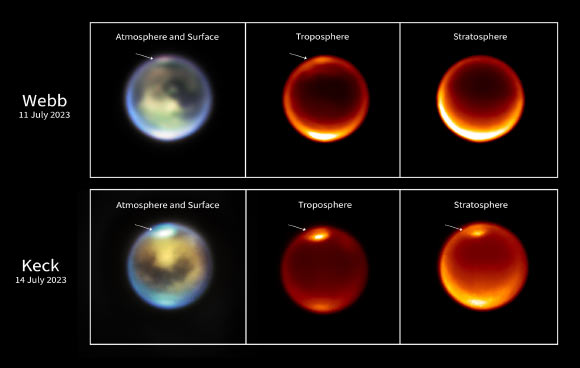
These images of Titan, captured by Webb on July 11, 2023 (top row), and the Keck II telescope on July 14, 2023 (bottom row), illustrate methane clouds (indicated by white arrows) at varying altitudes within Titan’s northern hemisphere. Credit: NASA / ESA / CSA / STScI / Keck Observatory.
Titan presents as a fascinating celestial body, enshrouded in a characteristic yellowish, hazy atmosphere. Analogous to Earth, its atmosphere is predominantly composed of nitrogen and exhibits meteorological phenomena, including cloud formations and precipitation.
In stark contrast to Earth, where weather patterns are dictated by the evaporation and condensation of water, Titan operates under a frigid methane cycle.
Methane transitions from its liquid state on the surface, ascends into the atmosphere, and subsequently condenses to form clouds of methane.
Periodically, this condensed methane descends as a chilling, viscous rain upon a solid surface where water ice possesses a rock-like rigidity.
“Titan stands as the sole other location within our Solar System to exhibit Earth-like weather patterns, encompassing both cloud formation and surface rainfall,” remarked Dr. Conor Nixon, an astronomer affiliated with NASA’s Goddard Space Flight Center.
Dr. Nixon and his associates conducted observations of Titan in November 2022 and July 2023, employing the combined capabilities of both the Webb and Keck II telescopes.
These observational campaigns not only revealed the presence of clouds in Titan’s mid and high northern latitudes – a hemisphere currently experiencing summer – but also indicated that these clouds were ascending to higher altitudes over time.
While prior investigations had documented cloud convection at southern latitudes, this marks the inaugural instance of evidence for such convection being observed in the northern regions.
This finding holds considerable significance, given that the majority of Titan’s lakes and seas are situated within its northern hemisphere, and evaporation from these bodies represents a substantial potential source of methane.
On Earth, the lowest atmospheric stratum, or troposphere, extends vertically to an altitude of approximately 12 kilometers.
However, on Titan, where its reduced gravitational pull permits atmospheric layers to expand, the troposphere reaches an altitude of roughly 45 kilometers.
Webb and Keck utilized distinct infrared filters to penetrate to varying depths within Titan’s atmosphere, enabling astronomers to ascertain the altitudes of the cloud formations.
The research team observed clouds that appeared to migrate to higher altitudes over a span of several days, although direct observation of any precipitation events was not achieved.
“Webb’s observations were acquired towards the conclusion of Titan’s northern summer, a season that we were unable to study during the NASA/ESA Cassini-Huygens mission,” stated Dr. Thomas Cornet, a researcher with ESA.
“In conjunction with ground-based observations, Webb is furnishing us with invaluable new perspectives on Titan’s atmosphere, which we aspire to investigate with greater proximity in the future through a potential ESA mission to the Saturn system.”
Titan is a subject of intense astrobiological interest due to its sophisticated organic (carbon-containing) chemistry, notwithstanding its extreme frigid temperature of minus 180 degrees Celsius.
Organic molecules form the foundational elements of all terrestrial life, and their investigation on a world such as Titan could illuminate the processes that precipitated the advent of life on Earth.
The fundamental constituent driving a significant portion of Titan’s atmospheric chemistry is methane.
Methane within Titan’s atmosphere undergoes dissociation by solar radiation or energetic electrons emanating from Saturn’s magnetosphere, subsequently recombining with other molecules to yield substances such as ethane and more complex carbon-bearing compounds.
The data acquired by Webb has supplied a critical missing element in our comprehension of these chemical processes: a definitive detection of the methyl radical (CH3), which is generated when methane is fractured.
The identification of this compound signifies that scientists can now witness the chemical reactions unfolding on Titan in real-time, rather than merely observing the initial reactants and the ultimate products.
“For the first time, we are able to perceive the chemical transformation as it evolves, analogous to observing a cake rising in the oven, rather than solely the raw ingredients of flour and sugar followed by the finished, frosted product,” commented Dr. Stefanie Milam, a researcher at NASA’s Goddard Space Flight Center.
This intricate hydrocarbon chemistry carries profound long-term implications for Titan’s future trajectory.
When methane is dissociated in the upper atmosphere, a portion of it re-forms into other molecules that ultimately settle on Titan’s surface in various chemical states, while some hydrogen escapes from the atmosphere.
Consequently, methane is destined to be depleted over extended periods, unless a replenishing mechanism is in operation.
A comparable phenomenon transpired on Mars, where water molecules were deconstructed, and the resultant hydrogen was lost to space, leading to the arid, desert landscape observed today.
“On Titan, methane is a finite resource,” stated Dr. Nixon.
“It is plausible that it is perpetually replenished and seeping from the crust and interior over billions of years.”
“Absent such replenishment, it will eventually be entirely consumed, transforming Titan into a largely airless world adorned with dust and dunes.”
The findings of this research have been disseminated in the esteemed journal Nature Astronomy.
_____
C.A. Nixon et al. The atmosphere of Titan in late northern summer from JWST and Keck observations. Nat Astron, published online May 14, 2025; doi: 10.1038/s41550-025-02537-3