The recently identified moon possesses an estimated diameter of 38 kilometers (23.6 miles) and a V magnitude of 28, positioning it as likely the most obscure celestial body ever detected orbiting a trans-Neptunian object.
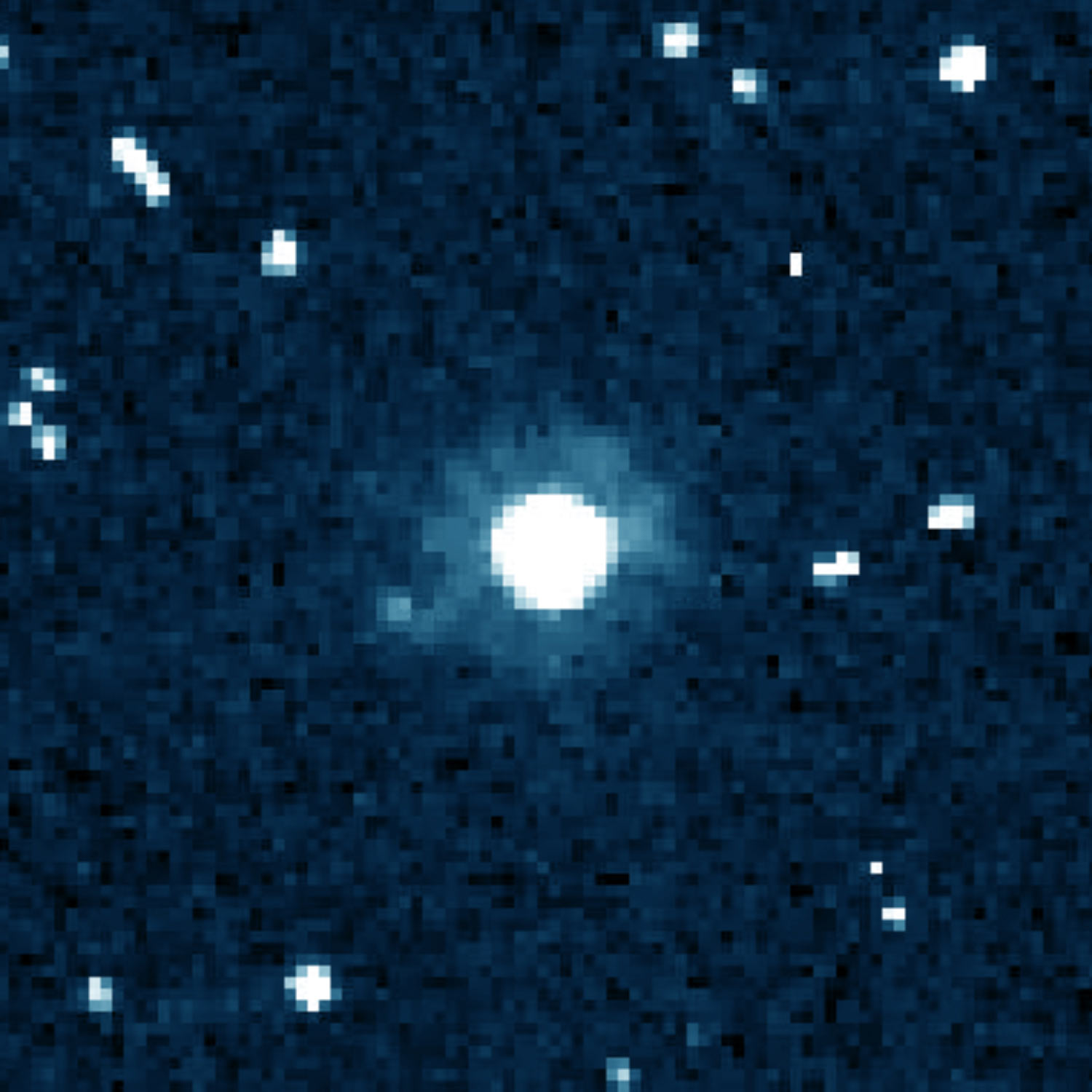
This image of Quaoar and its moon Weywot was captured by the NASA/ESA Hubble Space Telescope on February 14, 2006. Image credit: NASA / ESA / Hubble / Michael E. Brown.
First observed on June 4, 2002, Quaoar is classified as a trans-Neptunian object measuring approximately 1,100 kilometers (690 miles) across.
Analogous to the dwarf planet Pluto, this celestial entity resides within the Kuiper Belt, a vast expanse of icy remnants and cometary bodies.
Also designated as 2002 LM60, Quaoar maintains an orbital path at a distance of 45.1-45.6 astronomical units (AU) from the Sun, with a revolution period spanning 284.5 years.
In the year 2006, astronomical researchers documented the existence of Quaoar’s satellite, named Weywot, which has a diameter of 80 kilometers (50 miles) and orbits at a distance equivalent to 24 Quaoar radii.
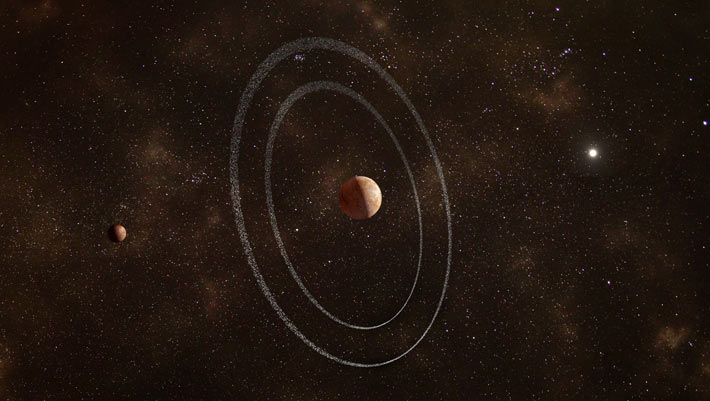
More recently, the detection of two distinct rings encircling Quaoar, identified as Q1R and Q2R, was announced.
“Over the last decade, stellar occultation events have served to reveal the presence of ring structures around diminutive celestial bodies,” stated Benjamin Proudfoot, an astronomer affiliated with the Florida Space Institute, alongside his collaborators.
“Among these configurations of rings around small celestial objects, the rings surrounding Quaoar are arguably the most enigmatic.”
“The two rings identified thus far are situated considerably beyond the Roche limit and exhibit heterogeneity.”
“Quaoar’s outermost ring, designated Q1R, appears to be influenced, at least in part, by mean motion resonances with Quaoar’s moon, Weywot, as well as spin-orbit resonances stemming from Quaoar’s non-spherical shape.”
“The interior ring, Q2R, seems to possess lower density, and its confinement characteristics are subject to greater uncertainty.”
“Recently, during an observation of a stellar occultation, synchronized data anomalies recorded by two telescopes indicated the presence of either a previously undetected satellite or a densely packed ring around Quaoar.”
“The duration of this observed anomaly suggests a minimum diameter or width of 30 kilometers.”

An artist’s impression of Quaoar and its two rings. Quaoar’s moon Weywot is shown on the left. Image credit: ESA / Sci.News.
Within their latest research endeavor, the astronomers set out to meticulously define the orbital parameters of this nascent satellite candidate.
Their findings indicate that the object is probably following an orbital trajectory of 3.6 days, situating it in close proximity to a 5:3 mean motion resonance with Quaoar’s most distant identified ring.
Furthermore, they investigated the feasibility of observing this satellite through subsequent stellar occultation events.
“Quaoar’s advantageous position within the Scutum Star Cloud will persist for approximately another decade, offering optimal conditions for occultation observations during its 286-year orbital cycle,” they remarked.
“Current terrestrial and space-based observatories will encounter difficulties in detecting the recently identified satellite due to both its low luminosity (9-10 magnitudes dimmer than Quaoar) and its minimal angular separation from Quaoar.”
“Our analysis of the Webb/NIRCam imagery of the Quaoar system did not yield any conclusive detection of the satellite,” they pointed out.
“Direct imaging with contemporary instruments would necessitate a substantial commitment of telescope observation time to reacquire the satellite’s phase through blind searching, assuming it is indeed detectable.”
“However, observatories of future generations will likely be capable of easily observing it.”
According to the research cohort, the identification of this new satellite provides corroborating evidence that Quaoar’s surrounding rings may have originated from an expansive, primordial collisional disk that has undergone significant evolution since its inception.
“An in-depth examination of the formation processes and historical trajectory of the moon-disk system will offer profound insights into the genesis of trans-Neptunian objects,” the researchers posited.
“We advocate for the implementation of sophisticated tidal, hydrodynamical, and collisional modeling techniques applied to the Quaoar system.”
The team’s publication has been submitted for peer review and subsequent publication in the Astrophysical Journal Letters.
_____
Benjamin Proudfoot et al. 2025. Orbital characterization of a newly discovered small satellite around Quaoar. ApJL, in press; arXiv: 2511.07370