A groundbreaking investigation led by Dr. Ross Young from the University of Adelaide, in collaboration with the QCDSF Collaboration, is delving into the fundamental constituents of matter. Their objective is to illuminate the forces governing our universe, culminating in what is potentially the most detailed visualization of nature’s forces at the subatomic level ever achieved.
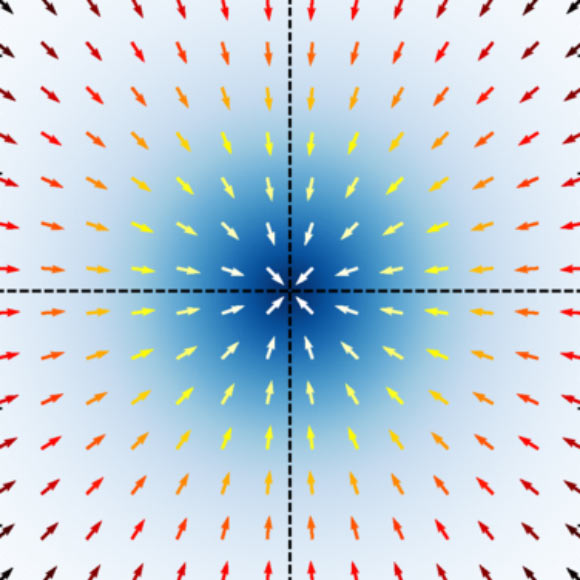
Visual representation of the color-Lorentz force acting on a randomly oriented up quark within the transverse plane (depicted by the vector field), overlaid on the density distribution of the up quark in impact-parameter space for an unpolarized proton. Image courtesy: Crawford et al., doi: 10.1103/PhysRevLett.134.071901.
“We employed a sophisticated computational methodology known as lattice quantum chromodynamics to chart the forces operative within a proton,” stated Dr. Young.
“This technique involves discretizing spacetime into a minute lattice, thus enabling us to simulate the behavior of the strong nuclear force — the essential interaction responsible for binding quarks into protons and neutrons — across various internal regions of the proton.”
“Our findings indicate that despite operating at these infinitesimal scales, the forces involved are of tremendous magnitude, reaching as high as half a million Newtons. This is comparable to the collective weight of approximately 10 elephants, all confined within a space considerably smaller than an atomic nucleus,” remarked Joshua Crawford, a Ph.D. candidate at the University of Adelaide.
These detailed force maps offer a novel perspective for comprehending the complex internal dynamics of the proton, contributing to an enhanced understanding of its behavior in high-energy particle collisions, such as those conducted at CERN’s Large Hadron Collider, and in experimental investigations of matter’s fundamental structure.
“Thomas Edison did not conceive the incandescent light bulb by merely studying brighter candles; he advanced upon the accumulated knowledge of generations of scientists who investigated the interplay between light and matter,” Dr. Young observed.
“In a parallel fashion, contemporary research, including our recent work, is elucidating the behavior of matter’s fundamental constituents when subjected to photonic impact, thereby deepening our comprehension of nature at its most elemental level.”
“As scientific inquiry continues to unravel the proton’s internal architecture, a more profound understanding may facilitate refinements in how we utilize protons in advanced technological applications.
“A notable illustration of this is proton therapy, which harnesses high-energy protons to precisely target cancerous tumors while minimizing collateral damage to surrounding healthy tissue.”
“Analogous to how early insights into the nature of light paved the way for contemporary lasers and imaging technologies, augmenting our knowledge of proton structure holds the potential to shape the next generation of scientific and medical applications.”
“By rendering the previously imperceptible forces within the proton visually apparent for the first time, this research establishes a crucial link between theoretical predictions and experimental validation, echoing the efforts of historical pioneers who unlocked the secrets of light to revolutionize the modern world.”
The research detailing the team’s discoveries has been formally presented in a publication within the esteemed journal Physical Review Letters.
_____
J.A. Crawford et al. 2025. Transverse Force Distributions in the Proton from Lattice QCD. Phys. Rev. Lett 134, 071901; doi: 10.1103/PhysRevLett.134.071901