The celestial body designated TIC 290061484 harbors a binary star system in close orbital proximity, completing a revolution every 1.8 days, alongside a third star that circumnavigates this pair on a mere 25-day cycle. This remarkable finding establishes a new benchmark for the shortest outer orbital period recorded for such a configuration, surpassing the previous record held by Lambda Tauri since 1956, which featured a third star revolving around an inner binary in 33 days.

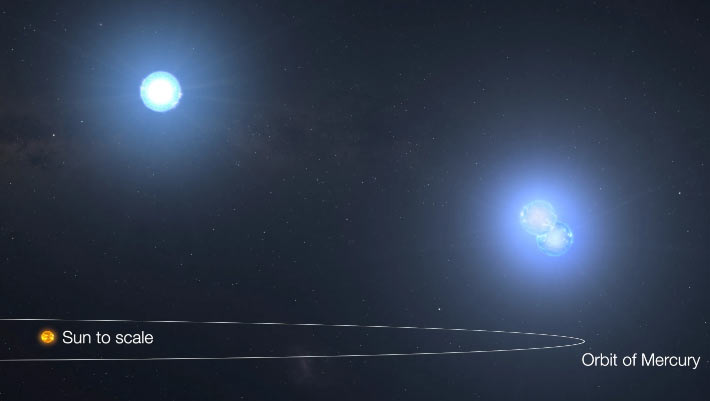
This artist’s concept illustrates how tightly the three stars in the TIC 290061484 system orbit each other. If they were placed at the center of our solar system, all the stars’ orbits would be contained a space smaller than Mercury’s orbit around the Sun. The sizes of the triplet stars and the Sun are also to scale. Image credit: NASA’s Goddard Space Flight Center.
Stellar binaries are a pervasive feature of the Milky Way, with over half of star systems similar to our Sun exhibiting at least one stellar companion, and frequently more than one.
Indeed, the closest stellar neighbor to our Sun, Proxima Centauri, is an integral component of the Alpha Centauri triple star system.
This particular configuration is relatively diffuse, allowing all three stellar bodies to be resolved visually. The inner binary pair, comprising Alpha Centauri A and B, possesses an orbital period approaching 80 years, while Proxima Centauri requires approximately 550,000 years to complete a single revolution around their collective center of mass.
Triple star systems span a vast spectrum of physical characteristics, stellar classifications, and orbital arrangements.
The more extensive orbital period systems, akin to Alpha Centauri, represent one end of this continuum, where the gravitational interplay between constituent stars unfolds over such immense timescales that significant dynamic events are highly improbable within a human lifespan.
Conversely, tightly packed, short-period systems at the opposite extremity of stellar triple configurations are capable of displaying a diverse array of observable dynamical interactions, often quite spectacular in nature.
Logically, the shorter the outer orbital period, the more pronounced the gravitational interactions among the individual components become. Consequently, the most scientifically compelling systems are typically those with outer orbital periods under 1,000 days, commonly classified as compact hierarchical triples.
Notwithstanding the substantial advancements in our comprehension of compact hierarchical triples facilitated by these recent discoveries, one aspect had remained constant since the mid-20th century.
For upwards of 68 years, Lambda Tauri held the distinction of being the compact hierarchical triple system with the shortest outer orbital period, measuring 33.02 days.
Now, owing to NASA’s Transiting Exoplanet Survey Satellite (TESS) mission, astronomers have confirmed TIC 290061484, a triply eclipsing compact hierarchical triple star system, boasting an outer period of a mere 24.5 days – a reduction of almost 9 days compared to Lambda Tauri.
Also identified as Gaia 2169382208774963072, TIC 290061484 is situated at a distance of 1,519 parsecs (equivalent to 4,954 light-years) within the constellation Cygnus.
“The system’s compact, edge-on arrangement enables us to precisely determine the orbital parameters, masses, dimensions, and temperatures of its constituent stars,” stated Dr. Veselin Kostov, an astronomer affiliated with NASA’s Goddard Space Flight Center and the SETI Institute.
“Furthermore, we can analyze its formation history and project its future evolutionary trajectory.”

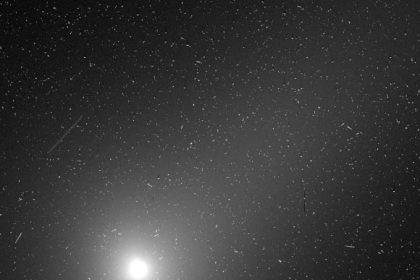
PanSTARRS image centered on the TIC 290061492 system. Image credit: Kostov et al., doi: 10.3847/1538-4357/ad7368.
Through the application of machine learning algorithms, Dr. Kostov and his research team meticulously processed extensive datasets of stellar light curves obtained from TESS, successfully identifying patterns of light diminution indicative of eclipses.
Subsequently, a dedicated cohort of citizen scientists performed a more refined analysis, leveraging their extensive experience and informal training to pinpoint particularly compelling astronomical phenomena.
These amateur astronomers were participants in an online citizen science initiative known as Planet Hunters, which operated from 2010 to 2013.
These volunteers later joined forces with professional astrophysicists to establish a novel collaborative effort named the Visual Survey Group, which has been actively engaged for over a decade.
“Our primary objective is to detect signatures of compact multi-star systems, atypical pulsating stars within binary configurations, and enigmatic celestial objects,” explained MIT Professor Saul Rappaport.
“The discovery of a system like this is thrilling, as they are exceedingly rare, yet their prevalence may be underestimated by current astronomical catalogs.”
“Numerous other such systems likely populate our Galaxy, awaiting their detection.”
The near-coplanar orbital alignment of the stars within the TIC 290061484 system contributes significantly to its probable long-term stability, despite their close proximity.
The gravitational influence of each star on the others is minimized, unlike scenarios where their orbital planes are significantly inclined.
“However, while their orbital configurations are projected to remain stable for millennia, this environment is not conducive to life,” commented Professor Rappaport. “We hypothesize that these stars coalesced from a singular stellar nursery, a process that would have precluded the formation of planets in close proximity to any of the individual stars.”
“An exception might exist in the form of a planet with a distant orbit around the entire triple system, as if it were a single massive entity.”
“As the inner stars progress through their life cycles, they will inevitably expand and eventually merge, culminating in a supernova event approximately 20 to 40 million years from now.”
In the interim, astronomical researchers are actively pursuing the identification of triple star systems exhibiting even more abbreviated orbital periods.
“Our understanding of many stars situated in the galactic core is limited, with the exception of the most luminous ones,” observed Dr. Brian Powell, a data scientist at NASA’s Goddard Space Flight Center.
“The advanced resolution capabilities of NASA’s forthcoming Nancy Grace Roman Space Telescope will empower us to measure faint light emissions from stars that typically appear blurred together, thus providing an unprecedentedly detailed view of stellar system characteristics within our Galaxy.”
This groundbreaking discovery has been documented in a research publication featured in the Astrophysical Journal.
_____
V.B. Kostov et al. 2024. TIC 290061484: A Triply Eclipsing Triple System with the Shortest Known Outer Period of 24.5 Days. ApJ 974, 25; doi: 10.3847/1538-4357/ad7368