Recent scientific investigations conducted by the University of Adelaide offer novel insights into the enigmatic disappearance of cold eclogites—rocks subjected to intense pressure during metamorphism, predominantly composed of garnet and omphacite—from the geological strata during the planet’s formative epochs.
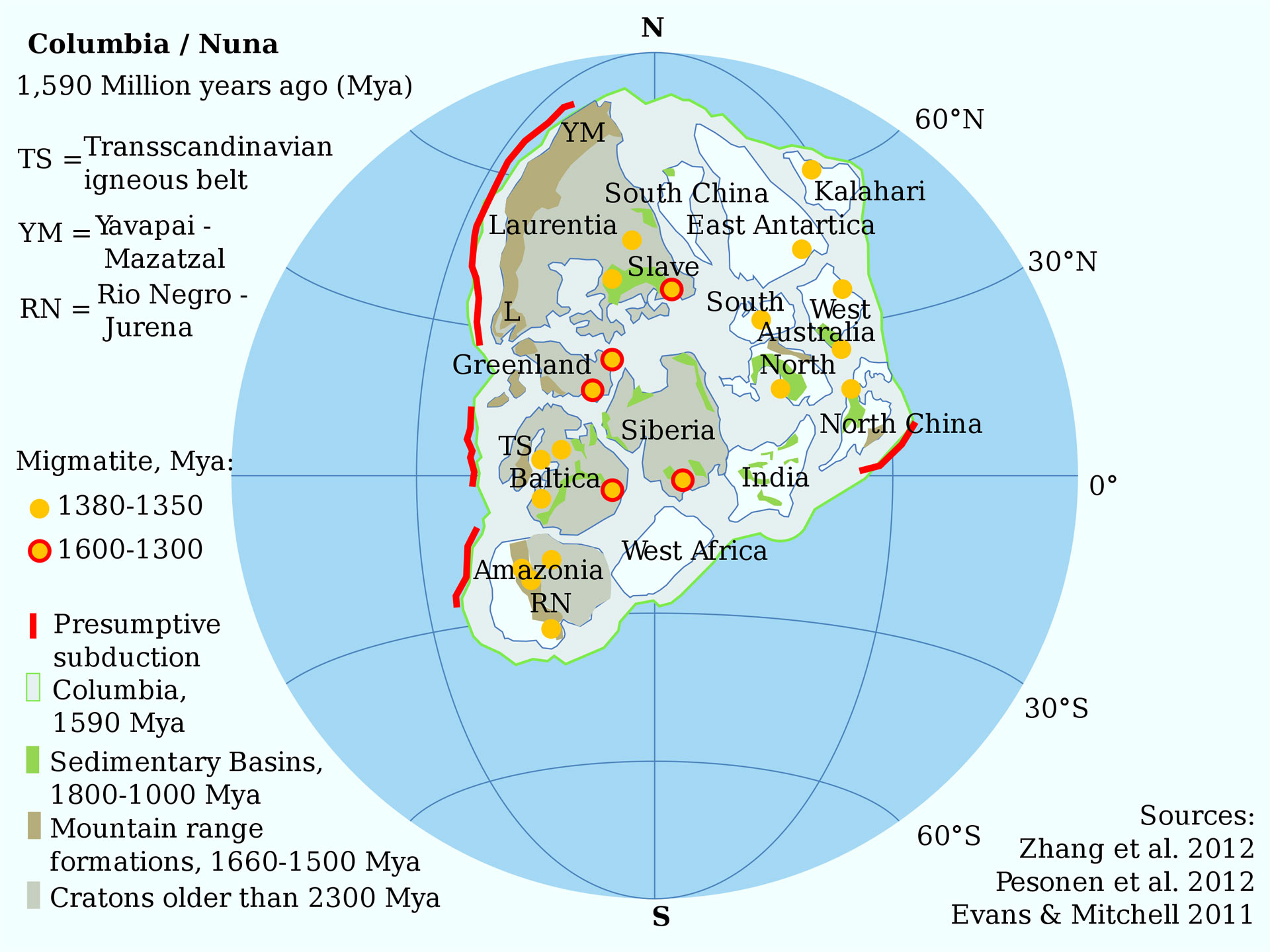
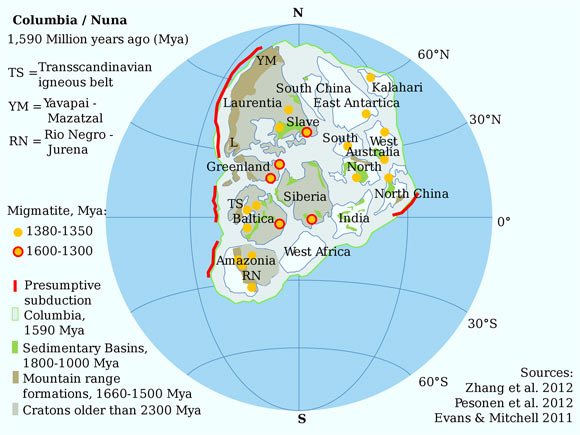
The supercontinent Nuna approximately 1.59 billion years ago. Image credit: Alexandre DeZotti.
“The geological chronicle shows an unexplained absence of cold eclogites between 1.8 and 1.2 billion years ago, followed by their subsequent reappearance,” observed Dr. Derrick Hasterok, a member of the Department of Earth Sciences faculty at the University of Adelaide.
“These formations are significant because they are highly sensitive to thermal conditions in the upper mantle and provide tangible proof of crustal material being rapidly transported to profound depths within the Earth’s interior, often along fault lines that develop at convergent plate boundaries.”
“The prevailing hypothesis suggests that the preservation of cold eclogites is contingent upon periods of supercontinent aggregation,” he posited.
“However, substantial evidence indicates a largely continuous geological record of cold eclogites spanning the last 700 million years, a timeframe marked by the formation and fragmentation of two supercontinents.”
Coinciding with this observed alteration in eclogite occurrences is a discernible shift in the elemental composition of various trace elements within igneous rocks found in other sections of the Earth’s crust, which further corroborates the notion of sub-continental thermal augmentation.
These trace elements are integral components of critical minerals, which are indispensable for the economic vitality of both established and emerging global economies.
“Our examination of the trace element geochemistry in granites points towards a widespread thermal event affecting the continents approximately 2 billion years ago, which aligns temporally with the consolidation of Nuna (also identified as Columbia, Paleopangaea, and Hudsonland), a supercontinent whose formation was finalized 1.6 billion years ago,” stated Dr. Renee Tamblyn, also affiliated with the Department of Earth Sciences at the University of Adelaide.
“While the Earth has generally experienced a cooling trend since its inception, the Nuna supercontinent acted as a thermal insulator for the mantle, analogous to a substantial blanket. This insulation led to elevated temperatures beneath the continental masses, thereby hindering the preservation of eclogites and modifying the geochemical signatures of granites.”
“The compositional anomalies stemming from this unique paleo-thermal episode could potentially aid in the exploration for specific critical mineral deposits, by identifying geological formations predating or postdating this heating event, depending on the particular element of interest.”
The discoveries have been disseminated through the esteemed journal Geology.
_____
R. Tamblyn et al. Mantle heating at ca. 2 Ga by continental insulation: Evidence from granites and eclogites. Geology, published online September 21, 2021; doi: 10.1130/G49288.1