Current observations of extensive valley networks on Mars strongly indicate formation by fluvial processes. Nevertheless, prevailing climate models struggle to account for temperatures persistently above the freezing point. To reconcile this discrepancy, a cadre of planetary scientists developed models for the two principal theories of valley genesis: one driven by precipitation (implying a temperate, humid environment) and another by episodic melting of ice at the periphery of ice caps (suggesting a frigid setting). Their analysis revealed that the primary differentiator between these scenarios was the topographical origin point of the nascent valleys. In a warm, wet regime, valleys tend to initiate at a broad spectrum of elevations. Conversely, under an icy, cold scenario, valley formation is primarily confined to altitudes near the ice melt boundary. Subsequently, the researchers meticulously examined a Martian region characterized by numerous large valley systems, with a specific focus on the location and altitude of the valley headwaters. Their deduced patterns of valley head distribution align more closely with the predictions of a climate incorporating precipitation, rather than solely relying on meltwater runoff from glacial formations. This evidence suggests that precipitation played a pivotal role in sculpting these valleys, inferring that ancient Mars likely possessed a climate sufficiently mild to sustain rainfall.
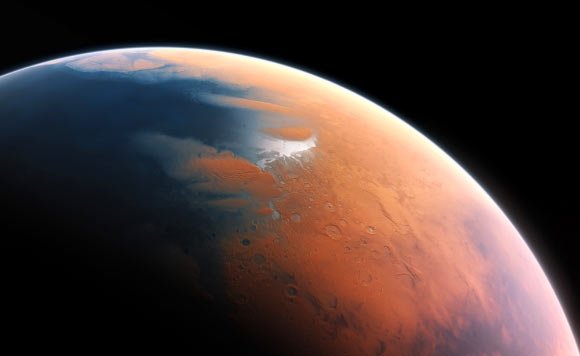
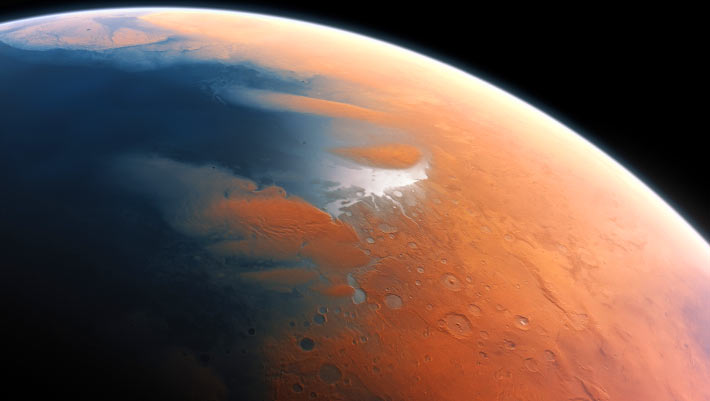
Heavy precipitation likely fed many networks of valleys and channels that shaped the Martian surface billions of years ago. Image credit: M. Kornmesser / ESO.
“One might examine satellite imagery of terrestrial locales such as Utah and observe striking resemblances to the Martian topography upon zooming out,” commented Dr. Amanda Steckel, a researcher affiliated with the California Institute of Technology.
The scientific consensus today largely acknowledges the presence of surface water on Mars during the Noachian epoch, which spanned approximately 4.1 to 3.7 billion years ago.
However, the precise origins of this water have remained an enduring enigma.
Certain scientific hypotheses propose that ancient Mars was not characterized by a warm, humid environment, but rather consistently cold and arid.
At that juncture, the nascent Sun within our Solar System emitted roughly 75% of the solar irradiance observed today.
Expansive ice sheets may have blanketed the elevated regions surrounding the Martian equator, undergoing intermittent melting over discrete periods.
In their recent investigative work, Dr. Steckel and her collaborators endeavored to scrutinize the divergent theories of a warm-and-wet versus a cold-and-dry past climate for Mars.
The research team leveraged computational simulations to explore the mechanisms by which water may have sculpted the Martian surface eons ago.
Their findings indicated that atmospheric precipitation, in the form of snow or rain, was a likely contributor to the formation of the valley patterns and headwaters that persist on Mars today.
“Ascertaining any definitive conclusions presents significant challenges,” stated Dr. Steckel.
“However, we observe these valleys originating across a wide range of topographical elevations, an observation that is difficult to attribute solely to glacial activity.”
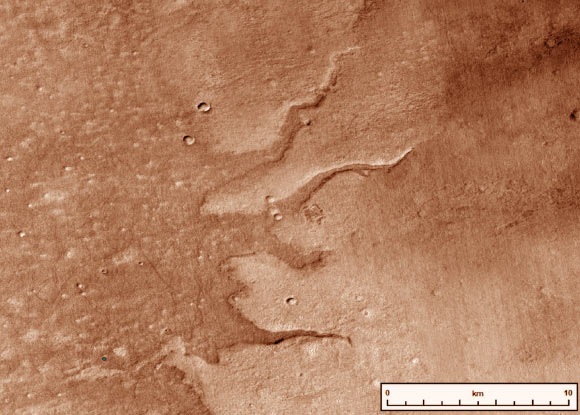
This image shows a suite of fluvial ridges on Mars (at –67.64 °E, 43.37 °S). Image credit: J. Dickson.
Contemporary satellite imagery of Mars continues to reveal the indelible marks left by water on the planet’s surface.
In the equatorial regions, for instance, intricate networks of channels radiate from Martian highlands, exhibiting a dendritic branching pattern akin to trees, ultimately converging into what were likely ancient lakes and perhaps even an ocean.
NASA’s Perseverance rover, which successfully landed on Mars in 2021, is presently conducting investigations within Jezero crater, the site of one such paleo-lake.
During the Noachian period, a substantial river system discharged into this area, depositing a sedimentary delta upon the crater floor.
“The deposition of such large-scale boulders would necessitate a water flow measured in meters in depth,” explained Dr. Brian Hynek, a researcher associated with the Laboratory for Atmospheric and Space Physics at the University of Colorado Boulder.
To meticulously reconstruct this ancient epoch, the scientists generated a virtual representation of a specific Martian region.
Utilizing this digital environment, they simulated the evolutionary trajectory of the terrain in synthetic landscapes mirroring the Martian equatorial zone.
In certain simulation runs, water was introduced through artificial precipitation. In other scenarios, the models incorporated the effects of receding ice caps.
Following this, the simulations allowed the simulated water to flow over extended periods, ranging from tens to hundreds of thousands of years.
The authors then meticulously analyzed the resultant geomorphological patterns, with a particular emphasis on the locations from which the headwaters feeding Mars’ intricate valley systems originated.
These distinct simulation scenarios produced vastly different planetary landscapes: In the case of melting ice caps, the valley headwaters predominantly formed at elevated altitudes, roughly coinciding with the inferred margins of the ancient ice extent. In contrast, the simulations involving precipitation resulted in a more diffuse distribution of Martian headwaters, initiating at elevations spanning from below the planet’s mean surface level to as high as approximately 3,350 meters (11,000 feet).
“Water originating from these ice caps tends to carve valleys only within a confined range of elevations,” Dr. Steckel elaborated.
“Conversely, when considering distributed precipitation, valley heads can emerge across a much broader geographical area.”
The research collective then proceeded to juxtapose these simulated outcomes with empirical data acquired from NASA’s Mars Global Surveyor and Mars Odyssey spacecraft missions.
The computational models that incorporated the influence of precipitation demonstrated a more robust congruence with the actual geological features observed on the Red Planet.
The researchers are careful to emphasize that these findings do not represent the definitive resolution to the question of Mars’ ancient climate; crucially, the mechanism by which the planet maintained sufficient warmth to support snowfall or rainfall remains an open inquiry.
“Nonetheless, our investigation furnishes the scientific community with novel perspectives on the geological history of another celestial body: our own,” stated Dr. Hynek.
“Once the erosive forces of flowing water subsided, Mars effectively became a time capsule, likely preserving an appearance remarkably similar to Earth’s state approximately 3.5 billion years ago.”
This investigation was formally documented and published in the Journal of Geophysical Research: Planets, accessible via the provided link: link.
_____
Amanda V. Steckel et al. 2025. Landscape Evolution Models of Incision on Mars: Implications for the Ancient Climate. JGR Planets 130 (4): e2024JE008637; doi: 10.1029/2024JE008637