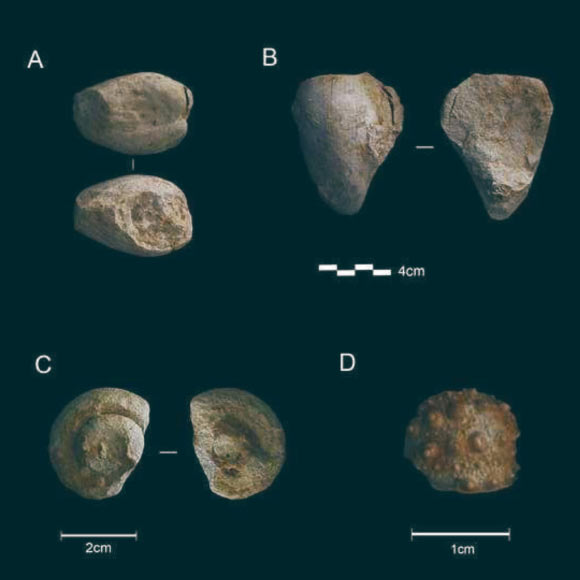
Analysis of a cave dwelling in contemporary Spain indicates that Neanderthal populations, existing approximately 46,000 years ago, engaged in the deliberate acquisition and curation of fossils, as detailed in a recent publication featured in the journal Quaternary.

Marine fossils originating from Prado Vargas Cave in Spain. Image attribution: Ruiz et al., doi: 10.3390/quat7040049.
The practice of collecting, characterized by the systematic gathering, preservation, and exhibition of items, stands as a pursuit often associated with leisure and even a profound personal interest.
When delving into the historical origins of collecting within scholarly discourse, attention is frequently drawn to the advent of written records and the consolidation of knowledge, notably exemplified by the Assyrian monarch Ashurbanipal in the 7th century BCE, whose affinity for amassing literary works, inscribed on clay tablets, is well documented.
However, this perspective does not fully encompass the chronological depth of collecting behaviors, as evidence suggests earlier instances of such practices.
The innate human inclination to gather stones or fossils possessing distinctive hues and configurations, identified as manuports, extends back to the earliest epochs of human existence.
For many years, archaeological findings have brought to light the presence of artifacts devoid of practical utility within the living spaces of Neanderthal communities.
Numerous archaeological sites across Europe have corroborated that these Neanderthal groups held certain objects in high regard, particularly those that captured their interest.
On occasion, these discovered items may have undergone modification for personal adornment or were even incorporated into subsistence activities, serving roles such as grinders or rudimentary hammers.
Typically, an excavation might yield one or two such artifacts; however, to date, no Neanderthal habitation site or encampment has produced a quantity comparable to that unearthed at Prado Vargas Cave, located in Cornejo, Burgos, Spain.
Within the Mousterian stratum of this cave, a team led by Marta Navazo Ruiz, an archaeologist from the Universidad de Burgos, along with her collaborators, discovered a collection of 15 marine fossils dating back to the Upper Cretaceous period.
The researchers elaborated that, with the exception of a single specimen belonging to the phylum of echinoderms, all the recovered fossils originate from the phylum Mollusca.
Among the molluskan specimens, precisely half are classified within the class Bivalvia, while the remaining half belong to the class Gastropoda.
The family exhibiting the greatest representation among the gastropods, accounting for six specimens, is Tylostomatidae. This particular fossil group shares its taxonomic class with contemporary snails and could attain lengths of up to 10 cm. Their shells are characterized by a holostomatous structure with multiple whorls, the final and largest of which is particularly prominent.
The Tylostomatidae fossils discovered within the cave represent snails that once inhabited the shallow marine environments millions of years ago.
Aside from one instance, the fossils do not exhibit any indications of having been repurposed as tools.
Consequently, their presence within the cave can be attributed to deliberate collection activities.
The archaeologists posited that the selection and conveyance of these fossils by the Neanderthals into the cave likely held significant symbolic meaning, prompting the research cadre to propose several hypotheses to elucidate this behavioral pattern.
Potential motivations, as suggested by the team, might include their collection purely for their aesthetic appeal, stemming from an appreciation of their striking forms; for the purpose of trade and exchange among individuals within their social group or with other Neanderthal communities; as playthings for children; or as a means of reinforcing their collective cultural identity, serving as an element that forged a tangible connection between the group and the territory they occupied.
It is a plausible consideration that the act of collecting was undertaken by the younger members of the Neanderthal group, the researchers noted.
Studies focusing on our own species have demonstrated that the accumulation of objects is a commonly observed characteristic of childhood development.
According to experts in the field, the propensity for collecting typically emerges in human children between the ages of three and six, coinciding with the onset of self-awareness, and persists until approximately the age of twelve.
Whilst the intensity diminishes, collecting behaviors continue into adolescence; however, this pattern tends to wane from around the age of eighteen, only to re-emerge sporadically in adulthood, typically around the age of forty.
The researchers concluded that it is conceivable the Neanderthals associated with Prado Vargas cave encountered these fossils either through intentional search or serendipitous discovery; however, the deliberate, systematic, and repeated act of transporting them into the cave is undeniable, reflecting their earnest efforts and keen interest in collecting these particular fossils.
Therefore, the Neanderthal inhabitants of this Burgos cave are now recognized as the earliest known collectors of fossils within the timeline of human evolutionary history.
_____
Marta Navazo Ruiz et al. 2024. Were Neanderthals the First Collectors? First Evidence Recovered in Level 4 of the Prado Vargas Cave, Cornejo, Burgos and Spain. Quaternary 7 (4): 49; doi: 10.3390/quat7040049