Newly unearthed research from the University of Wyoming reveals that bone needles discovered at the 12,900-year-old La Prele site in Wyoming, USA, were fashioned from the skeletal remains of foxes, hares, and various felids, including bobcats, mountain lions, lynx, and potentially even the now-extinct American cheetah. These specific animal bones were favored by the early Paleoindian foragers at La Prele due to their optimal dimensions for crafting needles and their ready availability within the campsite, often remaining attached to pelts meticulously sewn into intricate garments.

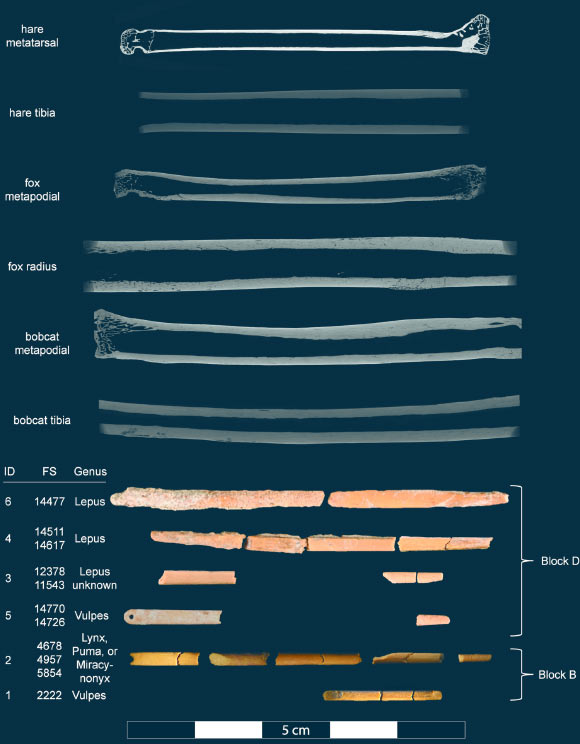
Reconstructions of La Prele bone needles and preforms, alongside Micro-CT scans of comparable faunal specimens. Image credit: Pelton et al., doi: 10.1371/journal.pone.0313610.
Situated on a tributary of the North Platte River near Douglas, Wyoming, La Prele stands as a significant Early Paleoindian mammoth kill site and campsite.
Over ten seasons of extensive excavations across four primary excavation blocks, a vast collection of tens of thousands of artifacts has been unearthed, all linked to a single period of occupation.
Among the diverse array of tools and objects recovered from the site to date are 32 fragmented bone needles.
“Our investigation marks the inaugural effort to identify the specific species and likely bone elements from which Paleoindians manufactured eyed bone needles,” stated Wyoming State Archaeologist Spencer Pelton and his research team.
“Our findings provide compelling evidence for the creation of tailored clothing utilizing bone needles and the pelts of fur-bearing animals.”
“These types of garments played a role in enabling modern human migration into more northerly latitudes and ultimately facilitated their colonization of the Americas.”
In their comprehensive study, Dr. Pelton and his colleagues meticulously examined the bone needle fragments recovered from the La Prele excavation.
They performed comparative analyses of peptides—short chains of amino acids—extracted from these artifacts, juxtaposing them with peptide profiles from animals known to have inhabited North America during the Early Paleoindian epoch, a prehistoric era spanning roughly 13,500 to 12,000 years ago.
The comparative analysis conclusively indicated that bones originating from red foxes; felids such as bobcats, mountain lions, lynx, or the American cheetah; and hares or rabbits were utilized in the fabrication of needles at the La Prele site.
“Despite the critical importance of bone needles in explaining the global dispersal of modern humans, archaeologists have historically struggled to identify the precise materials used in their construction, thereby limiting our comprehension of this pivotal cultural advancement,” the researchers commented.
Prior scholarly work has posited that to endure the frigid conditions prevalent in higher latitudes, early humans likely developed meticulously constructed, tailored garments with tightly sealed seams, offering robust protection against the elements.
While direct physical evidence of such garments is scarce, there exists substantial indirect proof in the form of bone needles and the skeletal remains of fur-bearing animals whose pelts were integral to these sophisticated outfits.
“Upon being outfitted with such protective clothing, modern humans gained the capability to extend their geographical range into territories from which they had previously been excluded due to the pervasive threat of hypothermia or fatal exposure,” the scientists explained.
“The perplexing question arises: how did the inhabitants of the La Prele site acquire these fur-bearing animals?”
“It is highly probable that their acquisition was achieved through trapping methods, and not necessarily as a primary source for sustenance.”
“Our research serves as a valuable reminder that ancient foragers utilized animal products for a wide spectrum of purposes beyond mere subsistence, underscoring that the mere presence of animal bones at an archaeological site should not automatically be interpreted as evidence of diet.”
“When considered in conjunction with a review of analogous findings from other Paleoindian sites across North America, our results strongly suggest that Early Paleoindians in North America possessed direct access to fur-bearing predators, likely obtained through trapping practices, and they represent some of the most detailed archaeological evidence discovered to date pertaining to Paleoindian attire.”
These significant findings have been formally published in the esteemed scientific journal PLoS ONE.
_____
S.R. Pelton et al. 2024. Early Paleoindian use of canids, felids, and hares for bone needle production at the La Prele site, Wyoming, USA. PLoS ONE 19 (11): e0313610; doi: 10.1371/journal.pone.0313610