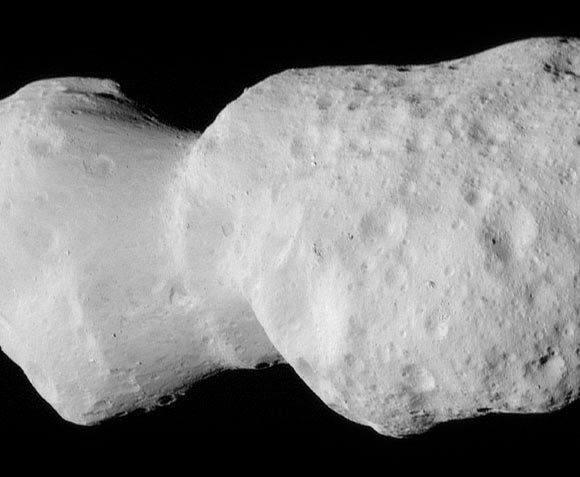
NASA’s Lucy probe successfully acquired images of an asteroid designated Donaldjohanson during a close orbital pass on April 20, 2025. The spacecraft executed its trajectory to within 960 kilometers (600 miles) of the celestial body at its nearest point.
Donaldjohanson is classified as a carbonaceous asteroid, situated within the inner precincts of the primary asteroid belt.
Its initial detection occurred on March 2, 1981, by the American astronomer Schelte Bus, who made the discovery from the Siding Spring Observatory.
Prior observations of Donaldjohanson had indicated significant fluctuations in its luminosity over a ten-day interval. Consequently, some expectations held by the Lucy mission team were validated when the preliminary imagery revealed what appeared to be a fused contact binary – a formation resulting from the impact of two smaller entities.
Nevertheless, the research community expressed surprise at the peculiar morphology of the narrow connection linking the two distinct masses, which bears a resemblance to two inverted ice cream cones.
“The geological complexity exhibited by asteroid Donaldjohanson is profoundly striking,” stated Dr. Hal Levison, the principal investigator for the Lucy mission and a researcher affiliated with the Southwest Research Institute.
“Through a detailed examination of these intricate structures, invaluable insights into the primordial constituents and the collisional dynamics that shaped the planets within our Solar System will undoubtedly be illuminated.”

This image of the asteroid Donaldjohanson was captured by the Lucy Long-Range Reconnaissance Imager (L’LORRI) on April 20, 2025, near closest approach, from a range of 1,100 km (660 miles). Image credit: NASA / Goddard / SwRI / Johns Hopkins APL / NOIRLab.
Based on an initial appraisal of the inaugural images acquired by the spacecraft’s L’LORRI imaging system, Donaldjohanson seems to exceed its previously estimated dimensions, measuring approximately 8 kilometers (5 miles) in length and 3.5 kilometers (2 miles) in width at its broadest point.
“In this initial compilation of high-resolution imagery transmitted back by the spacecraft, the entirety of the asteroid is not encompassed, as its dimensions surpass the field of view of the imager,” the scientific team elaborated.
“The complete transfer of the encounter data from the spacecraft is anticipated to require as much as a week; this comprehensive dataset will furnish a more holistic depiction of the asteroid’s overall configuration.”
“These initial photographic records of Donaldjohanson once again underscore the remarkable proficiencies of the Lucy spacecraft as a catalyst for discovery,” commented Dr. Tom Statler, the Lucy program scientist and a member of the research staff at NASA Headquarters.
“The potential for Lucy to truly unveil a novel perspective on the historical evolution of our Solar System, particularly as it approaches the Trojan asteroids, is exceptionally significant.”
In a manner analogous to Dinkinesh, the inaugural asteroid target encountered by Lucy, Donaldjohanson does not represent a primary scientific objective for the mission.
As per the mission’s design, the Dinkinesh flyby served as a diagnostic trial for the spacecraft’s systems, whereas this particular encounter was conceived as a full-scale operational test, during which the team executed a series of intensive observational protocols to maximize data acquisition.
The information gathered by Lucy’s other scientific instrumentation, including the L’Ralph color imager and infrared spectrometer, as well as the L’TES thermal infrared spectrometer, is slated for retrieval and subsequent analysis over the ensuing several weeks.
The Lucy spacecraft is scheduled to traverse the main asteroid belt for the majority of the remaining duration of 2025.
Lucy is set to rendezvous with the mission’s initial primary target, the Jupiter Trojan asteroid designated Eurybates, in August 2027.