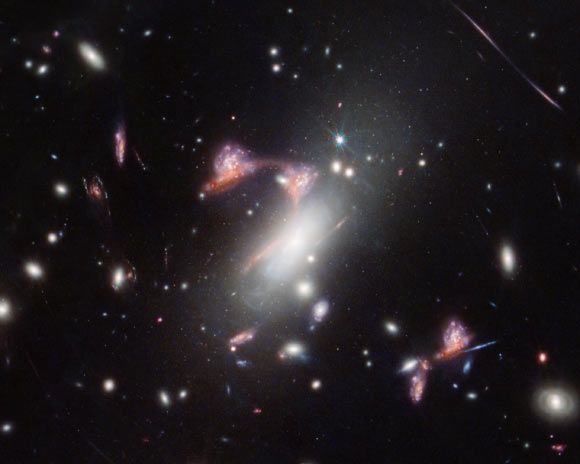
Seven billion years ago, the cosmos was experiencing its zenith of stellar generation, a period now entering a phase of decline. What celestial panorama might our own Milky Way galaxy have presented during that era? Utilizing the advanced capabilities of the NASA/ESA/CSA James Webb Space Telescope, astronomers have unearthed compelling evidence in the form of a cosmic question mark, a spectacular manifestation of a rare spatial alignment spanning vast interstellar distances.

The immense galaxy cluster MACS-J0417.5-1154 exerts such gravitational influence that it contorts the very fabric of space-time, distorting the visual representation of galaxies situated behind it—a phenomenon termed gravitational lensing. This intrinsic cosmic process serves to amplify the apparent size of remote galaxies and can, in some instances, render them visible multiple times within a single observation, as was the case with this Webb discovery. Two galaxies in close proximity, a spiral viewed face-on and a reddish, dust-laden galaxy seen in profile, are duplicated within the imagery, collectively sketching a recognizable punctuation mark against the celestial backdrop. The presence of vigorous star formation, coupled with the exceptionally preserved spiral morphology of the face-on galaxy, strongly suggests that their interaction is in its nascent stages. Image credited to NASA / ESA / CSA / STScI / V. Estrada-Carpenter, Saint Mary’s University.
“We are aware of only a handful of instances—three or four, at most—of comparable gravitational lens configurations within the observable universe. Consequently, this particular finding is exceptionally noteworthy, as it not only underscores the observational prowess of Webb but also hints at the potential for discovering more such phenomena henceforth,” stated Dr. Guillaume Desprez of Saint Mary’s University.
Although this cosmic locale has been previously surveyed by the NASA/ESA Hubble Space Telescope, the enigmatic dusty red galaxy, responsible for forming the striking question-mark silhouette, only became discernible upon observation with the Webb telescope.
This disparity arises from the differential interaction of light wavelengths with cosmic dust; Hubble’s detected wavelengths can be obstructed by such particulate matter, whereas Webb’s instruments are adept at capturing longer, infrared wavelengths that penetrate these dusty veils.
Astronomers leveraged the observational capabilities of both telescopes to scrutinize the galaxy cluster known as MACS-J0417.5-1154. This cluster functions analogously to a cosmic magnifying glass, its substantial mass inducing a curvature in the continuum of space-time.
This distortion effect empowers astronomers to discern considerably finer details within galaxies situated much farther afield, lying beyond the cluster’s influence.
Conversely, the identical gravitational forces responsible for the magnification also precipitate distortions, resulting in galaxies that manifest as elongated streaks across the celestial sphere, appearing as arcs, and in some cases, being imaged multiple times.
These visually deceptive arrangements in space are scientifically classified as gravitational lensing.
The crimson galaxy, brought to light by Webb’s observations, alongside a spiral galaxy with which it is dynamically engaged (previously identified by Hubble), are undergoing magnification and distortion in a highly distinctive manner. This requires a specific and infrequent geometric alignment involving the distant galaxies, the lensing mass, and the observer—a configuration astronomers refer to as a hyperbolic umbilic gravitational lens.
This particular lensing geometry accounts for the five distinct renditions of the galaxy pair observed in Webb’s image, with four of these forming the upper curve of the question mark.
The terminal point, or dot, of the question mark is attributed to an independent galaxy serendipitously positioned within the requisite spatial and temporal coordinates from our vantage point.
Beyond providing a valuable case study for the prowess of Webb’s NIRISS (Near-Infrared Imager and Slitless Spectrograph) instrument in pinpointing regions of stellar genesis within galaxies situated billions of light-years distant, the research consortium also found it irresistible to draw attention to the striking question mark formation.
“The sheer aesthetic appeal of this is undeniable. Captivating imagery of this caliber is precisely what ignited my passion for astronomy during my formative years,” remarked Dr. Marcin Sawicki, also affiliated with Saint Mary’s University.
“Comprehending the temporal, spatial, and mechanical intricacies of stellar formation within galaxies is paramount to elucidating their evolutionary trajectories throughout the Universe’s history,” emphasized Dr. Vicente Estrada-Carpenter of Saint Mary’s University.
“Our findings indicate that star formation is ubiquitously active in both galaxies. The spectral data further corroborated that the newly discovered dusty galaxy resides at an equivalent cosmic distance to the face-on spiral galaxy, strongly suggesting that their interaction is in its initial stages.”
“Both galaxies within the Question Mark Pair exhibit active star formation across several concentrated regions, likely a consequence of the collision of gas reservoirs from the two celestial bodies.”
“Nevertheless, the structural integrity of neither galaxy appears significantly compromised, implying that we are likely observing the very commencement of their mutual interaction.”
“These galaxies, observed billions of years in the past during the epoch of maximal star formation, bear striking resemblances to the mass our own Milky Way galaxy would have possessed at that time,” Dr. Sawicki elaborated.
“Webb is affording us the unprecedented opportunity to investigate what the formative, adolescent phase of our own galaxy’s existence might have resembled.”
The scholarly contribution by the team was formally documented and disseminated in the publication Monthly Notices of the Royal Astronomical Society. The associated paper is available for review.
_____
Vicente Estrada-Carpenter et al. 2024. When, where, and how star formation happens in a galaxy pair at cosmic noon using CANUCS JWST/NIRISS grism spectroscopy. MNRAS 532 (1): 577-591; doi: 10.1093/mnras/stae1368
This article is derived from a press release issued by NASA.