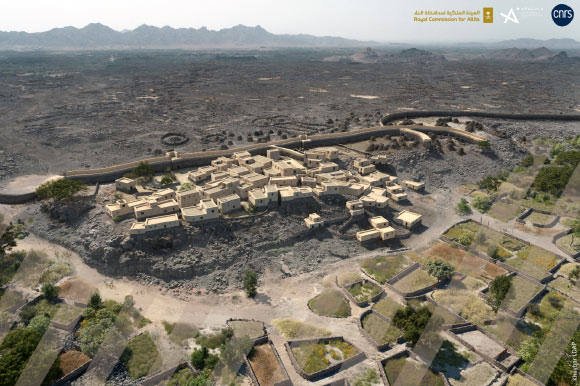
The geographical area of Northwestern Arabia, situated between Mecca and Aqaba, was characterized during the Bronze Age by a network of interconnected, substantial walled oases. These settlements were organized around modest fortified townships, exemplified by the recently identified settlement of al-Natah within the Khaybar Oasis, located in the Saudi Arabian region of Medinah.

A three-dimensional virtual reconstruction of the Bronze Age settlement of al-Natah. Image attribution: Charloux et al., doi: 10.1371/journal.pone.0309963 / AFALULA-RCU-CNRS.
The emergence of extensive urban centers marked a pivotal advancement in the trajectory of human civilization.
Investigating this process of urbanization within northwestern Arabia has presented considerable challenges, partly attributable to a scarcity of well-preserved archaeological locations in the region when contrasted with more thoroughly documented areas such as the Levant and Mesopotamia.
Nonetheless, numerous excavations conducted in northwestern Arabia over the past few decades have brought to light remarkable sites that offer valuable perspectives on the nascent phases of urbanization.
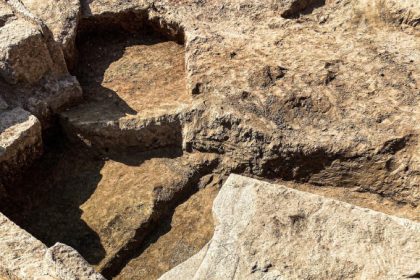
In a contemporary investigation, Guillaume Charloux, an archaeologist affiliated with the CNRS, and his research associates concentrated their efforts on the Bronze Age settlement of al-Natah, which was inhabited from approximately 2400 to 1500 BCE.
The settlement spanned an area of roughly 1.5 hectares, encompassing a central core and adjacent residential zones, all encircled by defensive ramparts.
The research team estimates that al-Natah was home to a population of approximately 500 individuals.
While its scale and structural organization bear resemblances to other contemporaneous sites in northwestern Arabia, these northern Arabian locations are notably smaller and exhibit less socio-political intricacy when compared to contemporary settlements in the Levant and Mesopotamia.
The scientific consensus posits that al-Natah represents a condition of ‘low urbanization,’ signifying a transitional phase situated between nomadic pastoralism and sophisticated urban agglomerations.
Current archaeological findings suggest that during the Early to Middle Bronze Age, northwestern Arabia was characterized by numerous rudimentary fortified settlements, a period when other regions were already demonstrating more advanced stages of urban development.
Further archaeological exploration across the Arabian peninsula is anticipated to furnish more granular details concerning the timeline of this transition and the concomitant evolution of societal structures and architectural styles.
The authors stated, “For the inaugural time in northwestern Arabia, archaeologists have identified a compact Bronze Age settlement (circa 2400-1300 BCE) linked to an extensive network of ramparts, thereby prompting inquiries into the nascent evolution of local urbanism.”
Their scholarly work was made publicly available online on October 30, 2024, within the esteemed journal PLoS ONE.
_____
G. Charloux et al. 2024. A Bronze Age town in the Khaybar walled oasis: Debating early urbanization in Northwestern Arabia. PLoS ONE 19 (10): e0309963; doi: 10.1371/journal.pone.0309963